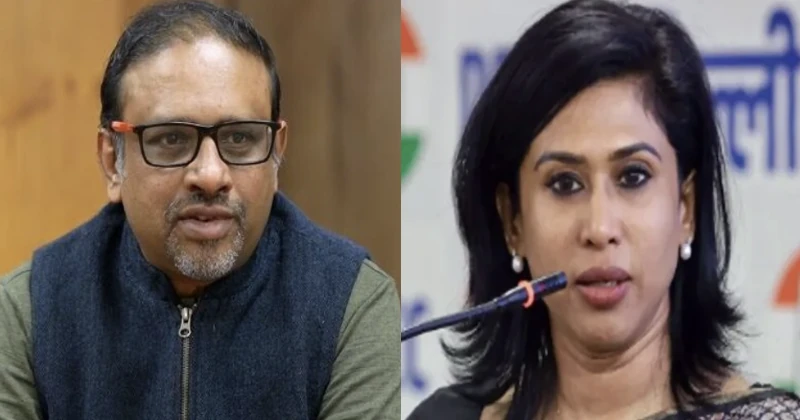
New Delhi: A fresh debate over the presence of traditional Sanskrit chants at educational institutions has erupted after Congress leader Dr Shama Mohamed questioned why the Gayatri Mantra was played during an IIT Delhi convocation, prompting a sharp response from Shivakumar GV, Director of INDICA.
Mohamed, reacting to the use of the mantra at the convocation ceremony, said that she listens to the Gayatri Mantra when her cook plays it at home but questioned its presence at an academic event.
“My cook plays the Gayatri Mantra every day when he enters my kitchen, and I listen to it every day and like it. But my question is: Why was the Gayatri Mantra played at an IIT convocation? It wasn’t a religious event,” Mohamed said. She argued that educational spaces should remain free from religious slogans and chants of all religions.
Shivakumar, however, hit back, arguing that the criticism reflected a fundamental misunderstanding of the mantra’s philosophical and civilisational significance.
Namaste Dr. Shama ji,
It is my pleasure and honor to bring some important aspects of this Mantra to your kind notice. The Mantra carries a civilizational distinction unique to Bharat.
Many have already pointed out that this is a Shanti Mantra from Shikshavalli of… https://t.co/LvMy5ZkqqB
— Shivakumar GV INDICA (@SaamaanyaJ) August 9, 2026
In a detailed response addressed to Mohamed, Shivakumar said the mantra in question carries a civilisational distinction that cannot simply be reduced to the category of a religious slogan.
He pointed out that the mantra is traditionally identified as a Shanti Mantra from the Shikshavalli section of the Taittireeya Upanishad, which begins and ends with the invocation.
śaṁ no mitraḥ śaṁ varuṇaḥ śaṁ no bhavatvaryamā | śaṁ na indro bṛhaspatiḥ śaṁ no viṣṇururukramaḥ || namo brahmaṇe | namaste vāyo | tvameva pratyakṣaṁ brahmāsi | tvāmeva pratyakṣaṁ brahma vadiṣyāmi | ṛtaṁ vadiṣyāmi | satyaṁ vadiṣyāmi | tanmāmavatu | tadvaktāramavatu | avatumām | avatu vaktāram || oṁ śāntiḥ śāntiḥ śāntiḥ ||
He reproduced the Sanskrit text in IAST transliteration and drew particular attention to two expressions contained in it:
“ṛtaṁ vadiṣyāmi | satyaṁ vadiṣyāmi”
Explaining their significance, Shivakumar said the lines convey the resolve: “I shall speak of Ṛta” and “I shall speak the Satya.”
According to him, the concepts of Ṛta and Satya represent foundational ideas in Indian philosophical thought, encompassing cosmic order, righteousness, truth and the relationship between universal principles and human conduct.
Taking direct aim at Mohamed’s objection, Shivakumar argued that Ṛta and Satya cannot be understood merely through the narrow framework of religious practice. He described Ṛta as the principle of cosmic order and Satya as absolute or unchanging truth, arguing that the two represent interconnected dimensions of the fundamental reality that sustains the cosmos.
In his interpretation, Ṛta represents the dynamic order of the universe, while Satya represents the unchanging truth underlying that order.
“ṛtaṁ-satyaṁ are two faces of the same coin,” he argued, presenting them as inseparable dimensions of a broader philosophical understanding of reality.
Shivakumar further linked this relationship to the Indian concept of Dharma, arguing that Dharma derives its meaning from the relationship between Ṛta and Satya and represents actions and pursuits that sustain the foundational order of the universe.
The INDICA director contended that this philosophical framework played a central role in shaping what he described as distinctive features of Indian civilisation, including diversity, harmony, pursuit of truth, coexistence and non-dogmatism.
His central argument was that a Sanskrit invocation at an educational ceremony should not automatically be interpreted as a religious imposition.
Instead, he suggested that the philosophical content of such texts can have relevance beyond ritual and religious observance, particularly in an academic environment dedicated to the pursuit of knowledge and truth.
Shivakumar also expanded his response into a broader argument about India’s intellectual heritage.
He highlighted the prominence of the Sanskrit letter ‘ऋ’ and its association with terms such as Ṛta, Ṛṣi, Ṛk, Ṛcā, Ṛju and Ṛtu, while pointing to the repeated references to Ṛta in the Rigveda.
He argued that the recurrence of these concepts across India’s ancient intellectual traditions demonstrates their importance in the country’s civilisational vocabulary.
For Shivakumar, therefore, the issue is not simply whether a religious chant should be played at an academic function. Rather, it raises a larger question about whether India’s educational institutions should be able to acknowledge and engage with the country’s classical intellectual traditions without automatically categorising them as religious expressions.
Ending his response with a pointed question, Shivakumar asked Mohamed whether it would not be worthwhile for graduating students to know and chant the mantra.