At a time when the global balance of power is steadily tilting toward the Indo-Pacific, India finds itself at a defining strategic inflection point. The emerging geopolitical order is no longer anchored in the Atlantic but increasingly shaped by the maritime space stretching from East Africa to the Western Pacific. In this evolving landscape, India’s choices today will determine not only its regional influence but also its standing as a global power in the decades ahead.
The ambitious Great Nicobar Development Project is not merely an infrastructure initiative, it is a statement of intent. It signals that under the leadership of Hon’ble Prime Minister Shri Narendra Modi, India is prepared to secure its strategic interests, expand its economic footprint, and assert its rightful place in the maritime order. It represents a shift from passive geography to active geopolitics.
Yet, as India moves forward, familiar roadblocks emerge: not only from external adversaries but also from internal debates, competing narratives, and institutional delays have that risked slowing strategic momentum.
The Strategic Core: Why Great Nicobar Matters
Great Nicobar occupies one of the most critical geographic positions in the Indo-Pacific. Located close to the Strait of Malacca, it sits astride one of the busiest maritime chokepoints in the world. A substantial share of global trade—especially energy flows to East Asia—passes through this narrow corridor. For economies such as China, Japan, and South Korea, uninterrupted access to this route is essential.
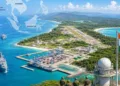
India’s plan to develop a transhipment port, a dual-use international airport, and modern logistics and energy infrastructure is therefore a decisive move. It transforms India into an active stakeholder capable of influencing and securing critical sea lanes.
This effort complements the capabilities of the Andaman and Nicobar Command, enhancing surveillance, logistics, and rapid response in the Indian Ocean Region. Together, these assets strengthen India’s maritime posture and expand its operational reach.
China’s Expanding Footprint — A Strategic Reality
India’s urgency must also be understood in the context of China’s expanding presence across the Indian Ocean. Through strategic investments, China has developed key nodes such as Gwadar Port, Hambantota Port, and the Djibouti Naval Base.
While these projects are presented as commercial, many possess dual-use potential. This network enhances China’s ability to secure maritime routes and extend strategic influence.
In this context, strengthening Great Nicobar is not optional—it is essential for ensuring maritime domain awareness, credible deterrence, and long-term strategic balance in the region.
Economic Opportunity: India as a Trade Hub
Beyond strategy, the project carries significant economic promise. India currently depends on external hubs such as the Port of Singapore for cargo transhipment, which increases costs and reduces efficiency.
A world-class transhipment facility in Great Nicobar can reduce this dependence, position India as a logistics hub between East and West, and generate employment and infrastructure growth. In an era of shifting supply chains, this is India’s opportunity to capture value rather than merely participate in global trade flows.
The Environmental Debate: Balance vs Delay
No major infrastructure project is without consequences, and the concerns raised regarding Great Nicobar deserve serious consideration. Issues related to biodiversity, fragile coastal ecosystems, and the rights and livelihoods of indigenous communities must be addressed with sensitivity, transparency, and scientific rigor.
However, a broader question emerges: why do projects of strategic national importance in India often face prolonged scrutiny and resistance, while comparable developments in other parts of the world proceed with relatively less friction?
Environmental safeguards are essential, but when regulatory processes become excessively prolonged or inconsistent, they risk transforming into instruments of delay rather than protection. India must strike a careful balance—ensuring that ecological responsibility is upheld without allowing procedural inertia to stall critical national initiatives.
Politics of Resistance: A Democratic Paradox
Political opposition to the project, including criticism from leaders such as Rahul Gandhi, underscores the vibrancy of India’s democratic framework. Debate and dissent are not weaknesses; they are integral to informed decision-making.
However, when key national projects repeatedly encounter delays due to legal challenges, political contestation, and narrative battles—both domestically and in international forums—it raises a legitimate concern. Is India, at times, inadvertently undermining its own strategic objectives?
Democracy must enable debate, but it must also facilitate decision-making. Endless contestation without resolution risks creating a perception of indecisiveness, which can have strategic consequences in a competitive global environment.
Global Context: Competition is REAL
The Indo-Pacific is an arena of active geopolitical competition. Major powerful countries are building alliances, securing supply chains, and expanding naval reach.
India’s role in the Quadrilateral Security Dialogue reflects its recognition of this reality. Every postponement has ripple effects, influencing regional perceptions, altering strategic calculations, and potentially benefiting competing powers. In such a competitive environment, delays in critical infrastructure projects have consequences that extend beyond domestic policy—they influence regional power dynamics.
The Modi Doctrine: Security with Development
The current government’s approach under Hon’ble Prime Minister Shri Narendra Modi integrates development with strategic foresight. Infrastructure is seen not only as an economic tool but as a pillar of national security.
Great Nicobar fits squarely into this vision—strengthening India’s maritime capabilities while unlocking economic potential.
Conclusion: No Room for Strategic Hesitation
The debate over Great Nicobar is not merely about environment versus development, it is about India’s future role in the world.
Constructive criticism and safeguards are essential. But indefinite delays in strategic projects carry hidden costs. In geopolitics, time lost often translates into opportunity ceded.
As India rises, it must ensure that its ambitions are matched by execution. Because in an increasingly competitive world, hesitation is not neutrality—it is disadvantage.