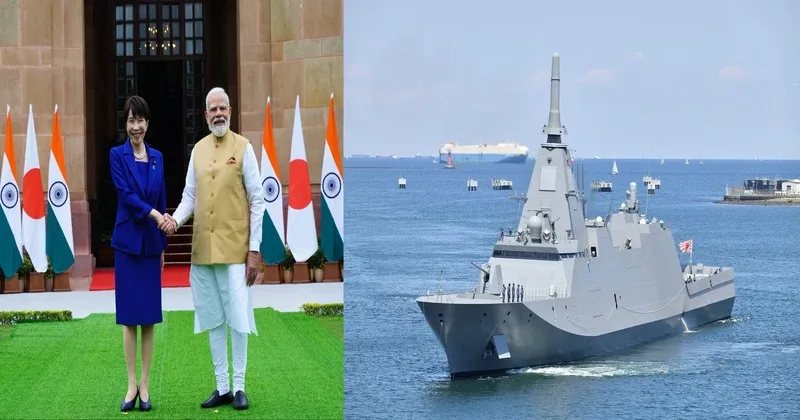
India and Japan are set to herald a new and vital chapter in the bilateral defence partnership, as both nations are discussing the co-production of Mogami class stealth frigates under the Make-in-India vision. This was not part of the official discussions held between Prime Minister Narendra Modi and Japan Prime Minister Sanae Takaichi in the recently concluded Indo-Japan Summit in New Delhi. However, as per the sources, there were informal negotiations regarding the co-production of the Mogami class stealth frigates.
Infact, Foreign Secretary Vikram Misri reiterated that such defence cooperation could be explored in the future, thus the doors are open for deeper military collaboration with respect to Mogami frigates. If rationalised, this mega defence deal will boost the defence indigenisation goal of India and pitch the country as a major defence manufacturing hub in the region. It also aligns with the Atmanirbharata or self-reliance agenda of India in the defence sector. Most importantly, Tokyo’s proposal to New Delhi to co-produce the state-of-the-art Mogami class stealth frigates, reflects the growing credibility of India as a trusted and resilient defence partner in the region.
🇮🇳🇯🇵 Japan Offers Mogami-Class Stealth Frigate for Make in India
Japan has reportedly offered local production of the Mogami-class stealth frigate in India, including design sharing and shipyard support under the Make in India initiative.
The advanced warship features stealth… pic.twitter.com/DYV1rRNypD
— Asia Nexus (@nexusasian) July 4, 2026
A shift in Japan’s defence policy & trust towards India
As key geopolitical actors and major democracies of the Indo-Pacific region, Japan and India have shared goals and commitment towards the security and prosperity of the maritime paradigm. Both nations have resolved to work towards a free, open, inclusive and rule-based Indo-Pacific against any geopolitical aggression and contentions. Thus, the deeper defence partnership and co-production of critical military systems help to achieve this common goal and ensure regional stability and collective security across the Indo-Pacific against increasing unilateral hedging.
As per the reports, Tokyo is willing to share the design of the Mogami class frigates and transfer other critical technology underlying the naval warship. Japan is also ready to support the construction of these Mogami class naval warships in India’s shipyards. This also signals a major shift in Tokyo’s defence export policy. Historically, Japan has maintained a stringent, restricted and isolated defence policy. It hardly acknowledges defence co-production and transfer of military technology.
Tokyo’s offer to co-produce Mogami class stealth frigates is thus a reflection of its trust in New Delhi as a strong and vital defence partner to accelerate Indo-Pacific security, which is emerging as a volatile geopolitical theatre and maritime zone. The defence partnership is thus a defining feature in the next phase of India-Japan strategic partnership. It could reinforce the interoperability between the Indian and Japanese Navy in terms of rigorous maritime operations across the Indo-Pacific.
As a prelude to this deeper and stronger defence partnership, Prime Minister Modi and Japan PM Sane Takaichi, during the recent bilateral summit, agreed to strengthen the defence relations across land, sea and air. During the summit, an MoU was also inked regarding the co-development of the UNICORN(Unified Complex Radio Antenna) stealth mast technology. This advanced system is already used on Japan’s Mogami-class frigates and will involve collaboration with Bharat Electronics Limited (BEL).
UNICORN: A Japanese game-changer in Indian warships
UNICORN is an integrated mast system that can be inducted into Indian naval warships. The UNICORN fundamentally changes electromagnetic survivability of the warships by consolidating multiple exposed antennas, communication arrays and electronic warfare systems into a single low-observable composite structure, thus designed to reduce radar detectability by the adversaries.
Traditional antennas in the warships generate substantial radar reflections that significantly increase vessel radar cross-section signatures, thus enabling hostile surveillance networks to classify, track and prioritise targets at extended operational ranges. However, the Japanese-designed UNICORN encloses multiple systems inside a Fibre Reinforced Plastic radome, engineered specifically to minimise radar reflections while preserving electromagnetic transmission efficiency across multi-band naval communication and surveillance requirements, thus successfully hiding from the enemy networks along with enhancing operational efficiency and defensive capabilities of the Indian Navy.
The technology also improves incoming signal detection ranges by optimising antenna placement geometry, enabling more efficient collection of low-observable emissions generated by hostile radar systems, aircraft, missiles and maritime surveillance platforms. Compared with India’s existing Advanced Composite Communication System configuration, the Japanese UNICORN system offers enhanced stealth optimisation designed specifically for hard-nosed naval operations against technologically sophisticated adversaries.
This UNICORN deal between India and Japan thus, can be considered as a stepping stone for deeper defence collaboration between New Delhi and Tokyo, including the co-production of the Mogami class stealth frigates.
What are Mogambi class stealth frigates
Mogami class stealth frigates are Japanese naval warships. The highlight is they have reduced radar signature and are efficient to carry out anti-submarine warfare, anti-surface operations and other critical or sensitive missions to ensure maritime security. It is built with significant automation features thus, Mogami class frigates require comparatively less crew, unlike the traditional warships. This helps to save the manpower, yet achieve the military goals, during combat situations. The Mogami class warships can be operated with 90 crew personnel, reflecting its high technical efficiency with limited man power.
Indigenous production of these Japanese stealth frigates under Make-in-India vision, helps to integrate Indian weapons systems in the warship, thus gain strategic edge in consolidating national security across the oceans.