

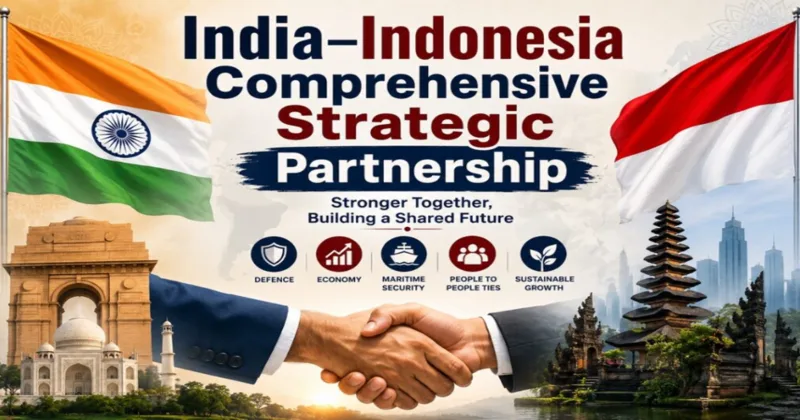
New Delhi is playing an active leadership role in the geo-restructuring of the Indo-Pacific region that directly confronts the old post-colonial binary system of global governance. For decades, the strategic consensus has been that midsized developing economies have had to choose between Western institutional supremacy and the predatory economic infrastructure offered by Beijing. Today, India is challenging this paradigm. The various high-level diplomatic milestones, from the strategic recalibration with the Philippines and Vietnam, to the Japanese Prime Minister’s high-profile engagement in New Delhi, India’s activation of the UPI with dozens of countries and operationalisation of the Bilateral Investment Agreement (BIA) with Israel, speak of a deliberate, multi-aligned framework. But it is Prime Minister Narendra Modi’s involvement with Indonesia that really anchors this new geopolitical architecture. Jakarta is not just another metropolis in a diplomatic itinerary; it is at the critical heart of the ASEAN region, and the unequivocal engagement to a democratic, rules-based maritime order that defies external hegemony.
Central to this growing collaboration is an indomitable civilisational base that neither Western hegemonic pacts nor China’s transactional cheque-book diplomacy can replicate. The bond between India and Indonesia is based on a deep-rooted cultural memory based on the Ramayana and the Mahabharata, not ageless epics, but the living history of an eternal civilisation. The world looks on with admiration as Indonesia proudly safeguards this treasure. Despite being home to the world’s largest Muslim population, Indonesia has consistently and purposefully rejected the comprehensive Arabisation of its cultural identity. The continued use of Sanskrit-derived words, the national reverence for Garuda, and the frequent presentation of traditional dance dramas drawn from Vedic literature, all testify to an organic cultural continuum. This cultural synergy allows New Delhi and Jakarta to converse with each other in a common vernacular of mutual respect and ancestral kinship, creating a profound depth of confidence that modern diplomatic accords can rarely establish. The recent partnerships in temple restoration projects further solidify this reality, turning historical cultural diplomacy into an active tool of modern statecraft, further putting into action PM Modi’s vision of taking Vikas and Virasat together.
The current state of strategic economic security, particularly the shift away from traditional resource dependence on a few, towards a larger global south cooperation framework, is a clear indication of this civilisational trust. Developing countries have historically been dependent on Western markets and the inflexible framework of the Organisation for Economic Co-operation and Development (OECD), making them extremely vulnerable to external shocks and Trans-Atlantic policy dominance. Against this backdrop of heightened volatility across the Middle East and Eastern Europe, such intensified South-South cooperation becomes deeply necessary.
In this context, India is actively hedging its risks and protecting its supply chains in vital resource markets through expanding its strategic footprint via South-South cooperation. Indonesia is a trillion-dollar economy that sometimes flies under the radar of mainstream Western media. It sits atop massive amounts of nickel, bauxite and other critical minerals that are crucial to the future of green technology and chip-based industrial revolution. The progress made by both countries within this critical mineral framework helps India to farther its resolve to develop resilient supply chains across the core areas of manufacturing. India, for its part, presents a mature and battle-tested basket of public goods, from its cutting-edge digital public infrastructure to its unmatched IT sector knowledge base and affordable space sector advancements. This builds a fair and non-exploitative cooperative ecosystem where both countries gain strategic autonomy, avoiding the asymmetrical weaknesses that come with deals with established global power blocs.
The geopolitical rationale for such a partnership becomes evident when one examines the deep-seated worries of Southeast Asian states caught in the crossfire of the Washington-Beijing rivalry. For a long time, countries like Indonesia have looked to New Delhi to provide a stable, respectable alternative to the existing geopolitical binary. Regional capitals, squeezed between Washington’s belligerent security posturing and Beijing’s rapacious maritime expansionism, are desperate not to be collateral damage of the neo-Cold War. India makes a case for itself as the perfect partner because it has no expansionist objective and does not impose delusional ideological or fiscal conditionalities for its partners. Unlike Western tendency to interfere in the internal affairs of the host country or Beijing’s state banks that weaponise infrastructure loans into sovereign debt traps, India respects the strategic autonomy of its counterparts. New Delhi acts as a stable anchor for Southeast Asian countries to diversify their partnerships and resist outside interference.
This transition can be best demonstrated through fundamental changes visible in defence cooperation and the harsh reality of Indo-pacific maritime security. The South China Sea is a theatre of unilateral aggressiveness, where China’s military advantage often eclipses smaller littoral governments embroiled in intricate maritime disputes. Additionally, the landmark agreement on Sabang Port further enhances India’s strategic maritime outreach in the crucial Indo-Pacific region, positioned directly adjacent to what is frequently termed as China’s Achilles’ Heel, namely the Malacca Strait.
Beijing’s expansionist misadventures in South Asia are being silently countered by New Delhi through this robust South-South cooperation, which spans across the defence, economic, and technological frameworks established with Southeast Asian nations.
The military imbalance in the South China sea, which is at a critical juncture, is being addressed by the proposed deal between India and Indonesia for the procurement of the BrahMos supersonic cruise missiles. This India-made sophisticated weapon system gives the military formation of the region, a decisive tactical edge, altering coastal defence capabilities and making maritime adventurism more costly for any revisionist power. Indonesia’s emulation of Philippines and Vietnam in sourcing Indian weapon systems marks a fundamental structural shift in regional security dynamics. Together, these countries are looking to India to stem the tide of hostile territorial expansion and view New Delhi not as a faraway hegemon but as a proximate security guarantor.
The proliferation of the BrahMos missile across the ASEAN landscape is also a powerful affirmation of India’s rapidly maturing domestic defence industrial sector. For decades, India was systematically mischaracterised as a perennial importer of military hardware, dependent on foreign technology to sustain its national security. Driven by a targeted policy of self-reliance and military export as a strategic foreign policy tool, New Delhi today has emerged as a high-technology exporter, able to provide fellow democracies with state-of-the-art deterrents. This move directly undermines Beijing’s exploitative debt-trap policies that undermine the sovereignty of developing countries. When Vietnam, Philippines and Indonesia choose Indian defence collaborations, they are voluntarily opting for a kind of security cooperation that strengthens their own national sovereignty, not undermines someone else’s. This defence network forms a resilient perimeter of stable governments that can defend the global commons in the Indo-Pacific region.
Ultimately, these interlinked political, economic and military campaigns support the larger, historical necessity of the Global South. India and Indonesia are together writing a new chapter in South-South cooperation by carefully bypassing the old dependence on Western-centric blocs and opposing the new and more insidious forms of economic colonialism. The deepening of the India-Indonesia connection ensures that ASEAN will remain an autonomous, fundamental pillar of regional geometry and not become a playground for extra-regional superpowers. For a confident, ascendant India, this partnership is the highest manifestation of its inherent role as a civilisational force devoted to a multi-polar international order. By integrating age-old cultural affinities with contemporary technical and military synergies, New Delhi is effectively demonstrating that real strategic resilience is forged via sincere cooperation, shared wealth and a steadfast devotion to collective national sovereignty.