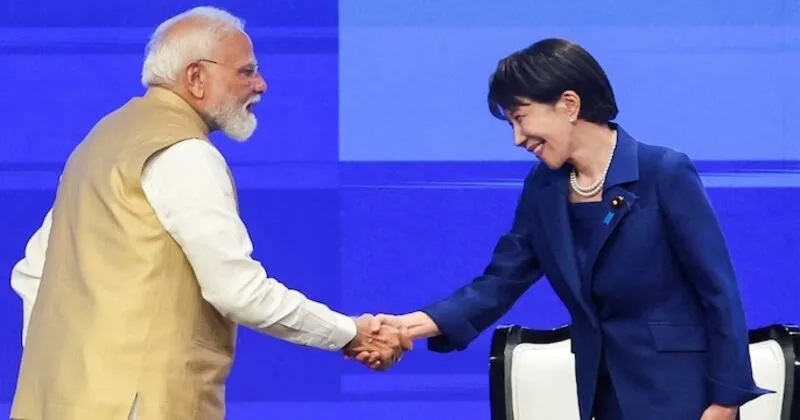
The three-day visit of Japanese Prime Minister Sanae Takaichi to India from 1–3 July 2026 marked far more than her first official bilateral state visit with Prime Minister Narendra Modi. It represented the consolidation of one of Asia’s most consequential strategic partnerships at a time when the international order is undergoing rapid transformation. From energy insecurity and disrupted maritime trade routes to technological competition, defence industrial cooperation and supply-chain resilience, New Delhi and Tokyo are steadily constructing a partnership that extends well beyond traditional diplomacy.
The summit unfolded against an exceptionally volatile geopolitical backdrop. Both nations have had to navigate arbitrary tariff measures introduced by the Trump administration, the economic consequences of the Iran conflict, uncertainty surrounding the Strait of Hormuz, and growing concerns over China’s use of economic leverage and strategic coercion.
Simultaneously, both governments recognise that the Indo-Pacific requires greater strategic resilience as traditional security assumptions evolve. Rather than merely reacting to emerging challenges, India and Japan are increasingly positioning themselves as architects of a more balanced Asian order based upon trusted partnerships, technological cooperation and stronger regional deterrence.
Energy security drives strategic convergence
One of the strongest motivations behind the deepening India-Japan partnership is energy security. The conflict involving Iran severely disrupted one of the world’s most critical maritime energy corridors. Although an interim understanding between the United States and Iran reduced immediate tensions, uncertainty surrounding the Strait of Hormuz remains significant.
The possibility of renewed hostilities involving Israel or another disruption to maritime traffic continues to pose substantial risks for energy-importing nations. Few countries are more vulnerable to such instability than India and Japan. For decades, both economies have depended heavily on crude oil and natural gas imported from West Asia.
The disruption forced both governments to diversify energy sources while simultaneously relying upon limited domestic reserves. The consequences have been felt across both economies.
Japan has experienced rapid inflation alongside shortages of important intermediate industrial goods, placing additional pressure on manufacturing competitiveness.
The West Asia conflict led to the biggest energy crisis of this century & India took appropriate measures to deal with it, says PM Modi in Rajasthan pic.twitter.com/mQjdHvuLjO
— Sidhant Sibal (@sidhant) July 4, 2026
India has likewise confronted higher prices across food, fuel and fertilisers. Currency pressures have compounded these challenges, with both the Japanese yen and the Indian rupee weakening during the crisis.
These shared vulnerabilities have created an important strategic convergence. Energy security is no longer viewed merely as an economic issue but as an essential component of national security, industrial policy and regional stability. This common assessment provides a durable foundation for deeper India-Japan coordination.
Changing Indo-Pacific demands stronger regional partnerships
The strategic environment in the Indo-Pacific has evolved considerably over recent months. India hosted the Quad Foreign Ministers’ Meeting in May 2026, reviewing progress across multiple initiatives aimed at strengthening the security and prosperity of the Indo-Pacific. However, another development generated considerable strategic discussion.
Washington unexpectedly restored the historical designation United States Pacific Command (USPACOM), replacing the more recent United States Indo-Pacific Command (USINDOPACOM) nomenclature. Officially, the Pentagon maintained that only the name had changed and that the Area of Responsibility, operational mandate and military posture remained entirely unchanged.
Nevertheless, symbolism matters in geopolitics. For many observers, the return to the older terminology raised questions regarding Washington’s long-term strategic messaging. While optimists interpreted the decision as recognition of PACOM’s historical legacy following the Second World War, others viewed it as signalling reduced emphasis on the Indo-Pacific concept or even an effort by the United States to stabilise relations with China.
Regardless of which interpretation ultimately proves correct, the development has reinforced the importance of stronger cooperation among the remaining Quad partners, India, Japan and Australia.
That trilateral relationship has gained remarkable momentum.
Prime Minister Takaichi visited Australia in May 2026, producing several agreements covering defence and economic cooperation. During the same month, Australian Defence Minister Richard Marles travelled to India for strategic discussions with Defence Minister Rajnath Singh. Both sides reaffirmed progress in security cooperation while emphasising stronger defence industrial collaboration.
This momentum is expected to continue with Prime Minister Modi’s scheduled visit to Australia during July, demonstrating that India, Japan and Australia are steadily strengthening an increasingly consequential strategic triangle within the wider Indo-Pacific architecture.
Japan’s historic security transformation
The most significant change within Asia’s strategic landscape has arguably occurred inside Japan itself. For decades after the Second World War, Tokyo maintained highly restrictive defence policies rooted in constitutional pacifism and severe limitations on military capabilities and arms exports. While successive American administrations encouraged Japan to assume greater security responsibilities, meaningful transformation gathered pace only under former Prime Minister Shinzo Abe.
The Abe years fundamentally altered Japan’s strategic outlook. In 2013, Japan established its National Security Council, creating an integrated national security decision-making structure. In 2014, Tokyo introduced new Principles on Arms Transfer, replacing older restrictions. A year later, Japan reinterpreted the doctrine of collective self-defence, permitting broader security cooperation with partners.
The transformation has accelerated under Prime Minister Takaichi. Japan has now increased defence expenditure to 2 per cent of GDP, signalling that military modernisation has become a long-term national priority rather than a temporary adjustment. Four major security drivers underpin this transformation.
North Korea continues to pose challenges through expanding missile and nuclear capabilities together with the long-standing abduction issue. However, Pyongyang’s recent rejection of reunification with South Korea has reduced the prominence of its territorial claims regarding the disputed Dokdo/Takeshima islands.
Russia represents another concern. Although Moscow presents a comparatively smaller direct territorial challenge than China, expanding military coordination between Russia and China, including joint exercises and operations near areas claimed by Japan, has intensified Tokyo’s security calculations.
Yet China’s rise remains the defining strategic challenge. Beyond Beijing’s continued claims over the Senkaku Islands, which China calls the Diaoyu Islands, Japan faces vulnerabilities created through decades of economic dependence upon Chinese manufacturing and supply chains. Chinese restrictions involving strategically important sectors such as rare earths have highlighted how economic interdependence can be weaponised for political purposes.
Perhaps most significantly, Tokyo’s evolving security doctrine has also been influenced by uncertainty surrounding its principal ally. President Donald Trump’s statements and policy decisions across both his presidential terms appear to have convinced Japanese policymakers that reliance upon the United States alone is no longer sufficient.
Consequently, Japan has pursued stronger indigenous military capabilities while simultaneously cultivating deeper partnerships across Asia.
Defence industrial cooperation opens new possibilities for India
Japan’s latest policy reforms have opened entirely new avenues for strategic cooperation with India.
Prime Minister Takaichi’s government recently undertook a substantial revision of the Three Principles on Arms Transfer, completing a reform process initiated during the Abe administration.
The original framework dates back to 1967, when Prime Minister Eisuke Sato announced strict restrictions governing arms exports. Those regulations became even more restrictive under Prime Minister Takeo Miki in 1976, effectively creating a near-total prohibition on Japanese weapons exports.
Meaningful change first emerged under Shinzo Abe in 2014, when the framework evolved into the Three Principles on Transfer of Defense Equipment and Technology. These reforms enabled non-lethal equipment transfers while encouraging defence industrial cooperation.
Under former Prime Minister Fumio Kishida, Japan advanced even further by moving from traditional Official Development Assistance (ODA) towards Official Security Assistance (OSA) alongside dual-use technologies and infrastructure. Kishida also approved Japan’s participation in the Global Combat Air Programme (GCAP) together with the United Kingdom and Italy to jointly develop a sixth-generation stealth fighter.
JETRO主催の「日インド経済フォーラム」にモディ首相と共に出席しました。
同フォーラムには、日本企業150社以上・インド企業80社以上のほか、両国政府関係者が参加し、今次訪問を機会に両国企業間等で取り交わされた129件の協力案件が発表されました。… pic.twitter.com/MGDJlZ3tSj
— 高市早苗 (@takaichi_sanae) July 2, 2026
Prime Minister Takaichi has now taken the final decisive step. Japan can not only export lethal military systems but also participate in genuine co-development and co-production of advanced defence technologies with trusted partners. Japan’s proposal to provide Australia with the latest Mogami-class stealth frigates illustrates the scale of this transformation.
For India, these policy changes present unprecedented opportunities. India already enjoys defence technology cooperation agreements with Japan, placing it among just seventeen countries eligible for transfers involving advanced defence technologies. Years of bilateral defence agreements have already established institutional mechanisms capable of supporting more ambitious industrial cooperation.
The Modi-Takaichi summit therefore represents an ideal platform to accelerate joint defence manufacturing under India’s Atmanirbhar Bharat initiative.
Technology, manufacturing and trusted supply chains
Strategic cooperation between India and Japan extends far beyond defence. As Japan seeks to reduce excessive dependence upon China, diversification of its defence industrial base and advanced manufacturing ecosystem has become an important risk mitigation strategy. India offers both industrial scale and strategic trust.
Existing collaboration already includes co-production of UNICORN masts for the Indian Navy. Even more significant is Japan’s reported interest in manufacturing Mogami-class stealth frigates within Indian shipyards. Such cooperation would elevate bilateral defence ties from procurement towards genuine industrial partnership.
सेमीकंडक्टर इलेक्ट्रॉनिक्स क्रांति का Next Step है। इसलिए हम मोबाइल और इलेक्ट्रॉनिक्स के साथ-साथ इस पूरी दुनिया को चलाने वाली चिप्स का भी निर्माण करेंगे। pic.twitter.com/8KKPam9VI5
— Narendra Modi (@narendramodi) July 4, 2026
Opportunities also exist across propulsion technologies, including electric motors, hybrid propulsion systems for unmanned aerial platforms, fighter aircraft engines and advanced propulsion systems for next-generation stealth warships.
Beyond military technologies, India stands to benefit enormously from Japanese expertise across semiconductors, artificial intelligence, robotics, unmanned systems, electronics, metallurgy, advanced welding technologies, shipbuilding and heavy hydraulic press manufacturing. The July summit further expanded cooperation into critical economic security sectors.
Both leaders agreed to strengthen collaboration in semiconductors, critical minerals and artificial intelligence while jointly addressing challenges arising from China’s economic practices. The two governments also expressed grave concern regarding economic coercion, arbitrary export restrictions and non-market policies that undermine reliable global supply chains. Their objective is not confrontation but the construction of resilient supply networks among trusted and like-minded partners capable of reducing strategic vulnerabilities.
This vision directly complements India’s domestic manufacturing ambitions while simultaneously supporting Japan’s effort to diversify industrial production beyond China.
China’s response and the road ahead
Predictably, the expanding India-Japan partnership has drawn criticism from Beijing. Chinese Foreign Ministry spokesman Guo Jiakun argued that India-Japan cooperation should not target third countries or damage China’s interests. He further claimed that regional partnerships should promote peace and stability rather than creating exclusive groupings or encouraging confrontation.
Beijing also criticised Prime Minister Takaichi’s commitment to a Free and Open Indo-Pacific, describing the concept as divisive and contrary to regional aspirations. Tokyo firmly rejected these accusations. Japanese Foreign Minister Toshimitsu Motegi emphasised that the Free and Open Indo-Pacific remains an inclusive vision intended to strengthen regional cooperation rather than provoke conflict.
Japan continues to regard India as an indispensable partner in maintaining balance across the Indo-Pacific amid China’s expanding military and economic influence.
🇮🇳🇯🇵🇨🇳 China responds after PM Narendra Modi and PM Sanae Takaichi pledged closer cooperation on critical minerals and resilient supply chains.
China said cooperation between countries "should not target any third party" and "should not be used as an excuse for division and… pic.twitter.com/nLrhFRJ1GE
— Asia Nexus (@nexusasian) July 4, 2026
The deterioration in Sino-Japanese relations following Takaichi’s parliamentary remarks on Taiwan has only reinforced Tokyo’s determination to strengthen partnerships with trusted democracies.
Her observation that a Chinese attack on Taiwan could potentially require a response from the Japan Self-Defense Forces in support of the United States further intensified tensions with Beijing.
Against this backdrop, India-Japan relations have acquired exceptional strategic significance.
Prime Minister Modi’s visit to Japan in August 2025 had already produced substantial outcomes, including a target of 10 trillion Japanese yen in private investment over the next decade and an ambitious action plan to facilitate exchanges involving 500,000 people, including 50,000 highly skilled Indian professionals expected to work in Japan.
To fully realise these opportunities, India must continue improving the investment environment for Japanese companies. Stronger coordination by central government departments can help firms navigate varying regulatory frameworks across different states, while state and municipal administrations should deepen understanding of Japanese business culture, particularly the importance of personal relationships, consistency and long-term institutional trust. Similar approaches have delivered positive results in countries such as China and Vietnam.
The India-Japan partnership has now evolved well beyond conventional diplomacy. It encompasses economic resilience, energy security, technological cooperation, defence manufacturing, trusted supply chains and strategic stability. At a time when discussions of an emerging global G-2 continue to surface, New Delhi and Tokyo are demonstrating that Asia’s future need not be determined by great-power rivalry alone.
Instead, India and Japan are steadily constructing a strategic axis capable of strengthening a genuinely multipolar Asia, one built on shared interests, trusted technology, resilient institutions and a common commitment to a stable, secure and China-resilient Indo-Pacific.