New Delhi: India’s ambitious Great Nicobar infrastructure project is set to significantly strengthen New Delhi’s strategic position in the Indo-Pacific while enhancing its ability to monitor one of the world’s most critical maritime chokepoints, according to a report published by the Canada-based Geopolitical Monitor on 8 July 2026.
The report argues that the project goes far beyond conventional infrastructure development, combining port expansion, civilian infrastructure and military capability into a long-term strategic initiative that could reshape the balance of power in the eastern Indian Ocean. It notes that the development assumes even greater significance in the aftermath of the Iran war, when the security of global maritime trade routes has come under increased scrutiny.
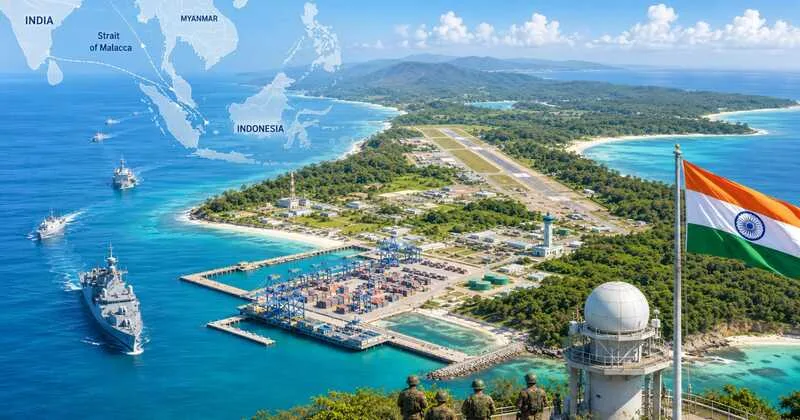
Located at the southernmost tip of the Andaman and Nicobar archipelago between Myanmar and Indonesia, Great Nicobar occupies a strategically important position near the Strait of Malacca. The strait is the world’s second-largest oil trade chokepoint after the Strait of Hormuz and serves as the primary maritime gateway connecting the Indian Ocean with the Pacific Ocean.
According to the report, the project is planned in three phases and is expected to be completed by 2047 at an estimated cost of 9-11 billion US dollars.
The proposed infrastructure includes a major international trans-shipment port, a dual-use civil and military airport, gas-based and solar power plants, and an entirely new township. These facilities will complement the existing Andaman and Nicobar Command, India’s only integrated tri-service military command, thereby creating an even stronger strategic footprint in the eastern Indian Ocean.
Rather than viewing the project solely as an infrastructure initiative, the report describes it as a strategic investment that combines economic development with national security objectives.
Strategic port network and Indo-Pacific Vision
The report states that one of the principal objectives of the Great Nicobar project is to reduce India’s dependence on foreign trans-shipment hubs such as Singapore and Colombo.
India has already developed the deep-water Vizhinjam Port in Keralam, but Geopolitical Monitor argues that the country’s expanding economy and rising international trade volumes require additional world-class port infrastructure.
Given India’s geographical location along major east-west shipping routes, the country is well positioned to attract global container traffic moving between West Asia and East Asia. The Great Nicobar trans-shipment hub is expected to play an important role in realising this potential.
The report places the project within the broader framework of India’s maritime strategy, including Maritime Vision 2030 and the Sagarmala programme, both of which emphasise port-led economic development.
Along with Vizhinjam in southern India and the upcoming Vadhvan Port in western India, Great Nicobar is expected to create a network of strategically positioned deep-sea ports serving different regions of the country while expanding India’s role in Indo-Pacific trade.
The report contrasts India’s port strategy with China’s expanding maritime footprint across the Indian Ocean. It notes that Beijing has developed or invested in ports across East Africa, Pakistan, Sri Lanka, Bangladesh and Myanmar.
According to the report, the increasing weaponisation of economic interdependence has made it essential for India to develop alternative maritime infrastructure capable of supporting both commercial and strategic requirements.
China’s Malacca dilemma and India’s strategic advantage
The report highlights that the strategic importance of Great Nicobar has grown considerably following the Iran war because the Strait of Malacca remains the principal energy lifeline for East Asia. It explains that Chinese strategic thinkers have long discussed the so-called “Malacca Dilemma”, Beijing’s heavy dependence on the narrow maritime passage for energy imports and international trade.
To reduce this vulnerability, China has invested heavily in alternative connectivity projects including the China-Pakistan Economic Corridor (CPEC) and the China-Myanmar Economic Corridor (CMEC). These initiatives seek to provide China with alternative access to the Indian Ocean while reducing dependence on the Malacca Strait.
However, the report argues that India’s development of Great Nicobar effectively strengthens New Delhi’s strategic position near the entrance of the Malacca Strait, allowing India to utilise geography as a major strategic advantage.
According to Geopolitical Monitor, the Malacca Strait serves not only Chinese commercial shipping but also the People’s Liberation Army Navy (PLAN). The report notes that Chinese research and surveillance vessels regularly operate in the Indian Ocean to collect hydrographic and operational data.
It points to China’s military base in Djibouti and dual-use facilities such as Gwadar Port in Pakistan as examples of Beijing’s growing ability to project influence across the Indian Ocean Region. The report further notes that Chinese spy ships have repeatedly entered the Indian Ocean to monitor Indian strategic activities, including missile tests. Such surveillance operations, it argues, underline China’s sustained military interest in the region.
Against this backdrop, Great Nicobar would substantially improve India’s capacity to monitor maritime movements around the Strait of Malacca while strengthening maritime domain awareness across the eastern Indian Ocean.
Military presence to strengthen India’s regional role
The report emphasises that India continues to face a long-term structural challenge from China despite recent diplomatic engagement between the two countries. It notes that the unresolved boundary dispute, China’s expanding naval presence and growing strategic competition make the eastern Indian Ocean increasingly important for India’s national security.
According to the report, the Great Nicobar project would significantly expand India’s ability to monitor activity around one of the world’s busiest maritime corridors and strengthen New Delhi’s strategic reach into Southeast Asia.
The report suggests that, much like Iran’s ability to leverage geography around the Strait of Hormuz during regional crises, India would be better positioned to incorporate geography into its strategic planning during future contingencies involving the Malacca Strait.
It further argues that the island could evolve into an important forward operating base supporting India’s expanding military presence across the Indo-Pacific. Geopolitical Monitor also places the project within the broader context of Indian Ocean geopolitics, arguing that forward military presence on remote islands has long been a characteristic feature of major maritime powers.
The report notes that the United States and the United Kingdom jointly maintain the strategic military facility at Diego Garcia, while France operates military bases across the southwest Indian Ocean. Australia, meanwhile, maintains control over Christmas Island and the Cocos (Keeling) Islands, both of which possess strategic significance.
According to the report, India’s development of Great Nicobar follows this established geopolitical pattern rather than representing an exceptional military expansion. The report concludes that for an emerging power with growing economic interests and expanding maritime responsibilities, maintaining a strategic presence on a remote island is consistent with regional geopolitical realities.
As India seeks to strengthen its position in the Indo-Pacific, the Great Nicobar project is expected to become one of the country’s most consequential strategic investments. By integrating economic infrastructure with military capability, reducing dependence on foreign ports, strengthening surveillance over the Strait of Malacca and reinforcing India’s maritime posture, the project could emerge as a critical pillar of New Delhi’s long-term Indo-Pacific strategy while simultaneously increasing China’s strategic vulnerability arising from its enduring Malacca Dilemma, the report said.