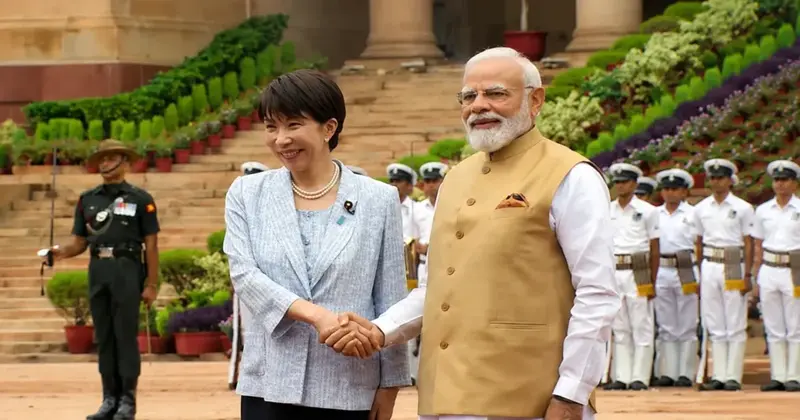
New Delhi: Japanese private companies are set to inject a massive $12.5 billion into the rapidly growing Indian market through approximately 120 cooperation agreements at the 16th Japan-India Annual Summit, coinciding with Prime Minister Sanae Takaichi’s first official visit to New Delhi on July 2, Thursday.
In a post on X, Japan’s Deputy Chief Cabinet Secretary Masanao Ozaki, who arrived in New Delhi along with PM Takaichi, noted that over 150 companies will be participating in the Japan-India Economic Forum, adding that it will strengthen government-to-government relations in areas such as security and economic security.
“Accompanying Prime Minister Takaichi to India. Today, the Japan-India Summit will take place. On this occasion, over 150 Japanese companies will also participate and the Japan-India Economic Forum will be held as well. In addition to strengthening government-to-government relations in areas such as security and economic security, I hope this will serve as a trigger for concrete and remarkable development in Japan-India economic relations”, Masanao Ozaki wrote on X.
He added a report by the Japanese newspaper The Yomiuri Shimbun, which noted that these initiatives, valued at approximately 2 trillion yen on the Japanese side, aim to deepen their footprint in India’s expanding market. Citing details from the draft of the upcoming joint statement, the Japanese newspaper further revealed that the two leaders plan to intensify partnerships regarding maritime and energy security.
According to The Yomiuri Shimbun, government sources noted that the finalised agreements encompass a variety of sectors, including Fujifilm’s collaboration on a semiconductor materials plant, a biogas facility initiative by Suzuki and application development joint ventures between Japanese and Indian artificial intelligence startups.
This 2 trillion yen injection aligns with a broader bilateral commitment established last year targeting 10 trillion yen in private Japanese investments in India over a ten-year period, the report added. Furthermore, The Yomiuri Shimbun reported that the draft joint statement solidifies last year’s accord and calls for “promoting mutually complementary cooperation between Japan and India”, with an emphasis on pressing issues like economic security. The text also welcomes the evolution of Prime Minister Takaichi’s “Free and Open Indo-Pacific (FOIP)” concept.
In defence matters, the draft conveys appreciation for ongoing maritime security collaboration and recognises Japan’s April updates to its operational guidelines regarding the transfer of defence equipment. It additionally outlines schedules to convene a Japan-India Foreign and Defence Ministerial Meeting (2+2) before the end of the year. Addressing recent export curbs on rare earth elements by China, the document explicitly notes deep apprehensions regarding nonmarket policies and economic coercion.
On energy, both nations pledge to bolster supply integrity through joint stockpiling initiatives. Additionally, the draft emphasises support for small and medium-sized enterprises entering the Indian market, backs improvements to India’s domestic business environment and advocates for cooperation on bringing JR East’s developing E10 series Shinkansen train to India. Regarding technological collaboration, it underscores that “promoting innovation, including AI, is extremely important in further expanding the foundation for cooperation”.
Prime Minister Takaichi arrived in New Delhi on July 1, Wednesday, marking her inaugural official visit to India since taking office. Prior to her departure, she highlighted the role of the private sector in expanding bilateral ties, noting that more than 150 representatives from Japan’s business community are expected to participate in the India-Japan Economic Forum. “On the occasion of this visit to India, we plan to hold the Japan-India Economic Forum with the participation of more than 150 individuals from Japan’s business community. By uniting government and private sectors, we aim to broaden the scope of Japan-India cooperation and realise a strong economy”, she said.
In the 16th India-Japan Annual Summit, economic security and energy security will be among the key issues on the agenda as the two countries seek to deepen their Special Strategic and Global Partnership. Prime Minister Takaichi said, “In discussions with Prime Minister Modi, centering on urgent issues including economic security and energy security, we will aim to deepen the strategic cooperative relationship between Japan and India in light of the current international situation”. The summit will provide an opportunity for both leaders to strengthen cooperation across strategic, economic, technological and security domains.
The bilateral meeting is also expected to focus on boosting investment and innovation, strengthening economic ties and enhancing resilient supply chains in critical sectors such as semiconductors and critical minerals. Diplomatic sources have indicated that discussions are also likely to cover maritime security, defence technology cooperation and the development of an “Industrial Value Chain” connecting the Bay of Bengal and India’s Northeast.
(With Inputs from ANI)