The history of post-independence Bharat is often written by the very hands that held the pens of ideological suppression. For decades, the corridors of academia and the high seats of the Fourth Estate were occupied by those who looked toward Moscow and Beijing for moral guidance, while turning a blind eye to the suffering of their own kin. Among the many skeletons buried in the closet of Indian “secular-progressive” history, none is more haunting, more gruesome, or more deliberately suppressed than the Marichjhapi Massacre of 1979.
Beneath the veneer of “proletarian justice” and the high-sounding rhetoric of the “People’s Government,” the Communist regime in West Bengal, led by Jyoti Basu, orchestrated a state-sponsored campaign of extermination against helpless Hindu refugees. These were people who had already lost everything to the fires of Partition and the Islamic zealotry of East Pakistan. They came to West Bengal seeking the warmth of a motherland; instead, they found the cold, ruthless efficiency of a Marxist killing machine.
The Namashudra Exile: A Twice-Displaced People
To understand the depth of the betrayal at Marichjhapi, one must understand the journey of the victims. The majority belonged to the Namashudra community, the hardy, agrarian backbone of East Bengal. During the Partition of 1947, while the affluent bhadralok managed to secure their assets and move to the safety of Calcutta, the marginalised Hindu communities remained behind, eventually forced to flee by waves of persecution.
When they arrived in West Bengal, they were not met with open arms by the then-Congress government. Instead, they were treated as a “logistical burden.” The elites of the era decided to ship these “inconvenient” Hindus off to the Dandakaranya region in central India, a harsh, rocky, and drought-prone wasteland spanning parts of modern-day Chhattisgarh and Odisha. It was a landscape alien to a community that lived by the rivers and lush deltas of Bengal. For twenty years, they languished in camps, forgotten by the state, until a new political force rose with a promise.
The Great Communist Lie
In the 1970s, as the Left Front sought to capture power in West Bengal, they identified the refugee vote as a crucial tool. In a display of calculated political opportunism, senior Left leader Jyoti Basu and his comrades visited the Mana refugee camps in 1976. They stood before the weary, hopeful masses and made a solemn vow: “If the Left Front comes to power, we will bring you back to the soil of Bengal. You will be settled in the Sundarbans.”
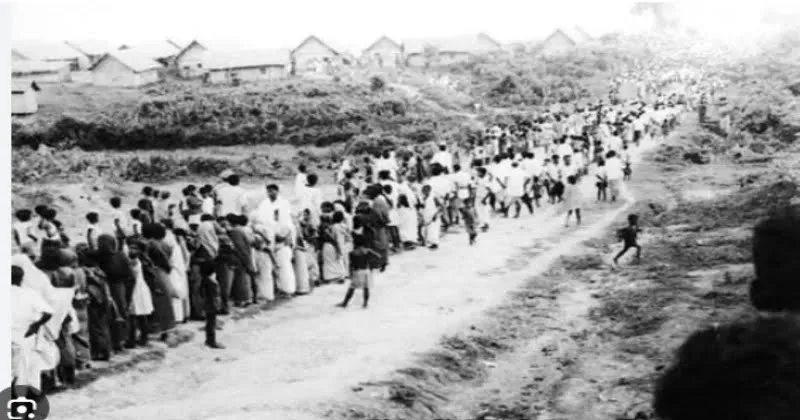
The refugees believed them. They saw in the red flag a symbol of defiance against the “bourgeoisie” Congress that had exiled them. When the Left Front swept to power in 1977, the refugees began to sell their meagre belongings in Dandakaranya. Tens of thousands boarded trains, singing songs of homecoming, heading toward the salt breeze of the Sundarbans.
But the moment they set foot in Bengal, they realised the “proletarian” promise was a death trap. The Left Front, now firmly ensconced in the seat of power, no longer needed the “burden” of these refugees. The votes had been harvested; the voters were now expendable.
Resilience in the Face of Rejection: The Birth of Marichjhapi
Refusing to be sent back to the rocky wastes of Dandakaranya, nearly 30,000 refugees made their way to Marichjhapi, an uninhabited island in the Sundarbans. Through sheer grit and the ancestral knowledge of delta-living, they did what the state said was impossible. Within months, they had cleared the scrub, built embankments to keep out the salt water, established fisheries, set up a salt-pan industry, and even started schools and health clinics.
Marichjhapi became a shining example of Hindu self-reliance. It was a community thriving without state aid, governed by its own co-operative spirit. But for a Marxist regime, self-reliance is a threat. The Communists do not want citizens; they want dependents. A community that could thrive outside the party’s control was a challenge to the totalising authority of the CPIM.
Using the excuse of “environmental protection,” Jyoti Basu’s government declared the refugees “encroachers” on a forest reserve. The irony was palpable: a regime that claimed to represent the “landless labourer” was now using the police to evict the most marginalised labourers in Bharat from land they had made fertile with their own sweat.
The Siege: Turning an Island into an Open-Air Prison
The assault on Marichjhapi did not begin with bullets; it began with the weaponisation of hunger. On January 26, 1979, the Left Front government imposed a total economic blockade on the island. Thirty police launches began patrolling the waters, circling the island like sharks.
The directives from the Writers’ Building were clear: No food, no water, no medicine
The refugees were prohibited from fishing or going to the mainland to buy rice. When the settlers tried to row across to find food, their boats were rammed and sunk by police launches. The tube wells on the island were destroyed or poisoned. As the weeks passed, children began to die of cholera and starvation. Desperate mothers tried to feed their infants the brackish, salty water of the Sundarbans, only to watch them wither away.
But the “vanguards of the revolution” in Calcutta remained unmoved. Jyoti Basu, the suave, London-educated Marxist, dismissed the deaths with the cold detachment characteristic of a regime that views human lives as mere statistics in a historical dialectic.
January 31, 1979: The Day the Mangroves Turned Red
The blockade was merely the prologue. On January 31, the “People’s Police,” supported by armed cadres of the CPIM, launched a direct assault. It was a co-ordinated operation between the state’s uniformed forces and the party’s goons-a hallmark of the “party-society” model that would plague Bengal for decades.
As the police launched, the refugees-men, women, and children-stood on the banks, holding nothing but their faith and a few makeshift tools. The police opened fire. It was not a “clash”; it was a massacre.
The air was filled with the sounds of screaming and the staccato of rifle fire. Boats carrying fleeing families were deliberately capsized. Those who tried to swim were picked off by shooters or left to the crocodiles. In the camps on the island, huts were set ablaze. Eyewitness accounts, hidden for decades, tell of women being dragged into police launches and subjected to horrific sexual violence before being thrown into the rivers.
For the Left, these were not “humans”; they were “reactionary elements” obstructing the state’s will. The ideological arrogance of the Communist regime had reached a point where the murder of thousands was seen as a necessary administrative chore.
The Erasure of Memory
The violence continued in waves until May 1979. By the time the island was finally “cleared,” thousands were dead. Some estimates suggest the toll was as high as 10,000 souls. But the horror of Marichjhapi did not end with the killing; it continued with the erasure.
The Communist regime utilised its total control over the local administration and its influence over the national media to ensure that Marichjhapi never became a headline. Journalists were barred from the island. Section 144 was permanently clamped. When a few brave souls tried to report on the stench of decomposing bodies in the mangroves, they were threatened or silenced.
The bodies were never returned to their families for the last rites. They were weighted with stones and dumped into the depths of the Raimangal River or buried in mass graves in the silt. The Left Front ensured that no monument would ever be built for these Hindu martyrs. They wanted to kill not just the people, but the very memory of their existence.
The Hypocrisy of the “Progressive” Left
The most galling aspect of the Marichjhapi massacre is the silence of the “intellectual” class. The same poets, writers, and “civil society” activists who frequented the coffee houses of Calcutta, debating the “imperialism” of the West or the “atrocities” in far-off lands, remained silent as Hindu refugees were slaughtered in their own backyard.
This silence was a calculated choice. To speak of Marichjhapi was to admit that the “Sun of Marxism” in Bengal was actually a scorched-earth policy of communal and caste-based hatred. The victims were Hindus and Dalits; the perpetrators were the “secular” elite. In the skewed morality of the Indian Left, the lives of these refugees were a small price to pay for the “stability” of the Communist regime.
Jyoti Basu, the man who presided over this carnage, would go on to be the longest-serving Chief Minister in Indian history, often hailed as a “great statesman” by the same media that buried the truth of Marichjhapi.
The Blood of Marichjhapi Cries Out
For over forty years, the truth of Marichjhapi lay buried in the silt of the Sundarbans. But the blood of the innocent has a way of seeping through even the thickest layers of propaganda. Today, as Bharat undergoes a civilisational awakening, the ghosts of Marichjhapi are finally being heard.
We must remember Marichjhapi not just as a tragedy, but as a warning. It is a warning of what happens when a nation allows an anti-national, anti-Hindu ideology to capture the instruments of the state. It is a warning of the ruthless nature of the “Red” ideology, which demands total subservience and offers only the grave to those who dare to seek self-reliance.
The massacre at Marichjhapi was a war waged by the Communist state against the Hindu spirit. The victims were people whose only “crime” was their desire to live with dignity on the soil of their ancestors. They were betrayed by the promises of the Left, starved by the blockade of the state, and murdered by the bullets of the party.
As we look back at the dark year of 1979, we must ask ourselves: Why was this history hidden? The answer is simple-the truth of Marichjhapi destroys the carefully constructed myth of the “humane” and “secular” Left. It exposes the Communist movement in Bharat for what it truly is: a predatory force that uses the marginalised as foot-soldiers and discards them as “encroachers” once power is secured.
It is time to pull back the curtain on this “secular” silence. It is time to name the perpetrators-the Jyoti Basus and the CPI (M) cadres who turned the Sundarbans into a killing field. It is time to honour the thousands of Namashudra Hindus who perished, not as victims of a “natural disaster” or “unfortunate incident,” but as martyrs of a state-sponsored genocide.
The mangroves of Marichjhapi may have been silent witnesses for decades, but the soul of Bharat remembers. We owe it to the thousands who were dumped into the crocodile-infested waters to ensure that their story is told, that their sacrifice is recognised, and that the Red ideology, which brought nothing but blood and stagnation to Bengal, is held accountable at the altar of history.