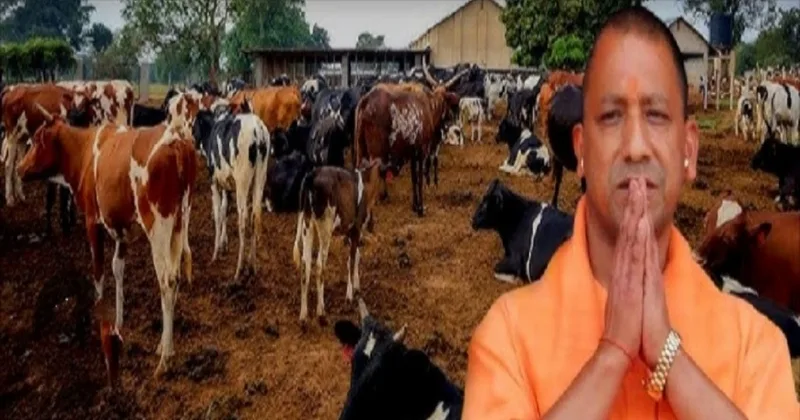
To boost farmers’ income and promote sustainable agriculture, the Uttar Pradesh government, led by Chief Minister Yogi Adityanath, is preparing a large-scale, data-backed action plan focused on cow dung-based compost, biogas, and organic fertilisers. The initiative will integrate agriculture with animal husbandry while transforming cow shelters (gaushalas) into self-reliant economic units. By doing so, the Yogi government wants to reduce dependence on chemical fertilisers, improve soil health, and create additional income streams for farmers across Uttar Pradesh.
The roadmap gained momentum following a high-level meeting chaired by State Animal Husbandry Minister Dharampal Singh at the Vidhan Sabha in Lucknow. During the meeting, officials from the Animal Husbandry and Agriculture Departments were directed to prepare a comprehensive strategy for the production, utilisation, and marketing of organic inputs such as compost, Jeevamrit, Ghanamrit, and biogas derived from cow dung. He reiterated that increasing farmers’ income while restoring soil fertility remains a core priority of the government, and emphasised that Uttar Pradesh possesses vast untapped potential in cattle-based resources that can be scientifically harnessed.
As part of the plan, the government is working to convert gaushalas into production hubs. Officials indicate that more than 300 cow shelters are being targeted for the installation of biogas plants in the coming phase, building on earlier pilot projects where around 40 to 50 gaushalas were already equipped with such units. These units have demonstrated the viability of the model, with individual centres producing approximately 50 quintals of organic slurry per month. This slurry will be a nutrient-rich fertiliser, while the biogas generated can be used for cooking, electricity, or even as compressed biogas fuel, thereby creating a dual-benefit system for rural communities.
The scale of opportunity is considerable. Estimates suggest that with coordinated efforts involving gaushalas, dairy units, and farmers, Uttar Pradesh has the capacity to produce lakhs of metric tonnes of compost every year. At a broader level, cattle-based resources in India generate tens of thousands of tonnes of dung every day, with the potential to produce over a million cubic metres of biogas daily. The Uttar Pradesh government under Yogi’s leadership is planning to tap into this resource stream to build a circular rural economy where waste is converted into valuable agricultural and energy inputs.
The government is also placing strong emphasis on expanding biogas infrastructure, including compressed biogas (CBG) plants and small-scale gobar gas units at the village level. To encourage investment, policy incentives such as electricity duty exemptions for up to 10 years and waivers on stamp duty and development charges have been introduced for bio-energy enterprises. These measures are likely to attract private participation and accelerate the development of rural bio-energy networks.
Ground-level examples have already demonstrated the income potential of this model. In one instance, a gaushala in Prayagraj generated revenue of around Rs 1.75 lakh in a year through vermicompost production. Similarly, large-scale plants in parts of western Uttar Pradesh are processing up to 50 tonnes of dung per day to produce both biogas and organic manure. Encouraged by such outcomes, the government has identified districts such as Jhansi, Chandauli, Farrukhabad, Kanpur, and Barabanki as successful models and has directed officials to replicate these initiatives across the state.
To ensure long-term success, the Yogi government is also focusing on standardisation and market development. Instructions have been given to establish clear quality benchmarks for organic manure, including moisture levels, nutrient content, and packaging standards. This will build farmers’ confidence and ensure that cow dung-based fertilisers can effectively compete with chemical alternatives. Moreover, the role of cooperative societies is being explored to improve distribution networks and ensure easy availability of these products to farmers.
The plan further includes collaboration with agricultural universities, scientists, and Krishi Vigyan Kendras (KVKs) to develop low-cost, easy-to-adopt production models, especially for small and marginal farmers. By promoting the combined use of organic manure and conventional fertilisers like urea, the government aims to facilitate a gradual transition towards more sustainable farming practices without compromising crop yields in the short term.
Beyond economic gains, the initiative carries significant environmental benefits. The use of cow dung-based manure enhances soil organic carbon, improves soil structure, and boosts long-term productivity. At the same time, converting dung into biogas helps reduce methane emissions and dependence on fossil fuels. This aligns with broader climate and sustainability goals while addressing the growing concern of soil degradation caused by excessive chemical fertiliser use. By turning agricultural waste into a source of income and energy, the Yogi government is planning to strengthen the rural economy, generate employment, and ensure a sustainable increase in farmers’ income.