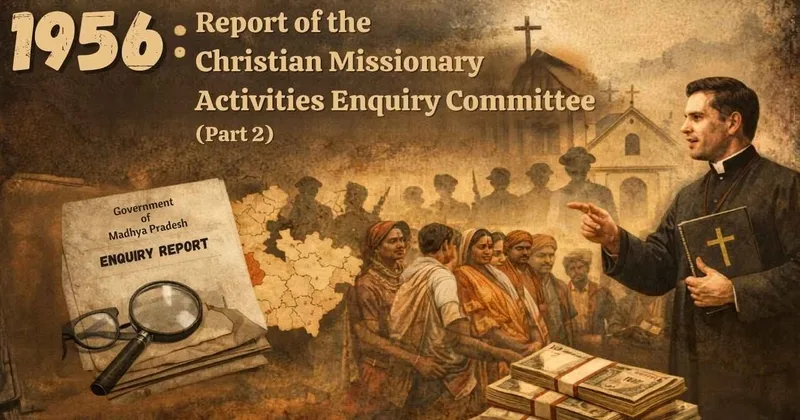
The report is 50 years old, yet its observations still feel strikingly relevant today. This series of articles is not an interpretation, but rather a reading that helps the reader understand how missionaries and the institutions they established functioned, and how a certain argument gradually and quietly seeped into our collective psyche. Over time, these narratives and their derived conclusions came to dominate academic spaces, ultimately distorting them.
The report noted in detail that whenever allegations failed to withstand scrutiny, certain missionary groups were seen resorting to false claims, a pattern it described as not entirely unexpected. It also observed that even the National Council of Churches had, at times, endorsed some of these disputed assertions. According to the report, this reflected a broader approach in which repeated assertions were used to gradually lend credibility to questionable narratives.
The report further stated that foreign missionaries, in particular, attempted to establish a strong foothold, which in turn generated public resentment. It held that proselytisation was an underlying objective in many such activities. Taken together, these developments, the report suggested, compelled the government to look into the matter, leading to the formation of the committee.
It also pointed out that several theories were constructed by missionaries to create social divisions. One such example cited was the Aryan invasion theory, which claimed that Aryans displaced indigenous tribal populations from the fertile Indo-Gangetic plains into forested and hilly regions. The report further noted that, over time, these communities were subjected to additional economic pressures from landlords, traders, and others who allegedly acquired their produce at low prices. It added that indebtedness, often accompanied by high interest rates, resulted in the loss of tribal lands and pushed many into wage labour, leaving them with limited means of livelihood.
The report further noted that during British rule, missionaries were permitted to establish schools and dispensaries in these regions, and it alleged that these institutions were often used as channels for conversion activities. According to the report, this influenced local perceptions among some vanvasi communities, where Hindu moneylenders were sometimes viewed as exploitative due to high interest rates, while Christian missionaries were perceived as more supportive of welfare needs.
It also described vanvasi communities as being closely tied to forest-based livelihoods, including hunting and the collection of forest produce, and dependent on basic necessities such as handwoven cloth and staple foods like rice, pulses, and meat. The report suggested that such socio-economic conditions made these communities more vulnerable to influence and persuasion.
At the same time, it acknowledged that certain vanvasi groups, such as the Marias of the Chanda and Bastar regions, reportedly had no recorded conversions.
The report observed that many tribes in districts such as Durg, Raipur, Chanda, and Bilaspur traditionally followed Hindu customs during social and religious occasions, including marriages and festivals like Holi, Deepawali, Dussehra, and Shivaratri. Despite this, it claimed that missionaries often did not classify these communities as Hindu and instead encouraged interpretations that emphasised distinct identities.
It also referenced Gandhiji’s view that colonial administrative classifications such as “animist aborigines” were introduced under British rule, and that historically these communities had been considered part of the broader Hindu fold, with cultural and religious roots deeply connected to the region.
Additionally, the report cited the research of late scholar M. M. Kunte (1880), who argued that intermarriage between Aryan and indigenous groups had been common in ancient times, and referenced mythological figures such as Vyas, Vidur, Hanuman, and Valmiki as examples often invoked in support of cultural integration narratives.
In the 1901 Census, Sir Herbert Risley observed that a clear distinction between Hinduism and animism could not easily be drawn. Similarly, in 1921, the Superintendent of Census for Bihar and Orissa recommended that animist groups be included within the broader Hindu category. However, in the 1931 Census, the Commissioner introduced a separate classification under “tribal religion,” thereby creating a distinct category. Despite this, some officials continued to hold the view that these communities should still be considered part of Hindu society. The report suggests that the rationale behind this separate categorisation can be better understood in the context of missionary activity in tribal regions during that period.
It further notes that in the 1941 Census, Scheduled Tribes were not recorded as Christians, which reportedly led to an apparent decline of around 2.5 lakh in the official Christian population, even though the actual number was said to have increased.
Subsequently, the Government of India introduced special constitutional provisions for the protection and welfare of Scheduled Castes and Scheduled Tribes, along with a range of dedicated benefits and support measures.
The report observes that missionary organisations, in its assessment, functioned in many respects like a “state within a state” and describes them as extensions of what it terms “national imperialism.” It further notes that missionaries were seen as attempting to challenge the religious nationalism of the country while also positioning themselves in opposition to communism. At the same time, it acknowledges that there were differences among various Christian organisations.
According to the report, there were 4,877 foreign personnel working in the country at the time of its publication in 1956, which it states was an increase of about 500 compared to 1952.
It classifies Protestant missionary work into five broad areas:
Economic activities: including agricultural settlements, cooperative societies, printing presses, literature distribution centres, and related initiatives.
Educational activities: covering schools, colleges, teacher training institutions, industrial schools, and training centres for missionaries.
Evangelistic activities: including theological colleges, seminaries, training programmes for workers, Bible correspondence courses, and Christian ashrams.
Medical activities: such as hospitals, dispensaries, leprosy care centres, and tuberculosis sanatoriums.
Philanthropic and general activities: including homes for women and converts, orphanages, institutions for the blind and deaf, as well as rest houses, retreats, and study centres for missionaries.
The report states that these activities collectively reached a wide range of social sectors. It further expresses the view that such initiatives were often interpreted as being linked to conversion efforts, rather than being seen solely as humanitarian service. It also traces the origins of such activities to the early missionary period, suggesting their continuation over time.
With the arrival of the Portuguese, the report describes the beginning of organised conversion efforts, including reference to the Inquisition. It cites accounts attributing large-scale conversions among fishing communities in Goa to Francis Xavier and notes historical references to directives issued during the Portuguese period regarding the destruction of idols and the imposition of penalties, as well as incentives for conversion.
The report also refers to Robert de Nobili, stating that he adopted local languages such as Tamil, Telugu, and Sanskrit, and adapted aspects of Brahminical customs in his missionary approach. It records accounts attributing a number of conversions to his efforts during the early 17th century and notes his extended period of work in the region. It further mentions estimates that by around 1700, the Catholic population in India was approximately six lakh, according to the report’s cited sources. The report concludes this section by noting that Protestant missions were also actively engaged in similar expansion efforts, and indicates that further details are provided in subsequent sections.