China rebrands 'homelessness' as 'dispersed persons'
June 23, 2026
  • Read Ecopy
  • Circulation
  • Advertise
  • Careers
  • About Us
  • Contact Us
Android AppiPhone AppArattai
Organiser
  • ‌
  • Bharat
    • Assam
    • Bihar
    • Chhattisgarh
    • Jharkhand
    • Maharashtra
    • View All States
  • World
    • Asia
    • Europe
    • North America
    • South America
    • Africa
    • Australia
  • Editorial
  • International
  • Opinion
  • RSS @ 100
  • More
    • Op Sindoor
    • Analysis
    • Sports
    • Defence
    • Politics
    • Business
    • Economy
    • Culture
    • Special Report
    • Sci & Tech
    • Entertainment
    • G20
    • Azadi Ka Amrit Mahotsav
    • Vocal4Local
    • Web Stories
    • Education
    • Employment
    • Books
    • Interviews
    • Travel
    • Law
    • Health
    • Obituary
  • Subscribe
    • Subscribe Print Edition
    • Subscribe Ecopy
    • Read Ecopy
  • ‌
  • Bharat
    • Assam
    • Bihar
    • Chhattisgarh
    • Jharkhand
    • Maharashtra
    • View All States
  • World
    • Asia
    • Europe
    • North America
    • South America
    • Africa
    • Australia
  • Editorial
  • International
  • Opinion
  • RSS @ 100
  • More
    • Op Sindoor
    • Analysis
    • Sports
    • Defence
    • Politics
    • Business
    • Economy
    • Culture
    • Special Report
    • Sci & Tech
    • Entertainment
    • G20
    • Azadi Ka Amrit Mahotsav
    • Vocal4Local
    • Web Stories
    • Education
    • Employment
    • Books
    • Interviews
    • Travel
    • Law
    • Health
    • Obituary
  • Subscribe
    • Subscribe Print Edition
    • Subscribe Ecopy
    • Read Ecopy
Organiser
  • Home
  • Bharat
  • World
  • Operation Sindoor
  • Editorial
  • Analysis
  • Opinion
  • Culture
  • Defence
  • International Edition
  • RSS @ 100
  • Magazine
  • Read Ecopy
Home International Edition News

China rebrands ‘homelessness’ as ‘dispersed persons’ to hide rising economic distress and urban poverty

As China's economic slowdown leads to rising urban homelessness, the CCP has rebranded "homeless beggars" as "dispersed persons" in an apparent effort to manage political optics and preserve the narrative of a "prosperous society." This terminology shift, occurring alongside reports of missing persons and systemic opacity, has fueled concerns that the regime is prioritizing narrative control over addressing the structural roots of social and financial distress

Dr Vishnu AravindDr Vishnu Aravind
May 8, 2026, 07:00 am IST
in News, World, China, Asia, International Edition
Follow on Google News
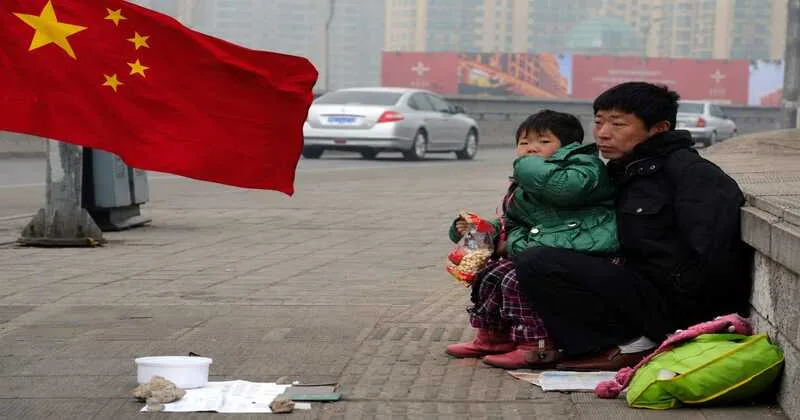
China’s economic slowdown pushes migrant workers into homelessness as Beijing reshapes the narrative through new terminology.

China’s economic slowdown pushes migrant workers into homelessness as Beijing reshapes the narrative through new terminology.

FacebookTwitterWhatsAppTelegramEmail

As China’s economic slowdown intensifies and unemployment spreads across major cities, the Chinese Communist Party (CCP) has quietly introduced a new official term for homeless people, replacing “homeless beggars” with “dispersed persons” in revisions to the country’s draft Social Assistance Law. The terminology change was reported on April 27 by the Chinese state-run newspaper The People’s Daily, which stated that the revision was intended to simplify administrative procedures and improve public services.

The adjustment appeared amid mounting evidence that increasing numbers of rural migrant workers are becoming homeless after failing to secure employment in urban centres.
The shift in wording has drawn attention because it comes at a time when videos circulating across Chinese social media platforms show unemployed labourers sleeping in railway stations, beneath bridges, on pavements, and in other public areas after exhausting their savings while searching for work in cities.

The renaming has been viewed as part of a broader attempt by the regime to soften the visible impact of worsening economic conditions without addressing rising unemployment, weakening domestic demand, and deepening social insecurity. The CCP has repeatedly promoted the narrative that extreme poverty in China has been eradicated and that the country has achieved a “moderately prosperous society.” The appearance of growing urban homelessness has increasingly contradicted those claims. The replacement of the term “homeless beggars” with “dispersed persons” has therefore been interpreted as an effort to manage political optics during a period of economic strain.

Reports have also highlighted the CCP’s long-standing reliance on administrative terminology and propaganda language to reshape public perception during periods of social distress. The latest wording change follows a broader historical pattern in which politically sensitive social problems are relabelled rather than publicly acknowledged.

Migrant workers and the legacy of control

China’s migrant population has historically faced strict state control and social discrimination under the CCP’s hukou household registration system. During the 1980s, rural migrants travelling to cities in search of work were officially described as “blind drifters,” a term that portrayed them as uncontrolled and socially disruptive. In 1982, the Chinese regime formally introduced regulations categorising such individuals as “homeless beggars.” The classification enabled authorities to detain and forcibly repatriate migrants under a system known as “custody and repatriation.”

The system remained in place until 2003, when the death of Sun Zhigang, a young migrant worker who died after being beaten in a detention centre in Guangzhou, triggered nationwide outrage. Public anger over the case forced authorities to abolish the custody and repatriation framework and replace detention centres with so-called “assistance stations.” Despite the policy shift, reports have continued to question whether the underlying system changed in practice. Concerns have persisted over allegations of abuse, arbitrary detention, lack of accountability, and mistreatment within facilities intended to assist vulnerable populations.

The latest terminology revision has revived discussion over whether the CCP is once again attempting to repackage an existing social crisis without implementing structural reforms.

Chinese internet users have increasingly responded to economic hardships and censorship through satire and coded language. Online discussions have reflected frustration over the regime’s emphasis on wording adjustments while unemployment and financial instability continue to affect large sections of the population. The economic downturn has placed particular pressure on rural migrant workers, many of whom depend on unstable construction, manufacturing, and service-sector jobs in cities. With reduced hiring, factory slowdowns, and a weakening property market, large numbers of workers have reportedly been left stranded without stable income or housing.

Missing data, censorship, and abuse allegations

Official figures released by China’s Ministry of Civil Affairs provide only limited information about the scale of homelessness in the country. According to data reported by Chinese news outlet The Paper, Chinese authorities provided temporary assistance more than 700,000 times during 2024 and approximately 625,000 times during 2025. However, the government did not publish nationwide statistics on the total homeless population. The absence of transparent data has fuelled further scrutiny.
A 2021 report concerning missing persons, published through Chinese state media China Daily, stated that more than one million people disappeared in 2020. The same report noted that missing person cases had reached 3.94 million in 2016. Since then, nationwide figures related to disappearances have largely vanished from public reporting. The lack of updated statistics has coincided with growing concerns over secrecy surrounding detention facilities, assistance stations, and vulnerable populations.

In early April, Chinese authorities censored a viral video alleging that large numbers of individuals had died or disappeared at a detention facility in southern China. The footage revived longstanding allegations involving abuse, unexplained deaths, disappearances, and possible human trafficking linked to state-run institutions. Independent verification of such allegations remains extremely difficult because of China’s extensive censorship system and restrictions on independent investigations. Questions surrounding state-run institutions expanded further in March 2026, when a Guangzhou resident launched an online petition calling for a suspension and investigation into China’s organ transplant system. The initiative was rapidly suppressed by authorities.

Although no direct evidence publicly linked homeless populations to organ harvesting allegations, reports noted that vulnerable groups remain at elevated risk within opaque administrative systems where independent oversight is limited.

Concerns have also emerged regarding corruption within the social assistance network. Reports described allegations that local officials inflated the number of aid recipients on paper in order to divert government funds. Under such practices, a single individual could reportedly be counted multiple times in official records while financial allocations were misappropriated by local authorities.

The combination of economic decline, growing homelessness, censorship, weak transparency, and longstanding allegations surrounding detention and assistance systems has intensified scrutiny of the CCP’s handling of vulnerable populations. Rather than addressing the visible social consequences of economic deterioration, authorities have increasingly focused on changing terminology and controlling public narratives as signs of distress continue to spread across China’s cities.


Topics: Sun ZhigangChinaChinese Communist PartyCCP
ShareTweetSendShareSend
✮ Subscribe Organiser YouTube Channel. ✮
✮ Join Organiser's WhatsApp channel for Nationalist views beyond the news. ✮
Previous News

Nida Khan – Key accused in the TCS ‘Corporate Jihad’ Case arrested, to be produced before magistrate

Next News

Rat poison in watermelon killed family of four in Mumbai, forensic report confirms

Related News

Chinese President Xi Jinping

China Back to Mao Era? Xi unveils new doctrine of party supremacy over state and people

Yoga Day celebrations in Shanghai, China

International Yoga Day: Global celebrations echo the message of health, well-being and timeless ancient Indian wisdom

UK retailers demand tougher curbs on Chinese online giants amid deepening EU–Beijing trade rift

Prestige Denim Mills' $20 million project marks India's industrial entry into one of Africa's fastest-growing textile hubs

India enters Egypt’s textile battlefield, challenging Chinese, Turkish and Pakistani dominance in Africa

In China's strategic map of threats, geography continues to give India a significance that cannot be overlooked

The Rival China Cannot Ignore: Why India matters more than Beijing admits

As economic pressures mount, Beijing is tightening control over business, investment and society, placing security and stability above growth

Xi, the CCP and China’s New Reality: Why regime survival now matters more than economic growth

Load More

Latest News

Female recruitment in Jihadist networks emerges as major security concern

Khadija Terror Case: Female recruitment, online radicalisation in Jihadi networks poses major security concern

Outcry grows after Dalits in Theeyathur village carry deceased woman across paddy fields due to lack of burial access

Tamil Nadu: Dalits forced to carry deceased woman through paddy fields as Pudukkottai village lacks road access

ASI transfers Rakhigarhi skeletal remains to Anthropological Survey of India for detailed examination

Rakhigarhi’s ancient secrets to be unveiled as human skeletal remains reach AnSI for advanced scientific analysis

Dr Syama Prasad Mookerjee: A Life That Still Guides Bharat’s National Resolve

(Left) Maoist Arms seized (Right) Security personnel with the seized arms of Maoists

Odisha: Major Maoist arms cache recovered in Koraput, sixth such seizure within two weeks

Delhi Chief Minister Rekha Gupta paid tribute to Bharatiya Jana Sangh founder Syama Prasad Mookerjee on his death anniversary

Article 370 abrogation was the greatest tribute to Syama Prasad Mookerjee: Delhi CM Rekha Gupta

Prime Minister Narendra Modi

Viksit Bharat: PM Modi slams Congress — ‘Blocks development, claims credit’

(Left) Petrol bomb hurled at BJP leader’s clinic opposite newly inaugurated RSS office in Bhatinda (Right) BJP leader Dr Tarsem Garg

Punjab: Petrol bomb hurled at BJP leader’s clinic opposite newly inaugurated RSS office in Bhatinda

Functionaries of Akhil Bharatiya Rashtriya Seva Bharati on the stage release Rashtriya Seva Sadhana–2026

Tamil Nadu: Seva Bharati reviews service initiatives, charts roadmap for future expansion

PM Modi Pays Homage to Jan Sangh Founder Syama Prasad Mookerjee

Balidan Diwas: PM Modi pays tribute to Jan Sangh founder Syama Prasad Mookerjee, hails his nationalist legacy

Load More
  • Privacy
  • Terms
  • Cookie Policy
  • Refund and Cancellation
  • Delivery and Shipping

© Bharat Prakashan (Delhi) Limited.
Tech-enabled by Ananthapuri Technologies

  • Home
  • Search Organiser
  • Bharat
    • Assam
    • Bihar
    • Chhattisgarh
    • Jharkhand
    • Maharashtra
    • View All States
  • World
    • Asia
    • Africa
    • North America
    • South America
    • Europe
    • Australia
  • Editorial
  • Operation Sindoor
  • Opinion
  • Analysis
  • Defence
  • Culture
  • Sports
  • Business
  • RSS @ 100
  • Entertainment
  • More ..
    • Sci & Tech
    • Vocal4Local
    • Special Report
    • Education
    • Employment
    • Books
    • Interviews
    • Travel
    • Health
    • Politics
    • Law
    • Economy
    • Obituary
  • Subscribe Magazine
  • Read Ecopy
  • Advertise
  • Circulation
  • Careers
  • About Us
  • Contact Us
  • Policies & Terms
    • Privacy Policy
    • Cookie Policy
    • Refund and Cancellation
    • Terms of Use

© Bharat Prakashan (Delhi) Limited.
Tech-enabled by Ananthapuri Technologies