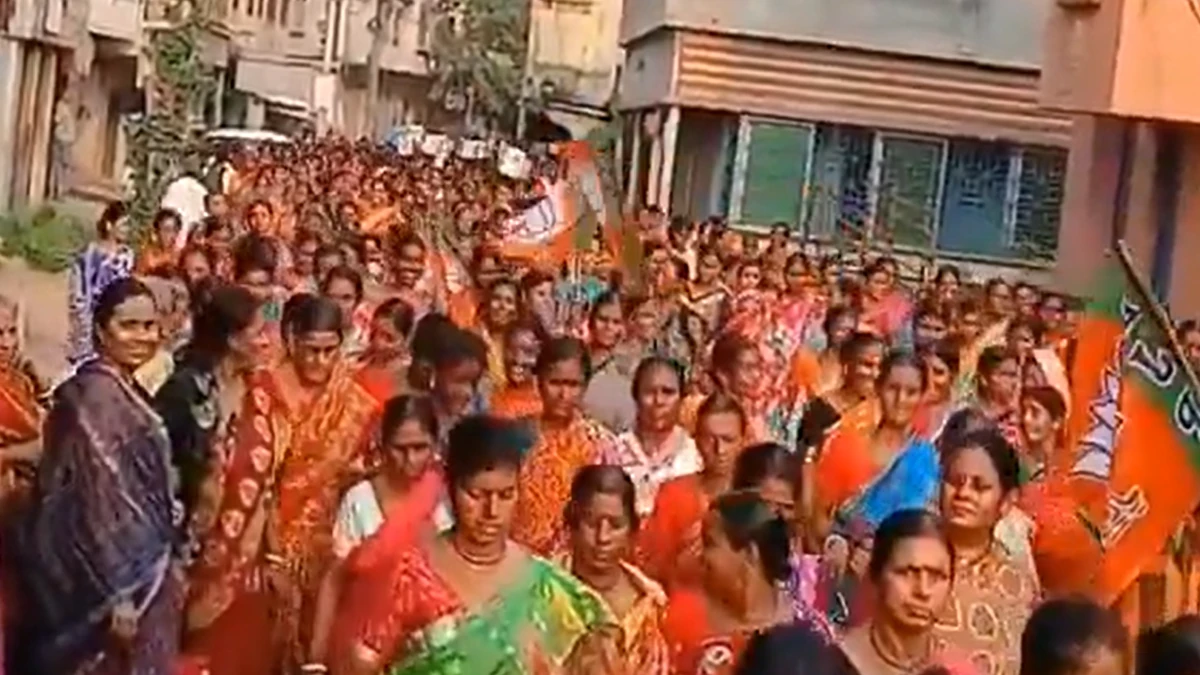
NANOOR, BIRBHUM: More than 5,000 women reportedly gathered in support of the BJP, turning the Birbhum constituency into a sea of women and party flags. For the BJP, the significance of the gathering lies not merely in the numbers. It lies in where it happened.
Nanoor has for decades been associated with some of the most violent chapters of Bengal’s political history. The constituency witnessed the 2000 Nanoor massacre, when 11 agricultural labourers were killed at Suchpur during the Left Front era. Political violence continued in different forms even after the Trinamool Congress replaced the Left as Bengal’s dominant political force.
In the years that followed, Nanoor became a battleground not only between political parties but also between rival factions within the TMC. That history gives the latest images from Nanoor a particular political resonance.
This gathering is a picture of a changing Bengal after the BJP came into power one in which women are increasingly becoming visible participants in politics rather than merely recipients of welfare schemes.
Beautiful visuals from Nanoor,Birbhum!
More than 5000 women came out in the support of BJP- mind you this is just from one assembly.
This is the same NANOOR – that saw violence unleashed by Communists and then TMC's Kajal Seikh then.
See the change now.
Islamists may cry. pic.twitter.com/P9O3uPfb0m
— Subham. (@subhsays) September 26, 2026
A constituency where political rivalry became a way of life
Nanoor’s political history predates the Trinamool Congress. The constituency was once a stronghold of the CPI(M), but the political landscape changed dramatically with the rise of the TMC. Yet the change of political colour did not mean the disappearance of violence.
In 2016, The Telegraph described Nanoor as having a long history of political violence and reported a factional battle between TMC groups associated with Birbhum district chief Anubrata Mondal and local leader Sheikh Kajal.
At the time, political clashes had become so persistent that students preparing for their Madhyamik examinations reportedly wrote to the police expressing fear and difficulty studying because of clashes in villages across Nanoor.
The rivalry was not simply between the TMC and its political opponents. It also existed inside the ruling party.
Reports from the period described a contest between the camp associated with Mondal and the faction led by Kajal Sheikh. One report said the rivalry had its roots in disputes over control of local political and development activity and had evolved into a broader turf battle.
Who was Anubrata Mondal?
To understand why Mondal’s name remains so closely associated with Birbhum politics, it is necessary to understand the influence he accumulated within the TMC. Known popularly as “Kesto”, Anubrata Mondal became one of the most powerful TMC leaders in Birbhum. He served as the party’s district president and was regarded as a close aide of Mamata Banerjee.
The media reported in 2022 that Mondal had not contested an election himself but exercised considerable influence over the party organisation in Birbhum, with sources describing his clout as greater than that of several ministers and MLAs.
His political dominance became part of the wider narrative surrounding Birbhum.
In Nanoor, his faction came into conflict with the group associated with Kajal Sheikh. A 2016 report described the constituency as being divided between TMC groups aligned with Mondal and Gadadhar Hazra on one side and Kajal Sheikh on the other.
The rivalry did not disappear after Mondal’s arrest.
In 2025, reports again described clashes and bomb attacks allegedly involving supporters of the two factions in Birbhum, demonstrating that the Mondal-Sheikh rivalry had continued to cast a shadow over the district’s politics.
Mondal’s legal troubles changed the political equation
Mondal’s political career also became entangled with major central investigations.
In August 2022, the CBI arrested him in connection with its investigation into an alleged cross-border cattle-smuggling racket. The agency alleged that Mondal was involved in the network; Mondal denied the allegations, while the TMC accused central agencies of politically targeting its leaders.
The CBI’s investigation subsequently referred to alleged links between Mondal and people involved in the cattle-smuggling network. These remain allegations made in the investigation and should not be treated as a judicial finding of guilt.
His arrest nevertheless had a major political consequence.
For years, Mondal had been one of the central figures in Birbhum’s political organisation. Once he was removed from the political scene, the balance between different TMC factions changed. The Indian Express reported that Kajal Sheikh’s influence increased following Mondal’s arrest.
That history matters when thousands of women now gather in Nanoor. The BJP’s argument is essentially that the political culture associated with the old order is changing.
From the politics of control to the politics of delivery?
The BJP is no longer speaking as an opposition force promising to change Bengal. It is now pointing to decisions taken by its own government. The administration’s first months have focused heavily on welfare delivery, healthcare, women, recruitment, border infrastructure and administrative access.
The BJP has sought to present these measures as a break from the political and administrative practices of the previous TMC government.
Annapurna Yojana puts women at the centre
One of the BJP government’s most prominent welfare initiatives is Annapurna Yojana, under which eligible women receive Rs 3,000 per month. The scheme has become a central component of the government’s women-focused political messaging.
The administration has also sought to put women’s names at the centre of housing and welfare delivery. At an Annapurna Divas programme, Chief Minister Suvendu Adhikari announced plans involving registration of houses under PM Awas Yojana in women’s names.
The significance of the Nanoor gathering is obvious in that context. The BJP is not simply talking about women as beneficiaries.
Healthcare: Ayushman Bharat enters Bengal
Healthcare represents another major area in which the BJP government has sought to distinguish itself from its predecessor. The government introduced Ayushman Bharat-Pradhan Mantri Jan Arogya Yojana in West Bengal after the BJP came to power.
The scheme provides cashless health coverage for eligible beneficiaries and had long been a point of political contention between the BJP-led Centre and the previous TMC government in Bengal.
The Adhikari government has highlighted the number of beneficiaries receiving treatment under the scheme since its introduction, presenting the move as an expansion of access to healthcare.
For the BJP, the message is straightforward, a central welfare programme that had not operated in Bengal under the previous administration is now available in the state.
Border fencing becomes a government priority
The BJP government has also placed the India-Bangladesh border high on its administrative agenda. It announced measures to expedite the transfer of land required by the BSF for fencing, arguing that administrative delays had slowed the process under the previous government.
The government has also spoken about holding centres and action against undocumented foreign nationals. The issue is politically significant because border security has long been one of the BJP’s principal themes in Bengal.
Under the new government, it has moved from being primarily an election issue to becoming an explicit state-government priority.
Anganwadi and ASHA workers: Welfare beyond cash transfers
The government’s women-centric approach extends beyond direct financial assistance. Chief Minister Adhikari has announced a Rs 5,000 monthly increase for Anganwadi workers, helpers and ASHA workers, along with higher allocations for food served at ICDS centres.
The government has also announced plans to construct dedicated buildings for thousands of ICDS centres operating from rented premises. The proposed facilities include electricity connections, cooking gas, drinking water and hygienic toilets.
At the Angan Milan Seva programme in Panihati, BJP president Nitin Nabin highlighted these measures and credited the state government with implementing ICDS and child-nutrition initiatives at speed.
The government is therefore attempting to combine financial welfare with service delivery and infrastructure.
Recruitment and government employment
Government jobs have become another major component of the BJP’s governance narrative. The administration revised the upper age limits for recruitment to state government posts. It has also announced plans for large-scale recruitment and promised greater transparency in the process.
A 7th Pay Commission for state government employees has also been proposed. The issue carries particular weight in Bengal, where the previous government’s recruitment process became the subject of major legal and political controversy.
The BJP is using recruitment reform to make a broader argument: that government employment should be based on transparent procedures rather than political connections.
From welfare schemes to direct access to government
The government has also sought to create new channels through which citizens can directly approach the administration. The Janatar Darbar initiative allows citizens to present grievances directly to the chief minister.
The Apnar Sarkar Apnar Pashe programme similarly aims to help people facing difficulties in accessing government services. These initiatives are designed to create an image of a government that is more directly accessible to ordinary citizens.
It is a deliberate contrast with the BJP’s portrayal of the previous political system, which the party frequently criticised as being dominated by party networks and local political intermediaries.
A visible change in the state’s political and cultural agenda
The changes are not confined to welfare. The new government has also introduced a different political and cultural vocabulary. The administration mandated Vande Mataram in morning assemblies in government and government-aided schools and extended the directive to recognised madrasas and other educational institutions.
The government has also announced changes in the use of official state branding and sought to replace the previous administration’s Biswa Bangla branding with the Ashoka emblem.
Its approach to religious events, government schemes and administrative identity has similarly reflected the BJP’s political priorities.
These are not merely bureaucratic changes. Together, they signal a government with a distinctly different ideological and administrative approach from the TMC government that preceded it.
Law and order remains the biggest political contrast
Yet for a place like Nanoor, the most powerful part of the argument remains law and order. Bengal’s history of political violence did not begin with the TMC. The Left Front era produced some of the state’s most notorious episodes of political violence, including the Nanoor massacre.
But the violence did not end when the Left lost power.
Under the TMC, Nanoor again became associated with factional clashes, including battles between rival groups within the ruling party itself. Reports from the period documented clashes involving the Mondal and Kajal Sheikh camps.
That history makes the current imagery particularly striking. Bengal can move from a culture of political confrontation to a culture of governance and participation.