Today marks the birth anniversary of Mahatma Gandhi. (157th Anniversary). On such a sacred occasion, it is important that Gandhi’s fundamental principles and messages reach the youth of India in their true spirit and as part of their own intellectual inheritance. It is unfortunate that many of Gandhi’s ideas have been used merely as instruments to attain political power.
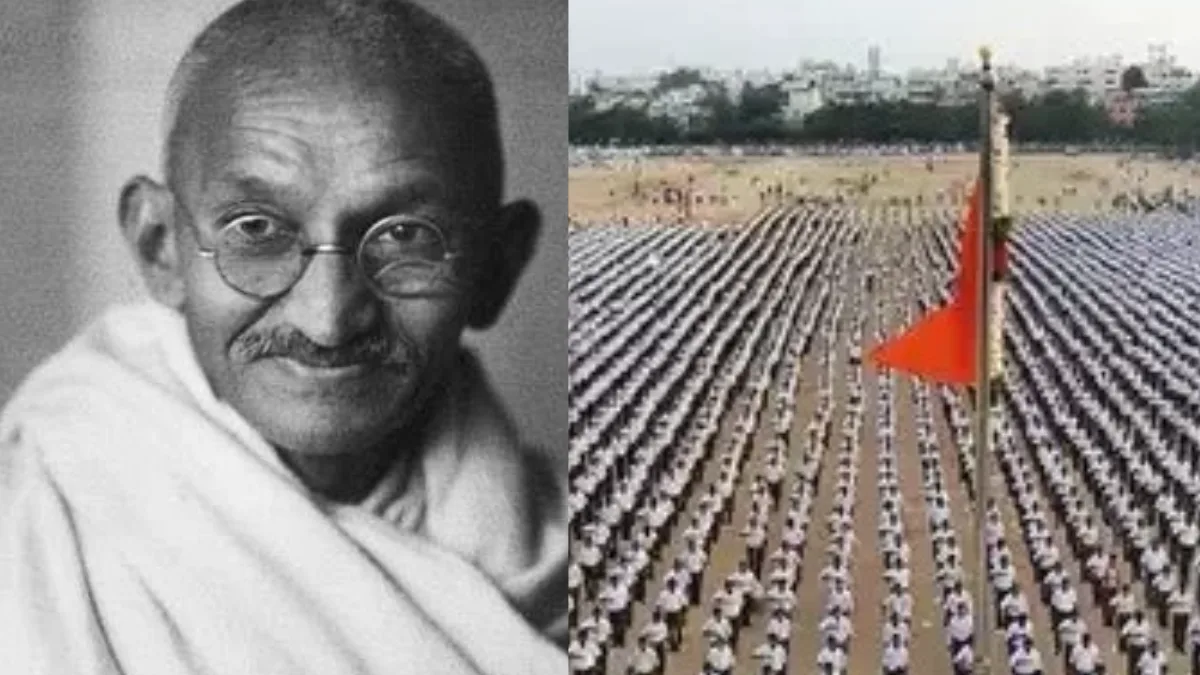
Even today, attempts continue to distort his deeper messages and mislead society. Among the many subjects that deserve reflection is the relationship between the Rashtriya Swayamsevak Sangh (RSS) and Mahatma Gandhi.
The birth anniversary of Gandhi provides an appropriate occasion to revisit this relationship. Today, the RSS has grown into a vast social organisation with a presence across different parts of the world. Its ideals seek to create workers who possess a sensitive awareness of the wider world and who are constantly willing to examine and renew themselves.
At the same time, it would be unreasonable to expect those who do not respect the Constitution to understand, or even attempt to understand, the RSS.
Even as the RSS is increasingly being recognised globally as an important social organisation, and as the number of its volunteers continues to grow, there have also been repeated attempts to restrict its activities through legal and administrative measures. At the same time, attempts to ban the organisation have repeatedly faced judicial scrutiny and setbacks.
Those who seek to criticise or oppose the RSS should at least make an effort to understand the relationship between the organisation and the Mahatmas of our national movement. Should they not also read the writings and views of leaders such as Dr B. R. Ambedkar, Sardar Vallabhbhai Patel and Mahatma Gandhi? Even if they do not agree with their ideals, should they not at least seek to understand them?
“The RSS and Gandhi”
After Independence, Mahatma Gandhi visited a shakha of the RSS near the Bhangi Colony where he was staying. Addressing more than 500 volunteers at the mandal level and above, he is reported to have said: “Once before, in 1934, I had visited an RSS camp at Wardha. Dr. Hedgewar was with us. I was pleased to see the simplicity and discipline at the camp and the absence of any feeling of untouchability among the members.”
He further observed: “The organisation has grown considerably today. Any organisation that embodies the ideals of service and sacrifice also grows in strength.” (Source: The Complete Works of Mahatma Gandhi, Vol. 193–194.)
This statement is cited as evidence that caste discrimination and untouchability had no place within the organisation.
Can leaders who believe that political power is paramount, with everything else relegated to a secondary position, truly appreciate the words, values and contributions of those who helped bring them to power?
For nearly a century, the RSS has propagated and followed several ideas associated with Gandhi’s thought, including cow protection, the promotion of Swadeshi, social harmony and a simple way of life.
The RSS’s Sarsanghchalaks have also spoken of Gandhi and his principles and values with considerable respect and appreciation.
For instance, Param Pujya Guruji, while referring to Gandhi at an event commemorating Gandhi’s birth centenary in Sangli, is said to have remarked, while unveiling a statue, that Gandhi “extracted gold from dust” and transformed ordinary people into extraordinary individuals.
He further expressed the view that the revival of Dharma was possible by imbibing Gandhi’s thoughts.
Such statements, it is argued, reflect the RSS’s internal appreciation of Gandhi and his philosophy.
Gandhi himself is also quoted as having expressed the view that Hindutva was not something static and that, one day, it could become a spiritual tradition capable of illuminating the entire world.
(Reference cited: Complete Works of Param Pujya Guruji, Vol. 1, pp. 208–221.)
Thus, numerous statements attributed to Mahatma Gandhi over the years are cited in support of the compatibility between Hindutva and the broader ideals associated with the RSS.
Should we not, at the very least, study Gandhi’s messages? Is it not an injustice to Gandhi to make accusations without first understanding his objectives and ideals? Or does this discussion imply that Gandhi himself was less informed than those who make such allegations today?
These are questions that deserve serious public debate.
From an electoral perspective, political parties such as the Bharatiya Janata Party (BJP) may certainly be subjected to political criticism and scrutiny. However, sections of Hindu society may not accept disparaging remarks about the RSS.
Some people may have little regard for the Constitution, but the RSS itself has its own constitution and organisational framework.
To date, it is argued, no RSS shakha, milan, baithak or Sangh Shiksha Varg has conducted an activity on the basis of caste. Nor, according to the organisation, is such discrimination visible in its functioning. This, the author argues, is consistent with the message embodied in Gandhi’s life.
In the Indian subcontinent, the RSS is presented as an organisation that seeks to maintain social harmony without asking for or emphasising a person’s caste. The author argues that Gandhi would have been proud of such an approach.
The author further maintains that Gandhi repeatedly and emphatically recognised the importance of the RSS’s work for the preservation of India’s Sanatana heritage and for the country’s progress.
On the occasion of Gandhi Jayanti, therefore, there is a pressing need to create greater awareness among India’s youth about the relationship between Mahatma Gandhi and the RSS.