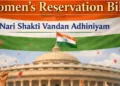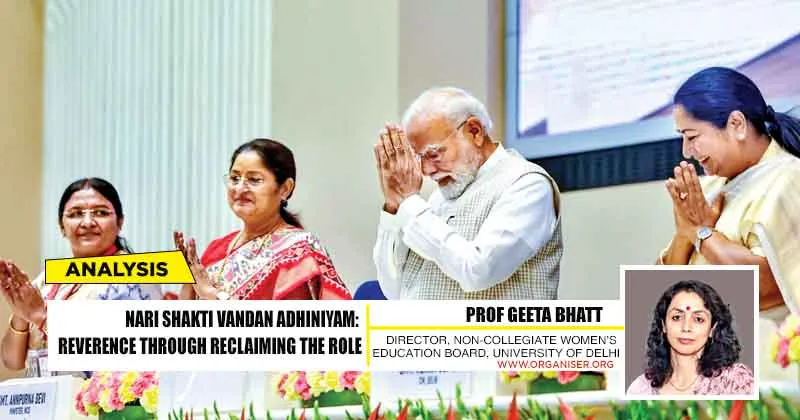
Shakti Vandan Adhiniyam 2023 is aspiring to see the light of the day with its implementation tabled in the parliament for legislative approval. A historic moment when half of the nation’s population will get representation in the parliament and legislative assemblies with thirty three per cent reservation. The women reservation bill was initiated in 1996 in the parliament and is fructifying after three decades as a living reality. Our civilisational memory is rich with women who led kingdoms, governed states, inspired and performed art, dance and culture. It is a profound moment that a nation which worships Durga as the destroyer of evil, Saraswati as the embodiment of knowledge, and Lakshmi as the guardian of prosperity is reclaiming the leadership role for women in governance which was sidelined over centuries of invasion and colonisation. The Nari Shakti Vandan Adhiniyam is not a foreign import but rather a homecoming.
The constituent assembly witnessed the first brush with reservation for women in the constitution in the twentieth century when it was resisted by none other than the fifteen women members of the constituent assembly. Woman member Renuka Ray from West Bengal in the constituent assembly recalled that Bharatiya women never arose narrow suffragist movement that was common in the so called enlightened western nations. She said that in this country women have striven for their rights, for equality of status, for justice and fairplay and most of all to be able to take their part in responsible work in the service of their country. Hansa Mehta said in the constituent assembly that women seek social, economic, and political justice and have never asked for reserved seats or quotas. B Pattabhi Sitaramayya acknowledged and admired that women members said ‘No separate electorate for women, no reservation for women’. He agreed that declining of reservation by women representatives showed the way to Muslims who were debating for marked minority seats. The women in the constituent assembly preferred meritocracy over quota as they believed that organic inclusion in governance will happen in due course of time.
The limited participation of women in social and national life in the post-Independence socio-economic framework was often misconstrued as a lack of inherent potential. In reality, it reflected the structural constraints and systemic barriers that restricted their access to opportunities. Since the first general elections in 1952, where women constituted barely 5 per cent of Parliament, their representation has gradually increased to nearly 14 per cent in the present Lok Sabha. At the state level, representation remains at around 9 per cent in legislative assemblies while the global average is 26 per cent. While this upward trend indicates progress, it remains disproportionately low compared to women’s share in the population.
The data from the 2024 Lok Sabha elections further underscores this disparity. Women accounted for only 10 per cent of the total contesting candidates, and notably, 28 per cent of constituencies did not have a single female contestant. However, one of the most visible changes in electoral process in the last 15 years has been the ascent of women as voters – in numbers and in their aspirations. In 1962, voter turnout reflected a pronounced gender gap, with 63.3 per cent of men casting their votes compared to only 46.6 per cent of women. Over the decades, however, this disparity has steadily narrowed. By 2019, women had not only closed the gap but marginally surpassed men, with a turnout of 67.2 per cent compared to 67 per cent among male voters. This trend continued in 2024, where 65.8 per cent of female electors voted, slightly higher than the 65.6 per cent turnout recorded among men. This growing electoral participation needs to be translated into equivalent representation in positions of decision making. The challenge lies in bridging the gap between women’s active participation as voters and their limited presence in decision-making roles.
A Three-Decade Political Struggle
The journey of the Women’s Reservation Bill has been a long and arduous one, spanning nearly three decades and multiple governments. The bill was first introduced in 1996 under Prime Minister HD Deve Gowda’s administration, only to be referred to a Joint Parliamentary Committee without any substantive progress. Three years later, the National Democratic Alliance government led by Prime Minister Atal Bihari Vajpayee made a fresh attempt to pass the legislation, but fell short of the required majority. Undeterred, the Vajpayee government made two more attempts in 2002 and 2003 and both met the same fate, failing to muster adequate political support.
A significant breakthrough came in 2010, when the United Progressive Alliance (UPA) government under Prime Minister Manmohan Singh managed to pass the bill in the Rajya Sabha. However, faced with fierce resistance from several regional parties, most notably the Rashtriya Janata Dal and the Samajwadi Party, the government of the day lacked the political will to table it in the Lok Sabha, leaving the bill in a state of limbo.
The debates surrounding the bill were often marred by deeply troubling rhetoric, with caste and religious considerations being placed above the fundamental question of gender equity. AIADMK Chief J Jayalalitha observed that while men appeared to support the bill in public, their true intent was to quietly undermine it. The demand for a separate quota for Muslim women within the broader women’s reservation framework was also raised by some which was not only politically motivated but also constitutionally untenable, given that the Bharatiya constitution explicitly prohibits religion-based reservations. One of the cynical episodes was the decision by the Trinamool Congress to abstain from voting on the bill in the Rajya Sabha in 2010, a move widely perceived as an attempt to placate Muslim voters. The then Railway Minister and TMC Chief Mamata Banerjee later attributed the abstention to a vague “miscommunication,” and accused their alliance partner, Indian National Congress in UPA government for keeping them in dark about tabling the bill in the Parliament.
Women’s rising participation in the electoral process, coupled with their increasing independence in voting decisions and influence on electoral outcomes, has prompted political parties to actively engage through gender-specific campaigns, targeted welfare commitments, and empowerment-oriented policies. The Narendra Modi-led government has sought to move beyond welfare populism toward the constitutional inclusion of women in governance. In this direction, the passage of the Nari Shakti Vandan Adhiniyam 2023 through the 128th Constitutional Amendment in both Houses of Parliament marks a significant step.
As the country stands at this watershed moment, poised for the implementation of women’s reservation in legislatures, it is imperative for all political parties to rise above narrow partisan considerations. Strengthening women’s agency in governance must be viewed not as a political concession but as a democratic necessity. Only through collective political will can this reform translate into substantive and meaningful representation, ensuring that the growing voice of women as voters is matched by their presence as decision-makers. n