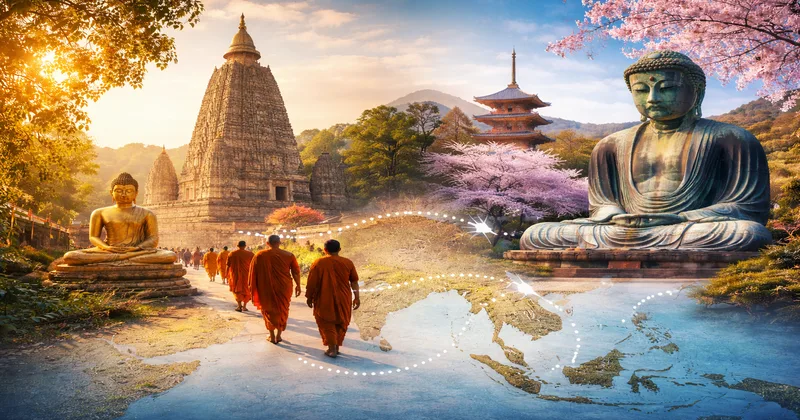
As one travels through the cities and bylanes of Japan, Taiwan, or China, the signs of Buddhist heritage, sprinkled across in various forms, are difficult to miss. It is easy to spot small shrines tucked away in quiet lanes where devotees can be spotted praying intently with closed eyes and folded palms. Buddhist values are not just part of cityscapes but are effortlessly embedded in modern Asian lifestyles. Japan’s Shyojin Ryori, a tradition of Buddhist monks that emphasises mindful eating with recipes devoid of meat, fish, and even garlic, is seeing a significant surge in popularity; while in Taiwan, busy office-goers try to skip meat and go vegetarian for at least one meal a day. From there, as we move towards the South West, one ends up landing in Thailand, a country which wears its Buddhist heritage with pride as no other does. Ayutthaya, the historic town of SukoThai and Si Thep are Thailand’s world-renowned, UNESCO-recognised heritage Buddhist sites which draw tourists and devotees from across the globe. While neighbouring Cambodia offers monk-led tours and spiritual retreats by leveraging its heritage to boost tourism. Wherever Buddhism has travelled, it has immersed itself in local culture and assumed a new, unique form; however, more often than not, we forget that this seed was originally planted in the bhoomi of Bharat. A tree of knowledge that was sowed in Bharat’s very own Bodh Gaya has spread its roots across a huge landscape, transcending oceans, rivers and mountains. In that regard, Buddhism remains Bharat’s greatest import till date in terms of sheer scale, impact and magnitude.
Centuries ago, as Shakyamuni’s philosophy strengthened in Bharat, dedicated monks and disciples travelled far and wide to preach his teachings. Buddhism found a place in faraway lands and ignited a thirst for knowledge wherever it went. Fascinated by these groundbreaking ideas, many Chinese took the arduous journey to Bharat, crossing mountains and rivers alike with the sole aim of understanding this philosophy. From these, Xuanzang was a prominent figure who went on to become a leading Indophile of ancient China. On his way back, he carried copies of Buddhist texts and took up the task of translating this mammoth body of work into Chinese. At the same time, China was witnessing an epochal event: an imperial concubine named Wu Zetian was on her way to becoming the country’s first female ruler. On this path, she found an unlikely ally in the form of Buddhism, which upheld her legitimacy and supported her claim to the throne. She gave generous donations to monasteries, commissioned cave excavations and encouraged the spread of Buddhism to the common Chinese. Owing to the unwavering support she extended, monks came to her aid and hailed her as the supreme ruler of China. Thus, a deeply rooted Bharatiya philosophy was instrumental in China getting its only female sovereign to date.
While Buddhism came to China’s aid centuries ago, Japan used it as a potent tool to shape its post-war image. Zen Buddhism of Japan is a distinct school originating from the Mahayana tradition. For much of the nineteenth century, it remained a small practice in the country, but the situation changed quickly during the Meiji Restoration Era as Japan rapidly industrialised itself and opened up to foreign trade and investment. It was during this time that a few influential figures, like Daisetz Teitaro Suzuki, introduced Zen to the Western world. In the early 20th century, Japanese intellectuals started describing Zen as the essence of Japanese culture or the unique form of Japanese spirituality. It was packaged as one of the core reasons behind Japanese health and longevity. Zen philosophy played its fair share of role in giving a makeover to Japan’s image post World War. Japan, which was once labelled as a war-mongering country by the West, started being perceived as a beacon of peace and tranquillity, and Buddhism had a role to play in this change of perception.
At the bottom of the fact that Buddhism was used as a positive tool to achieve different objectives by other nations lies an undeniable truth that Bharat was the land where this idea was born. Over the past few years, realising the importance of this civilisational heritage, Bharat has been wisely utilising its very own Buddhism in modern-day diplomacy. The Act East Policy, launched in 2014 by Prime Minister Narendra Modi, nudged us to turn our gaze eastwards. As a part of the Swadesh Darshan Scheme, the Buddhist circuit connecting the sites of Bodh Gaya, Sarnath and Kushinagar was incorporated, and the recent restoration of the 5th-century Nalanda University was a significant move made in the direction of honouring our Buddhist heritage.
Buddhism does not demand conversion or baptism. One can very well incorporate Shakyamuni’s teaching into their preexisting lives. A lot of people, even from Western countries, are displaying keen interest in learning about this philosophy, which is transforming the way the world looks at Buddhism. The past decade has seen an increased focus on this aspect, and there is still more potential waiting to be utilised in soft power diplomacy, modern-day narrative building and warfare of optics. In this land, there is no dearth of sites of religious significance, the Pali language finds enthusiastic learners across universities, and Vipassana meditation centres are thriving in different nooks and corners of the country. History took the religious practice of Buddhism away from Bharat’s shores and spread it to known and unknown lands. However, Bharat has a right to it just as a mother has to her child. It cannot be questioned, altered or denied. The full potential of Buddhism is waiting to be utilised and aid Bharat towards the journey of Amrit Kaal vision 2047.