For decades, India’s Northeast was often viewed through the lens of distance, difficult terrain and limited connectivity. Despite its strategic location, rich natural resources and vibrant cultural heritage, the region remained disconnected from mainstream economic activity due to inadequate infrastructure and geographical barriers.
That picture is changing rapidly.
Over the past twelve years, the Northeast has witnessed one of the most significant development transformations seen in any part of India. Roads now reach previously inaccessible villages, railway lines are pushing deeper into mountainous terrain, airports are connecting remote towns with major cities, and digital infrastructure is bringing government services and economic opportunities to millions. At the same time, improvements in housing, healthcare, drinking water, sanitation and education have begun changing everyday life across the region.
Today, the Northeast is increasingly being seen not as India’s frontier but as its gateway to Southeast Asia and a crucial pillar of the country’s long-term growth strategy.
Why Northeast is called Ashtalakshmi
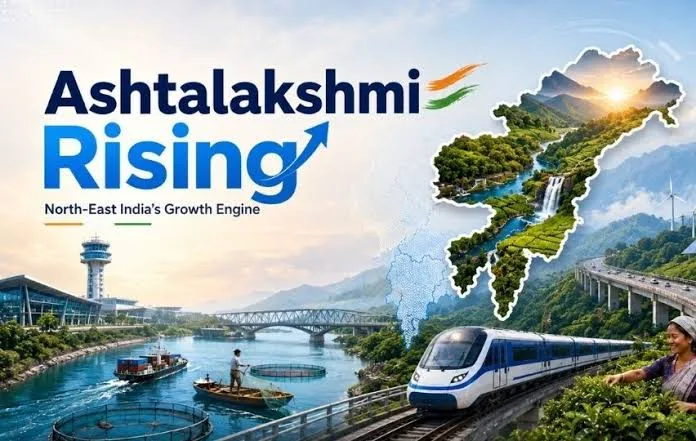
The eight Northeastern states: Assam, Arunachal Pradesh, Manipur, Meghalaya, Mizoram, Nagaland, Tripura and Sikkim, are collectively referred to as “Ashtalakshmi.”
The name draws inspiration from the eight forms of Goddess Lakshmi, each symbolising a different aspect of prosperity, abundance and well-being. In much the same way, each Northeastern state contributes its own unique strengths to India’s development story.
The region possesses extraordinary biodiversity, vast water resources, immense hydropower potential, rich agricultural wealth and a strategic location bordering Bangladesh, Bhutan, Myanmar and China. These advantages make the Northeast one of India’s most important regions for future economic expansion and regional integration.
A major shift in policy thinking began after 2014 when the Northeast was placed at the centre of national development planning.
The focus moved beyond traditional welfare measures to building long-term infrastructure, improving connectivity and integrating the region with national and international markets.
Government officials increasingly began describing the Northeast as a growth engine rather than a geographically isolated region. This vision was supported by sustained investments in roads, railways, airports, waterways, energy projects and social infrastructure.
The goal was not merely to improve connectivity but to create economic opportunities, attract investment and improve quality of life.
Policy architecture behind transformation
The transformation of the Northeast has been driven by a dedicated policy framework involving multiple ministries and specialised schemes.
The Ministry of Development of North Eastern Region (MDoNER) has played a central role in coordinating and financing projects across the eight states.
According to government data, 3,746 projects have been sanctioned under various programmes for the region. Of these, 2,730 projects have already been completed with an approved cost exceeding Rs 27,900 crore.
These projects cover sectors ranging from roads and bridges to healthcare, education, water supply and livelihood generation.
PM-DevINE: Targeted development for gaps
Among the most important recent initiatives is the Prime Minister’s Development Initiative for North East Region (PM-DevINE).
Launched as a 100 per cent centrally funded scheme, PM-DevINE was designed to address developmental gaps and support high-impact projects in areas where conventional funding mechanisms often fall short.
With an allocation of Rs 6,600 crore for the period between 2022-23 and 2025-26, the programme focuses on infrastructure, social development and livelihood generation.
Several projects are currently under implementation, while some have already been completed, including centres of excellence and passenger ropeway systems that improve connectivity in difficult terrain.
Building roads to connect remote communities
One of the biggest challenges facing the Northeast has historically been physical connectivity.
Mountainous terrain, dense forests and major river systems made transportation difficult and expensive. As a result, many communities remained cut off from economic opportunities and public services.
To address this, the government launched the North East Special Infrastructure Development Scheme (NESIDS), which finances roads, bridges and other critical infrastructure.
Under the roads component of NESIDS, dozens of projects have already been completed while many more remain under construction. The focus has been on connecting remote regions, improving market access and strengthening strategically important routes.
Infrastructure development in the Northeast is not limited to transportation.
The Other Than Roads Infrastructure component of NESIDS supports projects in healthcare, education, drinking water supply, electricity and social infrastructure.
More than a thousand projects have already been completed across these sectors.
These investments have improved access to basic services and helped narrow development gaps between the Northeast and the rest of the country.
The North Eastern Council’s role
Another important institution driving development is the North Eastern Council (NEC).
The NEC functions as the region’s nodal planning and development body and works closely with state governments to identify projects of regional significance.
Its interventions cover sectors ranging from irrigation and flood control to higher education, healthcare, tourism and livelihood generation.
The council has also supported initiatives in bamboo cultivation, piggery development and entrepreneurship, reflecting the region’s unique economic profile.
Recognising the need for targeted interventions in specific states, the government has also introduced Special Development Packages for Assam and Tripura.
These packages focus on infrastructure creation, employment generation, skill development and tourism promotion.
Officials say the programmes are designed not only to improve economic conditions but also to strengthen social inclusion and bring marginalised communities into the development mainstream.
Act East policy changed Northeast’s strategic importance
While infrastructure development has transformed internal connectivity, another major factor behind the Northeast’s rise has been India’s Act East Policy.
Introduced in 2014, the policy seeks to strengthen India’s engagement with Southeast Asia through economic cooperation, trade, connectivity and cultural exchanges.
The Northeast sits at the heart of this strategy.
Instead of being viewed as India’s farthest region, the Northeast is increasingly seen as the country’s bridge to ASEAN nations and wider Asian markets.
This shift has significantly elevated the region’s strategic importance.
India-Myanmar-Thailand highway
One of the flagship projects under the Act East framework is the India-Myanmar-Thailand Trilateral Highway.
The ambitious corridor aims to connect Moreh in Manipur with Mae Sot in Thailand through Myanmar.
When fully operational, the route is expected to facilitate trade, tourism and movement of people between India and Southeast Asia.
For businesses in the Northeast, the highway could provide access to entirely new markets and investment opportunities.
Another major initiative is the Kaladan Multi-Modal Transit Transport Project.
The project links India’s Northeast to Myanmar through a combination of sea, river and road transport networks.
Once completed, it will provide an alternative route for transporting goods and reduce dependence on the narrow Siliguri Corridor that currently connects the Northeast with mainland India.
The project is expected to benefit states such as Tripura by lowering logistics costs and improving access to international markets.
Border trade and economic integration
The Act East Policy has also accelerated efforts to improve border trade infrastructure.
Integrated Check Posts, border haats and customs facilities are being developed to facilitate smoother movement of goods and people.
Border haats in Meghalaya and Tripura have become important centres of local economic activity, helping communities on both sides of international borders engage in legal trade while strengthening cultural ties.
Officials believe such initiatives can generate livelihoods, reduce informal trade and promote regional economic integration.
Perhaps the most significant change in the Northeast’s development story is the shift in perception.
For decades, the region was viewed as geographically distant and economically disconnected.
Today, it is increasingly being positioned as India’s eastern gateway.
The combination of targeted policy support, infrastructure investments and international connectivity projects has begun creating a new economic geography where the Northeast serves as a link between India and Southeast Asia.
The transformation is still underway, but the foundations have clearly been laid.
In the next part, we examine how roads, railways, airports, bridges, tunnels and digital infrastructure are physically reshaping the Northeast and bringing millions closer to economic opportunity.
Railways reach the last frontier
For decades, railway connectivity remained one of the biggest challenges in the Northeast. Difficult terrain, dense forests, mountains and frequent landslides made railway expansion expensive and technically complex.
That situation has changed dramatically in recent years.
The government has invested heavily in expanding broad-gauge rail connectivity across the region. Several state capitals that once had no rail links are now connected to the national railway network, while major projects are underway to connect the remaining capitals.
Railway expansion has significantly reduced travel time, improved freight movement and strengthened economic integration with the rest of India. For local businesses, farmers and traders, better rail connectivity means lower transportation costs and improved access to larger markets.
The railway network is also expected to play a crucial role in supporting tourism, one of the Northeast’s fastest-growing sectors.
Bogibeel Bridge: A symbol of new connectivity
Among the most significant infrastructure achievements in the Northeast is the Bogibeel Bridge in Assam.
Stretching across the Brahmaputra River, the bridge is India’s longest rail-cum-road bridge and has dramatically improved connectivity between Assam and Arunachal Pradesh.
Before its construction, crossing the Brahmaputra often involved long detours and significant travel delays. Today, the bridge has reduced travel time substantially while improving movement of people, goods and security forces.
For residents of Upper Assam and Arunachal Pradesh, Bogibeel has become more than just a bridge. It represents a new era of connectivity and economic opportunity.
Roads transform everyday life
Road construction has been one of the most visible signs of change across the Northeast.
Under programmes such as Bharatmala, NESIDS and various state and central schemes, thousands of kilometres of roads have been upgraded or newly constructed.
Many villages that once remained cut off during monsoon seasons now enjoy all-weather road access.
Improved roads have had a direct impact on people’s lives. Farmers can transport produce more easily. Students can travel to schools and colleges with less difficulty. Patients can reach healthcare facilities faster. Businesses can move goods at lower costs.
The result is a steady integration of remote communities into larger economic and social networks.
Engineering marvels in difficult terrain
The Northeast’s geography presents unique engineering challenges.
Steep slopes, seismic activity, heavy rainfall and dense forests require specialised construction techniques.
Despite these obstacles, several major tunnels, bridges and mountain roads have been completed or are under construction.
These projects are helping overcome natural barriers that limited connectivity for generations.
In many places, travel times that once stretched to an entire day have been reduced to just a few hours.
The impact extends beyond convenience. Better transportation improves emergency response, supports tourism and encourages investment in previously inaccessible areas.
Air connectivity has emerged as another key pillar of the Northeast’s transformation.
A decade ago, many airports in the region handled limited traffic and offered few direct connections to major Indian cities.
Today, airports across Assam, Arunachal Pradesh, Meghalaya, Manipur, Mizoram, Nagaland, Tripura and Sikkim have witnessed significant upgrades.
The UDAN scheme has played an important role in improving regional air connectivity by making air travel more affordable and expanding routes to underserved areas.
New airports and expanded terminals have increased passenger capacity, reduced travel times and boosted tourism.
For entrepreneurs and investors, improved air links make the region far more accessible than before.
Digital connectivity reaches remote areas
Infrastructure today is not only about roads and railways.
Digital connectivity has become equally important.
Over the last decade, internet access and telecommunications infrastructure have expanded rapidly across the Northeast.
Mobile towers have reached remote villages, broadband networks have expanded and digital services have become increasingly accessible.
Government programmes have helped connect schools, healthcare centres and public institutions to digital platforms.
Citizens can now access government services online, make digital payments and participate more actively in the digital economy.
For young people, digital connectivity has opened access to education, entrepreneurship opportunities and global markets.
Improving access to healthcare
Healthcare infrastructure in the Northeast has also received significant attention.
Many districts that once struggled with limited medical facilities have witnessed the establishment of new hospitals, medical colleges and health centres.
Ayushman Bharat has expanded access to healthcare by providing financial protection for millions of families.
Health and Wellness Centres have improved primary healthcare delivery, particularly in rural and remote areas.
Improved road and air connectivity have further strengthened emergency healthcare services by reducing travel times to major medical facilities.
The COVID-19 pandemic highlighted the importance of healthcare infrastructure, and subsequent investments have sought to address gaps exposed during the crisis.
Education gains momentum
Education has emerged as another major area of focus.
New schools, colleges, universities and skill development institutions have expanded educational opportunities across the region.
Scholarship programmes and targeted educational initiatives have helped increase access to higher education.
The region is also witnessing growth in vocational training and skill development programmes aimed at preparing young people for employment in emerging sectors.
Improved educational infrastructure is helping create a more skilled workforce capable of supporting future economic growth.
Access to clean drinking water and sanitation has improved significantly across the Northeast.
Government schemes have expanded household tap water connections, improved sanitation facilities and strengthened rural infrastructure.
Many villages that previously depended on distant water sources now have access to piped drinking water.
Improved sanitation has contributed to better public health outcomes and enhanced quality of life, particularly for women and children.
These improvements may not attract the same attention as major highways or bridges, but they have had a profound impact on everyday life.
Housing programmes have transformed living conditions for thousands of families.
Under various central and state schemes, large numbers of houses have been constructed or upgraded.
Improved housing not only provides shelter but also enhances safety, health and overall living standards.
Rural development programmes have simultaneously improved roads, water supply, sanitation and community infrastructure.
Together, these initiatives have helped reduce regional disparities and improve living conditions across the Northeast.
Harnessing hydropower potential
The Northeast possesses enormous hydropower resources thanks to its river systems and mountainous terrain.
Several major hydropower projects are being developed to harness this potential.
These projects are expected to strengthen India’s energy security while creating employment opportunities and generating revenue for the region.
At the same time, policymakers face the challenge of balancing development with environmental protection.
Sustainable utilisation of natural resources remains a key consideration in the region’s growth strategy.
Agriculture remains the backbone
Despite rapid infrastructure development, agriculture continues to support a large share of the Northeast’s population.
The region’s fertile land and favourable climate allow cultivation of a wide variety of crops.
Government initiatives have focused on improving productivity, supporting farmers and expanding market access.
Organic farming has emerged as a major opportunity, with several Northeastern states promoting chemical-free agricultural practices.
Growing demand for organic products has created new income opportunities for farmers.
Alongside agriculture, fisheries, dairy and livestock sectors have received increased policy attention.
Programmes aimed at improving productivity, infrastructure and market access have helped generate additional livelihoods.
Piggery, poultry and fish farming are particularly important in many parts of the Northeast and contribute significantly to rural incomes.
These sectors are increasingly being viewed as engines of local economic growth.
GI tags and local products gain recognition
The Northeast is home to a remarkable range of unique products, many of which have received Geographical Indication (GI) tags.
These include agricultural products, handicrafts, textiles and traditional goods that reflect the region’s cultural diversity.
GI recognition helps protect local products, increase market value and create economic opportunities for producers.
From Assam’s tea to specialised varieties of spices, fruits and handloom products, the region is increasingly gaining recognition in national and international markets.
The Northeast’s natural beauty, cultural richness and biodiversity make it one of India’s most attractive tourism destinations.
Improved connectivity has led to a steady increase in tourist arrivals.
States such as Meghalaya, Sikkim, Arunachal Pradesh and Assam are witnessing growing interest from domestic and international travellers.
Adventure tourism, eco-tourism, cultural tourism and wildlife tourism are creating new economic opportunities for local communities.
Tourism is increasingly viewed as a sector capable of generating employment while preserving cultural and environmental heritage.
Peace and stability support growth
Development in the Northeast has also been supported by improvements in the security situation.
Several peace agreements with insurgent groups and sustained efforts to address longstanding conflicts have contributed to greater stability.
Reduced violence has encouraged investment, improved mobility and strengthened confidence among businesses and communities.
Peace and development have increasingly reinforced each other, creating a more favourable environment for long-term growth.
The Northeast’s transformation is far from complete.
Challenges remain, including difficult geography, environmental concerns, climate vulnerability and the need for greater private investment.
Yet the scale of change over the last decade is undeniable.
The region that was once viewed primarily through the lens of remoteness is now increasingly seen as a strategic growth corridor linking India with Southeast Asia.
Massive investments in infrastructure, connectivity, healthcare, education and livelihoods have laid the foundation for future progress.
As India pursues its vision of becoming a developed nation, the Northeast’s role is likely to become even more important.
The story of Ashtalakshmi is therefore not just about regional development. It is about redefining the Northeast’s place in India’s future, from a distant frontier to a central pillar of national growth, connectivity and prosperity.