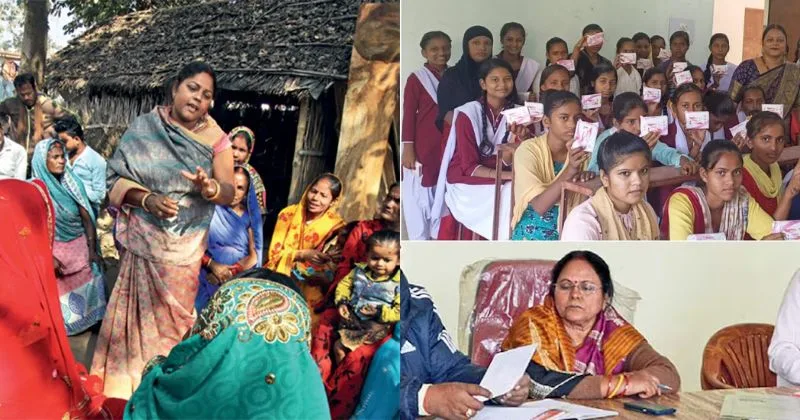
The biggest taboo in the rural areas is talking about menstrual hygiene. The number of sanitary pad production units operated by women’s self-help groups is increasing to improve menstrual health.
In districts like Bhojpur, small manufacturing units now produce affordable sanitary pads for local communities. This initiative was led by village mukhiya Sushumlata Kushwaha, who learned during a meeting that many women were still using cloth during their menstrual cycle instead of sanitary pads when one of her colleagues was looking for cloth. She took this matter seriously and sought support from the then District Magistrate, Roshan Kushwaha, to inquire about establishing a unit to produce affordable sanitary pads locally. These local units produce 4,000-4,500 pads a day and sell at Rs 23 per packet of six.
Today, she is proudly known as ‘Pad wali Mukhiya’.
How Biogas Plants Help in Clean Energy and Waste Management?
According to the Ministry of New and Renewable Energy, India has the potential for over 12 million household biogas plants, yet adoption in rural areas has historically been slow. Meanwhile, in Samastipur district, another Mukhiya, Prema Devi, has focused on climate resilience and environmental sustainability.
If we look at today’s scenario, these biogas plants are the best substitute for the LPG shortage in India. Three villages in the panchayat and more than 200 families who are involved in animal husbandry benefit from biogas plants. Her initiative to create a model Gramin Haat (rural market) in her panchayat, benefiting 380 families. Due to her effort, Motipur was awarded the Nanakji Deshmukh National Gramin Gaurav Award among many others.
Water Conservation: A Priority for Women Leaders
Not only with biogas, but also through Prema Devi’s water conservation efforts and the creation of an “amrit sarovar” (a water conservation pond), the village’s infrastructure is improving. This initiative helped restore village ponds, rainwater harvesting systems, and irrigation channels. These interventions are crucial in a state like Bihar, where agriculture employs over 60% of the rural workforce.
Rural Markets and Livelihoods
Women mukhiyas are also playing a role in strengthening local rural economies. In Samastipur, another mukhiya, Baby Devi, has worked to ensure women’s voices are heard in local governance. Through regular mahila sabhas (women’s assemblies), she encourages women to discuss issues ranging from education to domestic violence, and to voice their opinions on policy matters. Several panchayats have created or revived weekly village markets, enabling farmers and artisans to sell goods directly within their communities.
The Policy That Reshaped Bihar Governance
The amendment required at least 33 per cent reservation for women in local bodies. However, Bihar went further in 2006 by increasing the quota to 50%, the highest among Indian states at the time. The large-scale participation of women in governance has fundamentally changed the agenda of rural governance. Where earlier panchayat meetings often focused primarily on roads and construction projects, women leaders increasingly prioritise health, sanitation, drinking water, and education.
Bihar becomes the example for the rest of the nation of how women-led governance is the future of grassroots development and leads to compassionate, responsive governance capable of driving long-term social transformation.