For millennia, Bharat has considered the banyan as the Vata Vriksha, the imperishable tree, the Akshaya Vata beneath whose sages meditated, village councils convened and generations quietly measured the passage of time. That reverence has now met its scientific approval. A banyan tree (Ficus benghalensis) standing in Munger, Bihar, has been established as the oldest accurately dated banyan tree in the world, an estimated 700 years old through high-precision radiocarbon dating that rests solely on scientific evidence rather than folklore or written record.
The tree stands on the campus of the Indian Tobacco Company in Munger, land long associated in local memory with gatherings of rulers and commoners alike. For generations, its age was fixed only by story and inference, the loosest of yardsticks. That changed when Dr. Trina Bose of the Birbal Sahni Institute of Palaeosciences, Lucknow, an autonomous institute under the Department of Science and Technology, was invited by the Bihar Forest Department to determine the tree’s true age. Recognising at once that the usual methods would fail on a tropical broadleaf giant, she set out to build a fresh scientific protocol, leading a team that included Dr. Mayank Shekhar and Dr. Akhilesh K. Yadava.
Why the banyan challanged the calendar
In temperate forests, a tree’s years can be counted in the concentric rings laid down each season, the discipline of dendrochronology. But most tropical broadleaf trees, the banyan among them grow without forming distinct annual rings. Field sampling and laboratory analysis confirmed the obstacle with no clear yearly signature in the wood, conventional ring-counting simply had nothing to count. These living monuments of the past had never been scientifically dated, but for want of a reliable protocol suited to their nature. An alternative of far greater precision was required and radiocarbon dating offered it.
The alpha-cellulose breakthrough and rewriting the history
The team’s solution was to go to the very heart of the wood. From samples drawn near the pith of a secondary trunk and of an ancient primary branch, they extracted alpha-cellulose, the most stable primary component of the plant cell wall. The choice of the pith was deliberate and elegant, for the pith holds the earliest wood formed during the juvenile stage of secondary growth, the closest the tree keeps to a record of its own beginning.
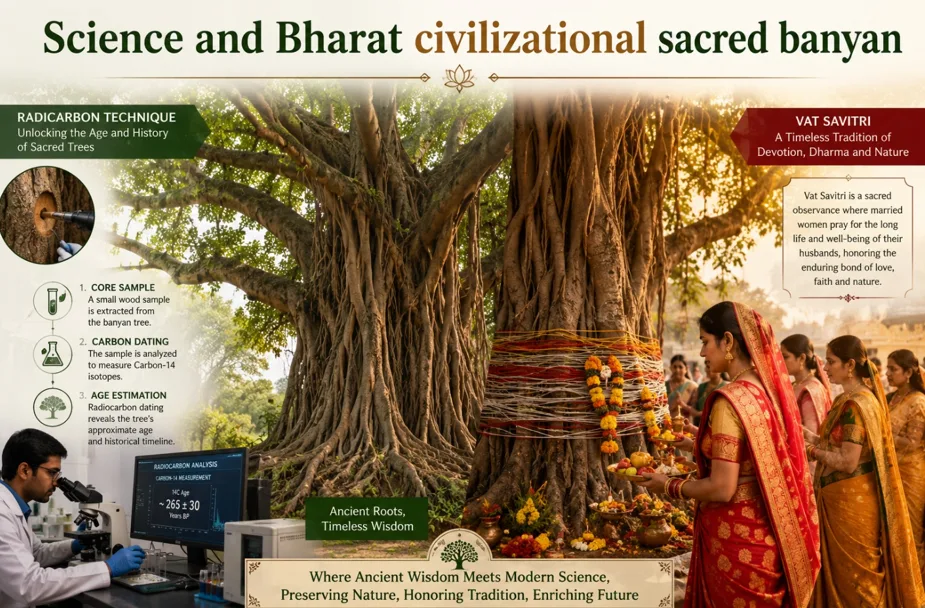
These cellulose samples were then subjected to high-precision radiocarbon dating using Accelerator Mass Spectrometry, or AMS, a technique that measures the slow, steady decay of the carbon-14 isotope to reveal the moment when a given piece of wood ceased to exchange carbon with the atmosphere. The raw results were calibrated against the latest IntCal20 calibration curve with OxCal software, converting laboratory measurements into a robust calendar age. The pith of the exposed secondary trunk returned an age of 276 plus or minus 36 years before present, while the ancient primary branch yielded 652 plus or minus 37 years before present, anchoring the living tree firmly across roughly seven centuries.
The finding does more than assign a number. It quietly overturns a long-held local assumption. Tradition held that the Munger banyan had been planted before the historic Burra Bunglow, a structure whose architectural style places it in the late Mughal to early British period, some 300 to 350 years old, as a venue for dialogue between rulers and citizens, for village assemblies, religious ceremonies and cultural exchange. The radiocarbon evidence reverses that sequence entirely.
At roughly 700 years, the tree is nearly twice as old as the building it was said to accompany. Far from being planted as an ornament to the bungalow, it is now understood as a surviving remnant of a natural forest that once clothed the region, a sentinel that had already stood on that ground for centuries and witnessed the very construction of the building that would later be credited with its planting.
That reordering carries a lesson familiar to anyone who has walked Bharat’s sacred groves. The civilisation’s instinct to protect its trees, to weave them into vrata and festival and daily worship, has again proved to be an instinct grounded in something real. The Vata Vriksha’s association with longevity and immortality, celebrated each year by women who circle it during Vat Savitri in prayer for long life. In Munger it is measurable fact that a single organism that has outlasted dynasties, administrations and empires lives yet.
From folklore to a repeatable protocol
The wider significance of the work, published online in April 2026 in the peer-reviewed international journal Quaternary Research and carried out by Dr. Bose with Dr. Shekhar, Dr. Yadava and colleagues Avanish Mishra, Arya Pandey and Anurag Kumar, lies in what it makes possible next. For the first time, there is a tested, repeatable scientific method for accurately dating heritage trees of the tropics, a class of living monuments that had until now slipped through the gaps of conventional science. Governments, forest departments and conservation agencies are handed a tool to identify, and therefore to protect, the trees that carry the greatest cultural and ecological weight. Uncertain estimates drawn from lore are replaced by evidence that can be checked, defended and built upon.
The method is not confined to Munger or even to the banyan. It can be extended to other ancient tropical trees across the world, opening avenues in biodiversity conservation, heritage management, environmental education, and the study of past climates and historical landscapes. Each accurately dated tree becomes a fixed point, a natural archive against which the region’s ecological and human story can be read with new confidence.
A convergence of knowledge systems
There is a deeper harmony in this achievement, one that speaks to Bharat’s enduring way of seeing the world. The ancient tradition never doubted the sanctity or the antiquity of the Vata Vriksha; it simply expressed that knowledge in the language of reverence, ritual and remembrance. Modern palaeoscience, working from cellulose and carbon isotopes, has now arrived at the same destination by a different road, confirming in the calibrated certainty of the laboratory what the sages held in the certainty of faith. The two are not rivals but companions, each enriching the other.
The Munger banyan now stands as both the oldest accurately dated banyan on Earth and a bridge between these systems of knowing. It is a reminder that the heritage of a nation is not stored only in stone and manuscript, but also in the living, breathing sentinels that have kept watch over the land for seven unbroken centuries. In dating this one tree with such care, Indian scientists have not only advanced a global method, they have honoured a civilisational conviction that the natural and the sacred, the measured and the revered, have always belonged together. Rooted on ground where the Indian Tobacco Company campus rose in 1901 and standing centuries before it, the tree that Bharat called imperishable has, at last, been shown to be very nearly so and the knowing of it now belongs to science and tradition alike.