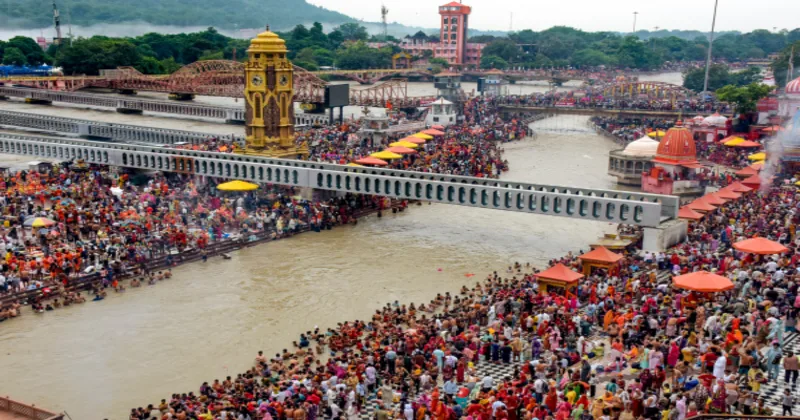
The road journeys during the month of Shravana (Sawan) is unlike any other. The highways, usually defined by speed and commerce, transform into rivers of faith. As my vehicle moved steadily towards the capital, another journey unfolded alongside—one that no map could truly capture. Thousands upon thousands of devotees, clad in saffron, carrying beautifully adorned Kanwars upon their shoulders, filled the roads with an extraordinary spiritual energy. Their destination was not merely a temple; it was an act of devotion itself.
Some walked barefoot despite the scorching roads. Some moved silently in meditation. Others sang resounding chants of “Har Har Mahadev” and “Bol Bam,” their voices echoing across fields and towns. I saw elderly devotees walking with remarkable determination, children accompanying their parents, groups of young people carrying the sacred water together, motorcycles decorated with saffron flags, cars bearing the trident of Bhagwan Shiva, and countless pilgrims undertaking Dandavat Parikrama, prostrating themselves repeatedly across miles as an offering of surrender. It was impossible to remain a mere spectator. The sheer magnitude of devotion compelled reflection.
One often speaks of India’s diversity, but during the Kanwar Yatra one witnesses something even more profound—India’s unity through faith. Languages differ, customs differ, regions differ, yet the chant remains one: Har Har Mahadev.
The origins of the Kanwar Yatra are deeply rooted in Hindu tradition and sacred literature. One of the most enduring stories emerges from the Samudra Manthana, described in the Bhagavata Purana, Vishnu Purana and other Puranic texts. During the churning of the cosmic ocean, the deadly poison Halahala emerged, threatening all existence. To protect creation, Bhagwan Shiva consumed the poison, holding it in his throat, which turned blue, earning Him the name Neelkantha. The gods are believed to have offered sacred waters from the Ganga to cool Shiva’s burning throat. This symbolic act of offering holy water continues today as millions of devotees carry Gangajal to Shiva temples across India.
Another tradition associates the yatra with Ravana, the devoted king of Lanka. According to the Shiva Purana and regional traditions, Ravana carried sacred waters to perform abhisheka of Bhagwan Shiva while undertaking severe penance to obtain divine blessings. Over centuries, this practice evolved into one of the largest annual pilgrimages in the world.
The sanctity of the month of Shravana finds repeated mention in the Shiva Purana, where it is described as especially dear to Lord Shiva. The Skanda Purana similarly extols the merit of worshipping Shiva during this sacred period, while the Linga Purana emphasises that sincere abhisheka with pure water symbolises purification of the mind and surrender of the ego. The profound Vedic invocation—
“नमः शिवाय च शिवतराय च” from Yajurveda, Shri Rudram, captures the timeless reverence accorded to Shiva, the auspicious one who embodies both destruction and renewal.
Historically, organised Kanwar pilgrimages are documented over several centuries across North India. Medieval travel accounts and regional chronicles refer to pilgrims carrying Gangajal from sacred ghats such as Haridwar, Gaumukh, Gangotri, and Sultanganj to ancient Shiva shrines. The pilgrimage expanded significantly during the nineteenth and twentieth centuries with improved roads and broader public participation. Today, it is regarded as one of the largest recurring religious movements anywhere in the world, drawing millions of devotees every year.
Yet, the Kanwar Yatra is not merely about carrying water. It is about carrying values. The Kanwar itself becomes a metaphor for life’s responsibilities—balanced equally on both shoulders, reminding us of duty, discipline, humility and perseverance. Every step is an exercise in self-restraint. Every kilometre becomes an offering. Every chant dissolves the boundaries between the individual and the collective.
In an era frequently characterised by digital distractions and material pursuits, the Kanwar Yatra quietly reaffirms that spirituality remains deeply woven into India’s civilisational fabric. The pilgrimage mobilises communities, volunteers, local administrations, healthcare workers and ordinary citizens who offer food, shelter and medical assistance to complete strangers. It exemplifies seva as much as shraddha. Faith here is not an isolated personal experience; it becomes a shared social responsibility.
The months of August and September occupy a special place in India’s cultural calendar. Beginning with the sacred observances of Shravana, the country moves through Nag Panchami, Raksha Bandhan, Krishna Janmashtami, Ganesh Chaturthi, Onam and numerous regional festivals. Together they create a remarkable tapestry of celebration where spirituality, community life and cultural identity converge. These festivals do not merely commemorate mythology; they sustain living traditions that continue to shape Indian society.
As I continued my journey towards Delhi, the images remained etched in my mind. The endless stream of saffron stretching beyond the horizon, the fluttering tricolour beside the saffron flag, the rhythmic chants, the disciplined resolve, and the quiet dignity of millions walking for no worldly reward reminded me that India’s greatest strength has never been measured only in its economy or its institutions. It resides equally in the invisible bonds of shared belief, inherited traditions and collective memory.
The Kanwar Yatra is, therefore, far more than a pilgrimage. It is a moving expression of India’s civilisational continuity. It demonstrates that in this ancient land, highways can become sacred paths, ordinary people can become pilgrims and faith can transform movement into meaning. As long as millions continue to walk these roads with unwavering devotion to Lord Shiva, India’s cultural soul will remain vibrant, resilient and profoundly alive.