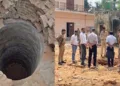
Located in the Dhar district of Madhya Pradesh, Bhojshala stands as a living symbol of the ongoing struggle involving India’s ‘Sanatan’ cultural memory, faith, and history. The recent hearing of this case before the Indore Bench of the Madhya Pradesh High Court has once again thrust this site into the centre of national discourse. The decision by the bench- comprising Justice Vijay Kumar Shukla and Justice Alok Awasthy- to conduct a personal site inspection prior to the next hearing signals that the judiciary, too, now seeks to directly comprehend the historical and factual depth of this matter.
Indeed, this case is not merely confined to the quest for worship rights; it represents a continuous struggle to reclaim a historical identity- one that has persisted in preserving its core consciousness despite centuries of vicissitudes, invasions, and transformations. The scientific survey conducted over 98 days by the ASI (Archaeological Survey of India), along with its detailed 2,189-page report, has provided a concrete foundation for this debate. According to this report, the current structure of Bhojshala was originally a Vagdevi (Saraswati) temple dating back to the 10th-11th-century Parmara era, and was also a renowned centre of learning.
Historians and ancient texts alike refer to the Bhojshala as a centre of learning. In the ‘Prabandha Chintamani’ (authored by Merutunga; Chapter 5), Dhar is described as a hub of knowledge and culture- a place where the worship of Goddess Saraswati held profound significance for centuries. Similarly, the ‘Samarangana Sutradhara’ (authored by King Bhoja; p. 112) contains references to the construction of temple architecture and educational institutions; a study of these references unequivocally validates the historical authenticity of institutions such as the Bhojshala.
The basalt stone foundations bearing the inscription “Sharada Sadan”- as documented in the Archaeological Survey of India (ASI) report- serve as direct evidence that this site was established as a place of worship dedicated to Maan Saraswati, also revered as ‘Vagdevi’. Both “Sharada” and “Vagdevi” are synonymous terms within the Sanskrit tradition for Adhishthatri Devi Saraswati, the presiding deity of knowledge and eloquence.
Furthermore, the inscriptions of the play ‘Parijat Manjari’- also documented in the report- corroborate the site’s status as a vibrant centre of education and culture. The prologue of ‘Parijat Manjari’ (authored by Madan; p. 34) explicitly states that the play was first staged within the precincts of the Saraswati Temple. This historical fact conclusively establishes the Bhojshala as a centre for both dramatic arts and scholarly learning.
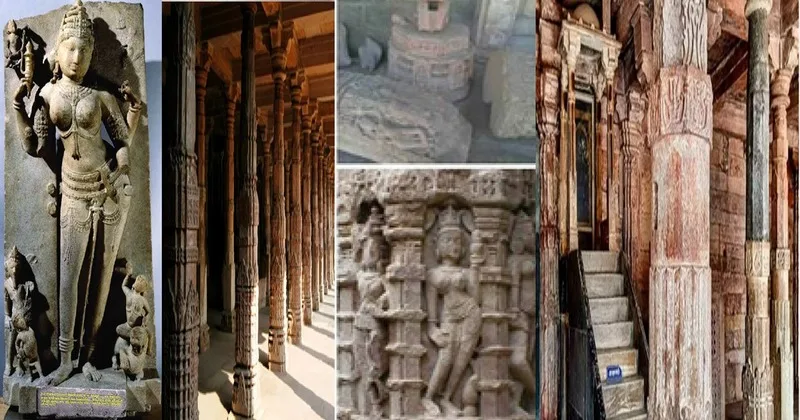
From an architectural perspective, an analysis of the Bhojshala is equally significant. Comprising 106 pillars and 82 half-pillars, this structure embodies the quintessential style of temple architecture. The decorative motifs carved into the pillars- including ‘Kirtimukhas’, ‘Nagabandhas’, ‘Chaitya-gavakshas’, and lotus patterns- are integral elements of traditional Bharatiya temple architecture. In ‘Indian Architecture’ (authored by Percy Brown; p. 198), these very symbols are explicitly identified as defining characteristics of Hindu temples.
In contrast, mosque architecture typically lacks this type of sculptural ornamentation and symbolism. The ASI report further notes that attempts were made to efface- by abrasion- or to invert Sanskrit inscriptions carved on numerous pillars, actions indicative of an intent to conceal the site’s original identity.
The sheer proportion of inscriptions also corroborates this fact; the discovery of merely 56 Arabic-Persian inscriptions, set against a backdrop of over 150 Sanskrit-Prakrit inscriptions, strongly suggests that the original structure served as a Sanatan Hindu religious and educational centre. The ‘Dhar District Gazetteer’ (page 72) also describes the Bhojshala as a Temple of Maan Saraswati and a centre of learning.
Within the annals of history, an inscription dated 1455 CE stands out as particularly noteworthy; it records the “demolition of an old ‘ashram’ and its conversion into a place of ‘Namaz’ (prayer)” during the reign of Mahmud Khilji, the ruler of the Malwa Sultanate. This account is documented in Section 4, Page 260 of the ASI report and is regarded as direct evidence of the transformation process.
Thus, a comprehensive study of historical texts, inscriptions, architectural evidence, and scientific analyses leads to the unequivocal conclusion that the Bhojshala was originally a temple dedicated to Goddess Saraswati (Vagdevi) and a centre of learning.
Today, as this matter remains ‘sub judice’- under judicial consideration- it stands not merely as a legal dispute; it is also abundantly clear that the efforts currently being undertaken by Hindu researchers and devotees to restore the Temple of Saraswati are, in essence, an endeavor to reinstate historical truth- a truth which, though perhaps obscured by the passage of time and shifting circumstances, now stands poised to reassert its existence.
The Decisive Language of the ASI’s Scientific Report and Evidence
Standing at the epicentre of the Bhojshala dispute, the 2,189-page report by the Archaeological Survey of India (ASI) serves as a scientific testimony- specifically, a testimony that grants history the opportunity to speak for itself through stones, inscriptions, sculptures, and structural layers. Conducted over a period of 98 days, commencing on March 22, 2024, this survey utilised modern techniques- most notably GPR (Ground Penetrating Radar), carbon dating, archival analysis, and structural studies. The conclusions of this report unanimously indicate that the original form of the Bhojshala was that of a Parmara-era Saraswati temple and a centre of learning.
The most significant piece of evidence is the phrase “Sharada Sadan,” discovered within the foundation. In Sanskrit literature, the term “Sharada” is synonymous with Saraswati. In the ‘Amarakosha’ (authored by Amarasimha, page 56), both “Sharada” and “Vagdevi” are listed among the various names of Saraswati. This linguistic evidence further clarifies the religious identity of the site.
It is also noteworthy that the three phases of construction outlined in the Archaeological Survey of India (ASI) report are of immense significance:
Phase I – Original Temple Construction (10th-11th Century)
Phase II – Partial Damage and Reconstruction
Phase III – Construction of a Mosque-like Structure
This chronological progression clearly demonstrates that the current structure is not the original edifice, but rather a modified form. The tradition of reusing temple materials- known as ‘spolia’- is also documented in ‘Indian Archaeology – A Review’ (an ASI publication, 2004, page 143), wherein pillars and stone slabs from older temples were repurposed for use in other structures. It is pertinent to understand here that ‘spolia’ refers to the reuse of building materials or decorative elements salvaged from older buildings or monuments within new structures. Derived from the Latin word ‘spolium’ (meaning “loot” or “spoils of war”), this practice is a historical tradition in art and architecture. It symbolises resource efficiency and the incorporation of past power into new construction. Overall, from the perspective of meaning and origin, the term ‘spolia’- meaning ‘looted goods’- refers to archaeological objects that are removed from one structure and incorporated into another new structure.
Indeed, this very phenomenon is clearly evident in the Bhojshala as well. The incongruous arrangement of pillars, inverted inscriptions, and eroded characters- all these signs point toward an “iconographic erasure,” implying that an attempt was made to obliterate the site’s original cultural identity. Furthermore, the evidence provided by the sculptures is of immense significance. The ASI has documented 94 sculptures and their fragments, including icons such as Ganesha, Brahma, Narasimha, and Ardhanarishvara. According to ‘Hindu Iconography’ (Author: T.A. Gopinatha Rao, p. 212), all these icons belong exclusively to the Hindu religious tradition and have no place within any Islamic architectural framework.
The study of the inscriptions is equally fascinating. Inscriptions written in Sanskrit and Prakrit contain literary references such as ‘Avanikurmastan’ and ‘Parijatamanjari’. In ‘The Sanskrit Drama’ (Author: A.B. Keith, p. 178), these texts are recognised as significant literary works of medieval Bharat. In contrast, the Arabic-Persian inscriptions are limited in number and are largely confined to supplications or names, suggesting a later period of usage.
Another crucial piece of evidence is an inscription dated 1455 CE, which explicitly records that an ‘ashram’ (hermitage) was demolished to construct a place of prayer (Namaz). This detail not only illustrates a historical transformation but also indicates that the original structure was of a distinct religious character. A total of 139 masons’ marks have been identified; the trident (Trishul), swastika, and lotus- all of which are quintessential Indian religious symbols. In ‘Indian Symbolism’ (Author: Heinrich Zimmer, p. 91), these symbols are described as embodying the core identity of Hindutva.
Thus, the ASI report corroborates the claims of one party, presenting them as the consolidated conclusion derived from a body of multi-dimensional evidence. This report establishes that the original form of the Bhojshala was that of a Vagdevi (Saraswati) temple and a center of learning, which was subsequently altered.
The Reinstatement (Punarpratishtha)of Vagdevi
The issue of the Bhojshala should not be viewed as being confined merely to the realm of history; it is, fundamentally, a matter concerning the faith and identity of millions of people who regard Vagdevi as the very centre of their worship. This is a site where knowledge, art, and spirituality converged- a place from which countless ‘shlokas’ (verses), hymns, and diverse streams of wisdom have flowed forth across the ages. Established by King Bhoja, this centre was far more than just a temple or a place of worship; it was, in essence, a university- a sanctuary of inner illumination. It was a place where knowledge was disseminated through the dedicated pursuit of Saraswati, the Goddess of Learning.
In the work ‘Bhoja Bharati’ (Author: K.K. Handa, Page 64), the Bhojshala is aptly described as the “Capital of Knowledge.” Similarly, ‘The History of the Paramara Dynasty’ (Author: D.C. Ganguly, Page 201) notes that King Bhoja established numerous institutions for the propagation of education and culture, among which the Bhojshala stood preeminent. Amidst the vicissitudes of history, this site has witnessed it all- invasions, acts of demolition, and structural transformations. During the reigns of rulers such as Alauddin Khilji, Dilawar Khan, and Mahmud Khilji, the structure underwent significant alterations. These events are documented in ‘Tarikh-i-Malwa’ (Page 132), which provides a detailed account of the demolition and subsequent alteration of the temples located at this site.
Even during the British colonial era, this site- and the sentiments and faith of the Hindu community associated with it- suffered injustice. The removal of the idol of Vagdevi to London by Lord Curzon in 1902 stands as a stark example of the displacement of this cultural heritage. This specific incident is recorded in ‘The Indian Antiquary’ (1903 Edition, Page 289). Today, in the modern era, this struggle continues. In 1997, administrative orders regarding the rights to perform worship (puja) and offer prayers (namaz) at the site escalated into a significant dispute. Yet, despite these challenges, the fact that the Hindu community has steadfastly maintained its faith- continuing to revere this site as the Temple of Vagdevi- underscores the profound significance it holds for Sanatani Hindus at the deepest levels of faith and devotion.
Today, the scientific report by the ASI, evidence from historical texts, testimony from inscriptions, and all analyses pertaining to architecture- indeed, everything- point in a single direction. This direction is clear: the Bhojshala was originally a temple dedicated to Vagdevi- that is, Goddess Saraswati- and served as a great centre of learning. Therefore, in conclusion, it would be appropriate to state that the Bhojshala stands as a symbol of that Indian tradition wherein knowledge itself is revered as the embodiment of the Goddess. Maan Saraswati constitutes the very bedrock of the Indian consciousness.
Today, as the judiciary moves towards delivering a verdict on this matter, it is only natural to expect that the judgment will emerge from a harmonious synthesis of historical truth, scientific evidence, and cultural sensibilities. The truth regarding the Bhojshala is gradually coming to light- indeed, it must be acknowledged that much of it has already been fully revealed- and this truth unequivocally affirms that this site was, is, and shall forever remain, within the realm of Indian faith, a temple dedicated to Vagdevi, Maan Saraswati.