Examinations and assessments constitute the final and most critical stage of any education system, whether they are end-of-term examinations, entrance tests for academic or professional programmes, or competitive examinations for public employment. The credibility of these examinations depends not only on transparency and fairness but also on their ability to ensure that merit alone determines opportunity. A robust examination system, therefore, is indispensable to the pursuit of equal opportunity and the optimal utilisation of the nation’s human capital.
Unfortunately, examination paper leaks have plagued India for decades, undermining public confidence in the integrity of the system. The latest instance is the NEET paper leak in 2026. In the aftermath of the controversy, students and young people organised protests at Jantar Mantar in New Delhi. Initially demanding reforms in the examination system, greater accountability and stronger protection of students’ interests, the protest soon, however, was marred by political contestation.
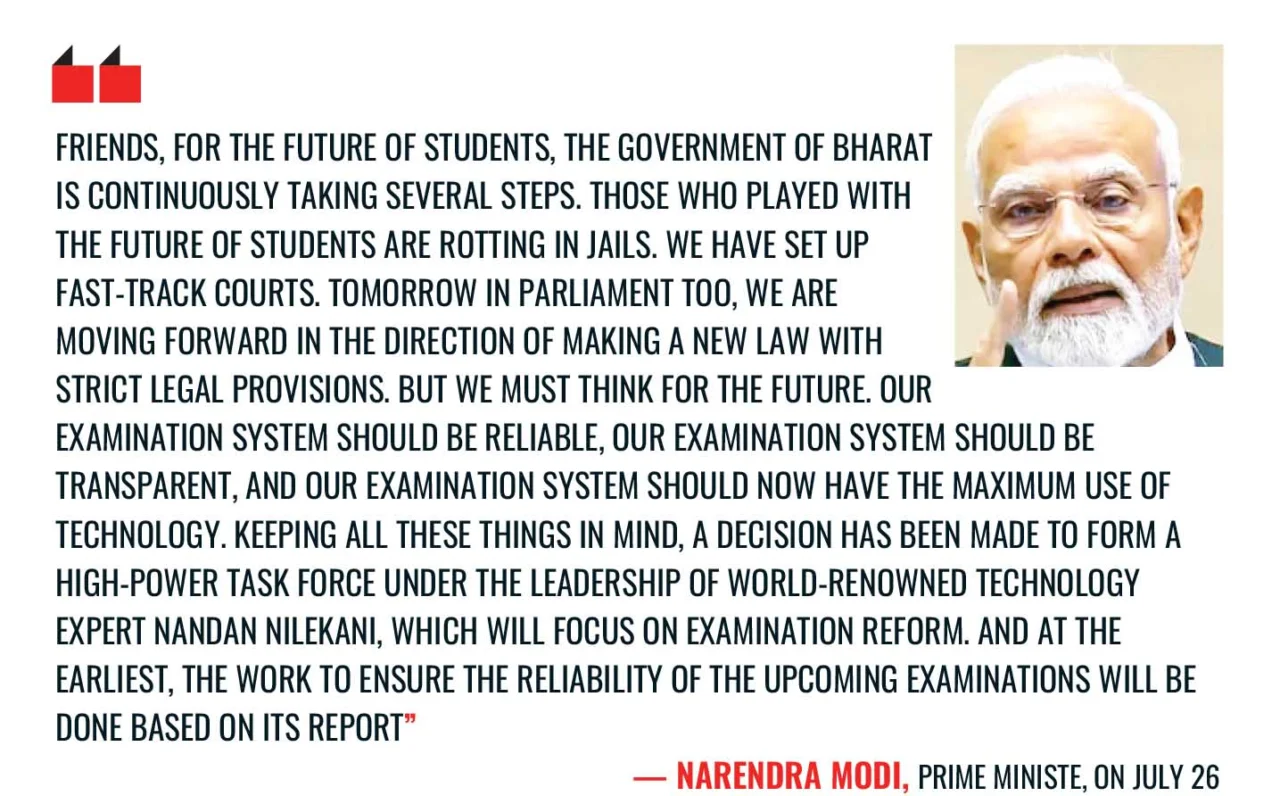
It must be mentioned that PM Modi, earlier, for the progress of youth, launched several transformative initiatives including the National Education Policy 2020 and expansion of higher education institutions, Skill India Mission and PMKVY for training youth, apprenticeship programmes, Startup India which has built third-largest startup ecosystem globally, PLI schemes creating lakhs of manufacturing jobs, Khelo India for sports development, and initiatives like Mudra, Stand-Up India, and IndiaAI Mission. In response to concerns about examinations, the Modi Government introduced the Public Examinations (Prevention of Unfair Means) Amendment Bill, 2026. The legislation seeks to strengthen the legal framework against examination-related offences by prescribing stricter penalties for malpractice, mandating time-bound investigations and trials, and providing for the establishment of Special Fast Track Courts to ensure the swift prosecution of offenders. The Bill represents an effort to reinforce the integrity of public examinations and restore the trust of millions of students whose futures depend upon a fair, transparent, and merit-based evaluation system.
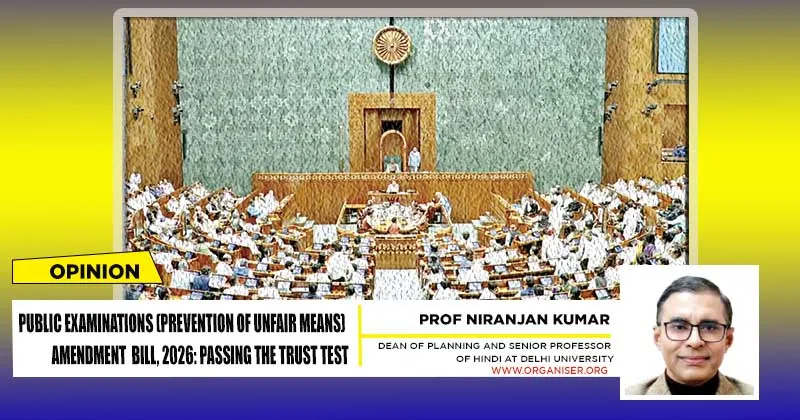
In fact, the credibility of public examinations, which shape the aspirations of millions of young Indians, is among the most valuable assets of any democratic society. However, when question papers are sold even before an examination begins, and criminal syndicates capable of purchasing leaked papers for a few lakh rupees crush the dreams of deserving candidates, the damage extends far beyond a single test. The series of paper-leak scandals witnessed across several states over the years has underscored this growing concern. In this context, the passage of the Public Examinations (Prevention of Unfair Means) Amendment Bill, 2026 by the Lok Sabha should be viewed not merely as a legislative exercise but as a significant step towards restoring the credibility of India’s examination system.
The controversies surrounding the NEET examination demonstrated that paper leaks are no longer isolated or localised phenomena. They have evolved into organised criminal enterprises involving technology experts, middlemen, operators of fraudulent websites, coaching mafia networks, and other coordinated actors. The greatest victims of these crimes are students who dedicate years of hard work and sacrifice to pursue their aspirations. When that opportunity is compromised through fraud and deception, the consequences extend far beyond the cancellation of an examination. They create a deep sense of mistrust in public institutions among an entire generation of young people. What was required was a robust legal framework capable not only of punishing offenders after the crime but also of deterring such offences in the first place. The new amendment appears to be a direct response to this necessity. Compared with the existing legislation, the new Bill introduces significantly stronger punitive measures. The revised provisions demonstrate the government’s intention to treat examination fraud with far greater seriousness. While earlier offences related to paper leaks or the use of unfair means attracted imprisonment of up to three years, the amended law prescribes a minimum sentence of five years, extendable to ten years. Similarly, the maximum monetary penalty has been increased from Rs 10 lakh to Rs 50 lakh. More importantly, those found operating organised paper leak syndicates may face imprisonment of up to seven years along with financial penalties of up to Rs 10 crore, signalling that the Government now regards such offences not merely as acts of cheating but as organised economic crimes.
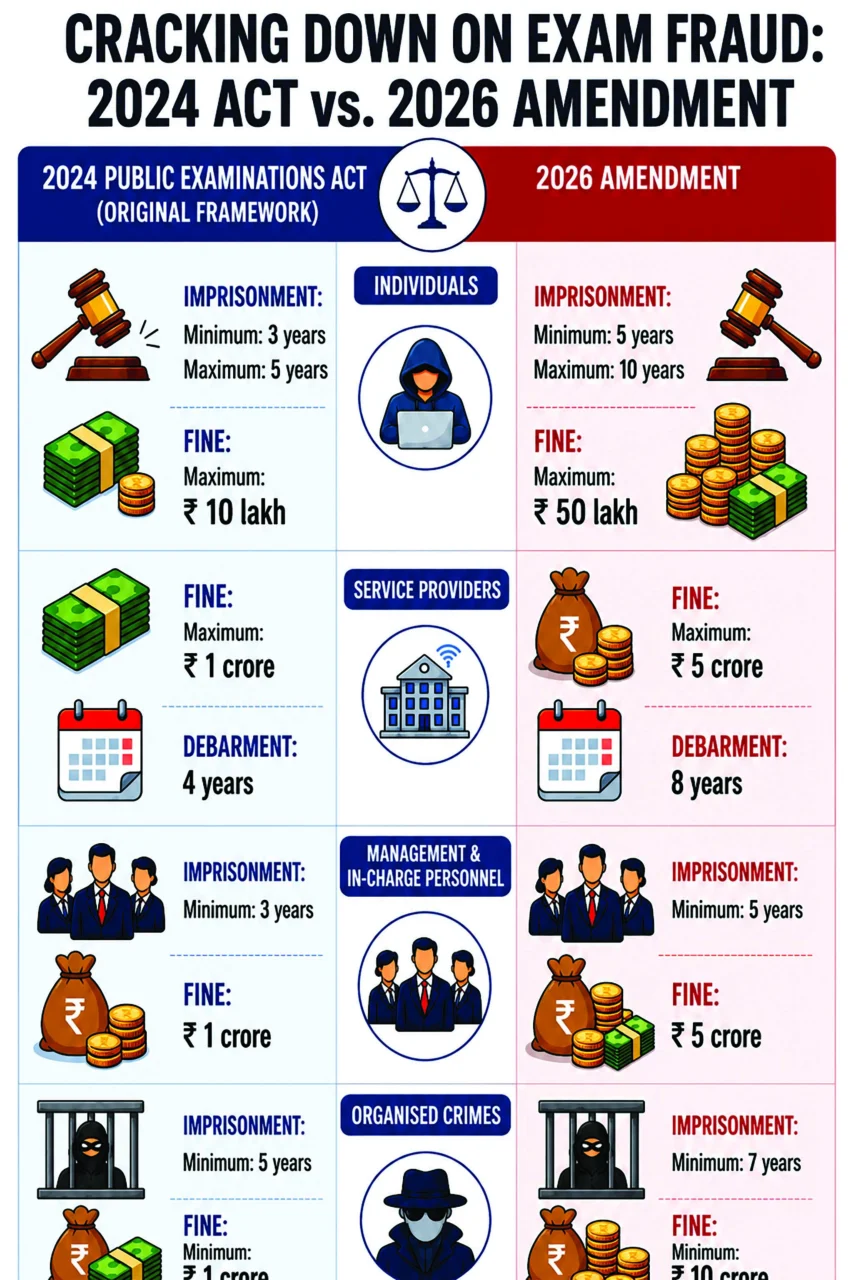
The legislation also directs States and Union Territories to establish fast-track courts, complete investigations within two months, and conclude trials within three months. This provision represents another significant reform. Experience has shown that prolonged investigations and delayed judicial proceedings weaken the deterrent effect of the law by diminishing offenders’ fear of punishment. Swift investigations coupled with timely justice are therefore likely to serve as far more effective deterrents. Another notable feature of the amendment is that it expands the definition of examination-related offences beyond the leakage of question papers. It explicitly criminalises tampering with OMR sheets, operating fraudulent examination websites, producing fake admit cards, and employing other technological means to manipulate public examinations. As examination-related crimes continue to evolve alongside advances in technology, it is imperative that the legal framework evolves accordingly.
Equally noteworthy are the stringent provisions aimed at service providers whose involvement in paper-leak operations has been established.
Paper Leaks: Opposition-Run States
It is equally important to recognise that paper leaks are not a recent phenomenon. The problem has persisted across different Governments and political administrations over many years. Several major examination scandals have surfaced at both the Union and State levels, illustrating that the challenge is systemic rather than episodic. For instance, the notorious UPSC civil services exam paper leak in 1991 occurred when the Congress-supported Central Government in Delhi was in power. Another high-profile case- the 1997 IIT-JEE Mathematics paper leak also took place during the Congress-backed Central Government in Delhi. Besides, dozens of paper leaks occurred during the tenures of Congress-led Central and State Governments, such as the AIIMS-MBBS paper leak in 2006 and 2012, the AIEEE engineering exam leak in 2011, and the Railway Group-D recruitment exam leak in 2012, or multiple recruitment exam paper leaks during the Ashok Gehlot Government in Rajasthan. During the Samajwadi Party Government of Akhilesh Yadav, numerous exam papers were leaked, including the UPPMT-2014 and UPPSC-2015. Similarly, in Punjab’s AAP Government, the Subordinate Services Selection Board exam (2025) and the Pharmacy Officer recruitment exam (2026) scams, as well as various cases of paper leaks from States like Jharkhand, Bengal, and Tamil Nadu, have come to light. These incidents demonstrate that the integrity of public examinations has long required structural reforms rather than temporary responses. In this light, the Modi Government’s current bill looks far-reaching.