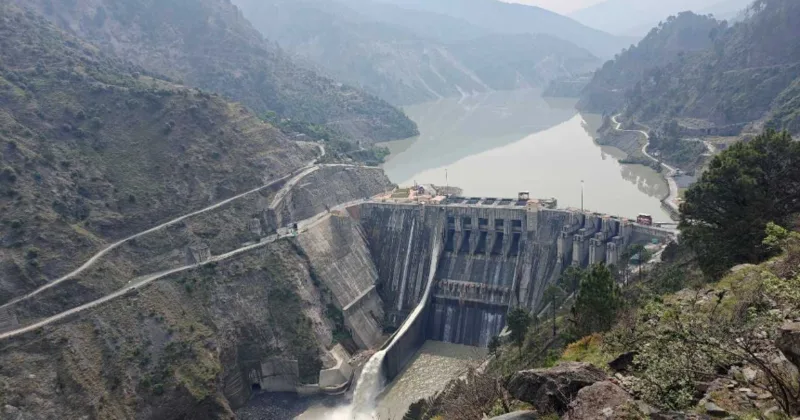
The National Hydroelectric Power Corporation (NHPC) has issued a fresh open tender inviting bids for the execution of civil and hydro-mechanical (HM) works for the 1,856 MW Sawalakote project located in the Ramban district of the Union Territory (UT) of J&K. The tender was issued on the evening of February 5 by the Faridabad-based public limited company, which acts as a sort of mother ship for the development of hydropower potential across the country.
Incidentally, the tender was issued a month after Union Power Minister Manohar Lal Khattar had visited J&K to review various hydropower projects on the Chenab. Besides visiting the Salal project in Reasi and the Ratle project in Kishtwar, Khattar conducted an aerial survey of the Sawalakot project site. He was then accompanied by senior officials of his ministry and the top honchos of NHPC. It bears mention here that the Sawalakot is the biggest hydropower project on any of the Western Rivers. Due to persistent if and buts by Pakistan, raised under the Indus Waters Treaty (IWT) 1960, this project has taken several decades to fructify.
In his interactions with mediapersons in Reasi and Kishtwar, Khattar had stressed that Prime Minister Narendra Modi, after putting the IWT in abeyance, was very keen that the hydropower projects be fast-tracked. There was no meaning of Pakistani objections now that the constraints put on India by the IWT were no longer there, he had clarified.
Nine Years’ Timeframe
The tender of little over Rs 5,129 crore was uploaded to the GeM portal, which serves as the central e-procurement portal. This is the first major tender floated by the NHPC, and the bidders have been given 3,285 days (nine years) to complete the works defined in the tender. Incidentally, this is just one of the tenders for the Sawalakote hydropower project; separate tenders (more than one) are needed for other aspects of it.
The tender title reads: Lot 1, Package, Sawalakote HEP, UT of J&K, and the tender fee has been set at Rs 40,000, while the Earnest Deposit Money (EMD) has been fixed at Rs 10 crores. The tender, NH/CCW/CC-III/CO439/PR14325/91, has been issued in the name of the General Manager (CC-III), Contracts-Civil Division, of the NHPC head office at Faridabad.
As per the document, the download/sale start date is February 5, the bid submission date is March 12, and the bids will be opened on March 24. The tender covers civil works and HM (hydro-mechanical), comprising the construction of the Diversion Tunnel (DT) and coffer dams, the Mandiyal nallah diversion tunnel, coffer dykes, and platforms. The works also include approach roads and associated works, the right-bank spiral tunnel, access tunnels, and dam works, with associated Hydro Mechanical (HM) works for Sawalakot HEP, UT of JK.
According to senior officials, most hydropower projects like Sawalakot have a long gestation period due to the massive works required to tamper with river courses. In the case of Sawalakot, too, it may take at least a decade to complete once the necessary steps for issuance and finalisation of tenders are taken.
Security Concerns
During his ongoing three-day visit to J&K, Union Home Minister Amit Shah and Lieutenant Governor Manoj Sinha are likely to discuss issues related to hydropower infrastructure, as well as other subjects that come before them for review. In view of tensions with Pakistan, some senior officials from the Union Power Ministry are also expected to attend to flag various issues and bring them to the notice of the Ministry of Home Affairs (MHA).
This has become necessary due to the possibility of sabotage by anti-national elements acting at the behest of Pakistan, as also thwart its terror proxies. The Army, the Jammu Kashmir Police (JKP), the Central Industrial Security Force (CISF), besides intelligence agencies, are keeping vigil to provide a safe environment to all the power infrastructure located all over J&K. At all hydropower plants, the CISF has primary responsibility of guarding the installations, and it has been adequately trained and armed for that. However, for working in the hinterland to neutralise Pakistani terrorists and their local sympathisers, the security grid is a multi-layered construct.
Pakistan’s Discomfort
For decades, Pakistan has worked with open hostility towards every hydropower project conceived, planned, and executed by India on the Western Rivers (Indus, Jhelum, and Chenab). It had consistently used the IWT 1960 framework to put the wheels of hydropower development in India out of gear. Its discomfort arises from the fact that this treaty was put in abeyance in April last year.
It needs to be stressed here that this treaty held for 65 years, not because of Pakistan’s sagacious and cooperative behaviour. It held field as India ignored all negative actions of Pakistan, starting with the 1965 war, the Bangladesh war of 1971, the 1999 Kargil war and fostering terrorism in Punjab as well as J&K. The good behaviour of India made Pakistan think that it will not do anything to the treaty as it stands in spite of all provocations.
With every passing day, Pakistan’s discomfort is rising because of the treaty being put in abeyance by India. It has often been said that the word “abeyance’’ is a new, arbitrary coinage by India, not found in treaty law.
Mehar Ali Shah
Speaking on Geo News‘ programme ‘Jirga’ last month, Pakistan’s Indus Commissioner Mehar Ali Shah talked about his legal perspective and said: “As far as holding the treaty in abeyance is concerned, the word ‘abeyance’ is not recognised under international treaty law. It is a coined term, because we believe India understands that it cannot suspend, breach or terminate the treaty.” However, he cautioned that India sidestepping its obligations was “alarming”.
“There is no fixed amount of water allocated to Pakistan,” he said, adding that the waters should be available to Pakistan based on the “natural pattern of the western rivers”. “So far, Chenab, Jhelum and Indus are receiving water in a natural pattern. But since April 24, 2025, India has created three such episodes, which we picked up — twice in May and once in December — when they increased the flow and then decreased it for a few days,” Shah said.
Interestingly, Pakistan’s Indus Commissioner also spoke about the 12th article of the Indus Waters Treaty and admitted that this provides for changes (modifications) in the treaty with the passage of time. However, he did not say how an impasse resulting from Pakistan’s refusal to modify the treaty as requested by India on January 25, 2023, can be resolved. He said, “The 12th and last article of this treaty has four provisions. In the last paragraph, it says that with the passage of time, some changes can be made to the pact, but both parties have to mutually agree; otherwise, the pact will remain fully enforced.’’
Article XII, called Final Provisions, of the Indus Waters Treaty, remains an eternal bugbear for Pakistan. It has consistently refused to discuss clause 3 of this article regarding “modification’’ of the treaty from time to time. It builds a narrative that India cannot unilaterally do anything under the treaty framework. Now that India has unilaterally initiated keeping the treaty in abeyance, Pakistan does not know how to nullify it.