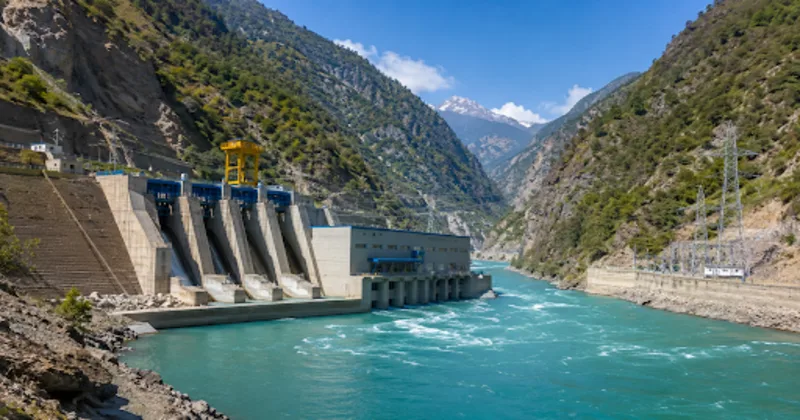
Srinagar: Chenab Valley Power Projects, an entity owned by the Union Territory (UT) of Jammu & Kashmir government, has sought diversion of about 197 hectares of forest land for the construction of the Kirthai Stage-II Hydroelectric Project on the Chenab river in Kishtwar district. Kirthai II is part of several other hydroelectric projects the Centre has sought to expedite after putting the Indus Waters Treaty (IWT) with Pakistan in abeyance in April 2025.
The Environment Ministry’s Forest Advisory Committee (FAC), which grants approval for such diversions, appraised the hydroelectric project on June 10, Wednesday. The meeting details are yet to be released publicly. The report stated that the proposed project is of “national importance” and “some trade-off” is required between developmental activities and environmental conservation.
Mandatory environmental clearances being hastened
Padder tehsil is one of the remotest areas of Kishtwar contiguous to Himachal Pradesh on the eastern side and Zanskar district of of the Union Territory (UT) of Ladakh on extreme north. The main thing is that the Indian government has approved the fast-tracking of the 930 MW Kirthai-II, ending a 42-year-long delay for one of the largest rojects in the region. First conceived and proposed in 1984, the project had remained stalled through changing governments, regulatory hurdles and bureaucratic delays.
It is finally moving towards construction phase now as the Central government is pushing for undertaking the project at the earliest. The decision is significant not just because of the electricity it will generate, but because it comes amid India’s broader push to fully utilize the waters of the Indus river system. This has become the government’s top priority and funds are being allocated for various hydropower projects as never before.
Central plants for power generation on Chenab
Another project, Kirthai I, is also located in the same area but will be much smaller, only of 390 MW capacity. Located in remote Padder tehsil of Kishtwar district, Kirthai I and II will together contribute 1,320 MW of clean hydropower to the grid. These projects are all set to transform this area which is one of the farthest and remotest areas of the Union Territory (UT) of Jammu & Kashmir.
In recent months, India has accelerated multiple projects on the Chenab, approved the Chenab-Beas river-linking initiative and moved to enhance storage and water-management capabilities across key dams. Kirthai-II is expected to become an important part of this larger Chenab basin network, joining projects such as Kiru, Kwar, Pakal Dul, Ratle, Baglihar, Salal and Dulhasti.
Potential being harnessed will bring prosperity
Together, these projects are gradually transforming the river into a major source of energy and strategic infrastructure for India. The Chenab has huge untapped power generation potential and most of it lies in the Kishtwar district. Once these projects are fast tracked, it will lead to substantial tapping of this potential. Otherwise, this potential had remained empty talk in official files with little work being executed on the ground. But all that has changed over the last over one year after the government put the Indus Waters Treaty (IWT) in abeyance in April 2025.
As India pushes ahead, the developments are being watched closely across the border in Pakistan which had repeatedly objected to hydropower projects in the past. This had led to substantial losses in terms of unharnessed electricity generation and stalling of many important projects.
Pakistan has repeatedly raised concerns on international platforms in its attempts to retard the pace of development of Jammu & Kashmir. India has, however, maintained consistently that issues related to the Western Rivers as designated in the Indus river system remain a bilateral matter. Ignoring Pakistan’s unwarranted objections, India has maintained that it will continue to pursue projects permitted within its territory.
Significantly, the UT of J&K is all set to become a power surplus area in the years to come. This will be hugely beneficial for its ordinary citizens as they will have access to clean, cheap energy. This transformation from a net importer to exporter will bring in valuable revenue also.
For India, the approval of Kirthai-II represents the revival of a long-forgotten infrastructure project which most people had heard of and almost forgotten. For Pakistan, the clearances and fast tracking is happening at a time when water security is becoming an increasingly sensitive domestic issue. This has become very important as inter provincial discord between Sindh and Pakistan Punjab, over water apportionment is growing.