
The Washington Post has laid off nearly 300 employees as part of a plan to cut roughly one-third of its workforce across all divisions. The layoffs, which affected several Indian journalists including current and former Delhi bureau chiefs, were announced on February 4.
The job cuts have largely hit the newspaper’s foreign bureaus, local reporting teams, sports desk, and significant sections of its business division. In some cases, entire international reporting units have been shut down. Many current and former staff members have described the move as a dark day- not only for the newspaper, but for global journalism as a whole.
Among those affected are journalists with direct links to India. These include Ishaan Tharoor, son of Shashi Tharoor; Pranshu Verma, the New Delhi bureau chief; and Gerry Shih, the Jerusalem bureau chief who had also previously served in Delhi.
And what is more interesting is that the two journos- Pranshu Verma and Gerry Shih have become well-known critics of India through their association with the media outlet. The Washington Post is already widely seen by many as biased, similar to other Western media organisations.
Pranshu Verma’s Post appealing to Jeff Bezos calling himself ‘warrior’ against Indian Government
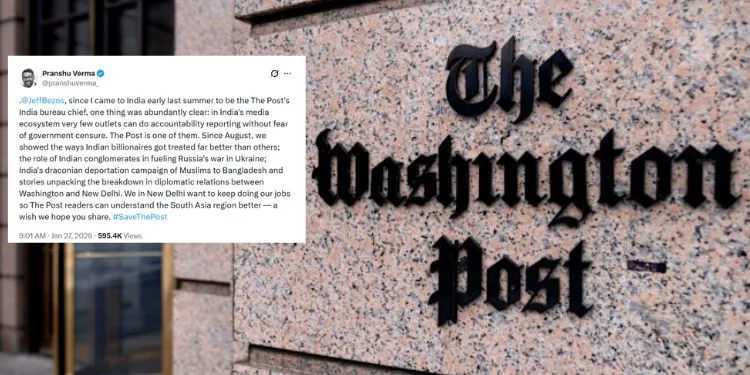
Pranshu Verma, in a post on January 27 this year, took to X, effectively requesting Jeff Bezos to personally step in after reports of large job cuts at the newspaper caused concern and uncertainty among its foreign reporting teams. In the post, he argued that ‘The Washington Post’ often reported without fear of “government censure.” He sought to suggest that his reporting was always factual and carried out without fear of the Indian government.
With this statement, he positioned himself as a courageous voice speaking out in what he claimed was an authoritarian media environment in India. He also portrayed the newspaper as a lone ethical force standing up to a harsh Indian government. However, ‘The Washington Post’ has already drawn criticism for what many describe as anti-India reporting through several of its articles. Its coverage included contentious reports on Operation Sindoor.
While accusing Indian media of spreading misinformation during wartime, ‘The Washington Post’ itself made similar errors. The paper published incorrect information by relying on unreliable sources, mistranslating local languages, and releasing reports without proper verification, issues for which it later issued corrections and apologies.
Verma itself pointed to several of his articles and spoke about them with pride. These included stories claiming that Indian billionaires received special treatment and that there was crony capitalism under Prime Minister Narendra Modi. He also referred to reports that accused Indian companies of helping Russia’s war in Ukraine and described India’s action against illegal immigration as a harsh deportation drive targeting Muslims sent to Bangladesh.
.@JeffBezos, since I came to India early last summer to be the The Post's India bureau chief, one thing was abundantly clear: in India's media ecosystem very few outlets can do accountability reporting without fear of government censure. The Post is one of them. Since August, we…
— Pranshu Verma (@pranshuverma_) January 27, 2026
Pranshu and Gerry Shih- critical reports against Indian Government
The Washington Post published an investigation co-reported by journalists including Pranshu Verma, which claimed that senior Indian officials helped steer a large LIC investment into a company, implying close ties between business and the government. Later, LIC publicly rejected the claim, calling the report false, baseless, and far from the truth. LIC also stated that no such document or drafted proposal existed, as alleged in the Washington Post article.
Pranshu Verma co-authored reports in The Washington Post that were critical of the Indian government’s handling of Rohingya migrants. It criticised the government policy. The article “In India’s deportation drive, Muslim men recount being tossed into the sea…” which he turned a national security issue into a story of religious victimhood was co-authored by Pranshu Verma.
Gerry Shih studied at Stanford University and joined the organisation in 2018. He worked as the Jerusalem bureau chief, covering Israel, the Palestinian territories, and the wider Middle East. Earlier, from 2021 to 2025, he served as the New Delhi bureau chief and reported on politics, foreign policy, intelligence, and technology in India and other South Asian countries.
Reported to be of Chinese descent, he also reported on China for The Washington Post. According tohis profile on the paper’s website, he worked with the Associated Press, Reuters, and The New York Times. He was a finalist for the Pulitzer Prize for International Reporting in 2024 for his work on India and won the Osborn Elliott Prize in 2020.
Gerry’s reports were accused of advocating for Khalistan separatists and of aligning with accusations made by Prime Minister Justin Trudeau’s government against India without substantiation. The reports he carried were seen by critics as supporting Khalistan separatist narratives and echoing allegations against India without providing solid evidence.
The newspaper published a report written by Gerry and Greg Miller in October 2024, soon after Canadian officials made their allegations. The article said Canadian officials believed a campaign of violence and intelligence gathering targeting Sikh separatists in Canada- including the 2023 killing of Hardeep Singh Nijjar- was connected to senior Indian officials and operatives. The story cited Amit Shah as one of the people accused of being involved in illegal activities. Canada’s National Security Advisor Nathalie Drouin and Deputy Foreign Affairs Minister David Morrison were cited as its sources.
Pranshu Verma and Gerry Shih Face Social Media Backlash for Anti-India Narrative
Journalists Pranshu Verma and Gerry Shih have come under sharp criticism on social media, with several users accusing them of pushing an anti-India narrative in their reporting.
Secular slave Pranshu Verma begging for his job amid layoffs at the Washington Post. He's so desperate to keep his job that he upsells his anti-Hindu journalism. According to him, the Post should continue to employ him because of his claimed usefulness to his Western masters in… pic.twitter.com/EC332MnFhG
— Rakesh Krishnan Simha (@ByRakeshSimha) January 28, 2026
The price of betraying your own country and sucking up to the white Maan. The price of continuous fake negative stories about India. No body cares about you. Good riddance to bad rubbish. Selling your soul for a few $. https://t.co/RDTw3rZWYy
— Mohandas Pai (@TVMohandasPai) February 5, 2026
I’m not the type to celebrate layoffs, but I’ll make an exception for Gerry Shih, Pranshu Verma, and Ishaan Tharoor. These three getting pink slips actually makes my day. If you’re an agenda-driven partisan first and a reporter second, you forfeited the right to call yourself a… pic.twitter.com/cbarnbv50M
— PM (@naannomad) February 4, 2026
The lay off decision was announced by ‘The Washington Post’ executive editor Matt Murray to bring “stability” to the organisation. However, many people described the move as an “absolute bloodbath” and one of the darkest days in the newspaper’s history. The newspaper is owned by Amazon founder and billionaire Jeff Bezos.