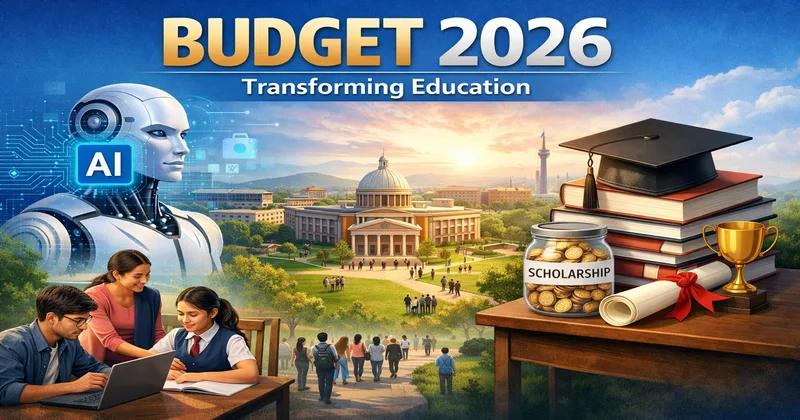
Finance Minister Nirmala Sitharaman presented the Union Budget 2026-27, unveiling a record Rs. 1.39 lakh crore allocation for the education sector, showing the government’s commitment to skilling, innovation, and future-ready learning. The budget, the highest-ever allocation for education, combines ambitious infrastructure projects, digital initiatives, and targeted reforms in scholarships, highlighting a dual focus on modernisation and equity.
One of the standout initiatives in the Budget 2026 is the establishment of content creation labs in 15,000 schools and 500 colleges across India. These labs are designed to train students in Animation, Visual Effects, Gaming, and Comics (AVGC) to meet the rising demand for creative talent in the media and entertainment industry. Students will have the opportunity to experiment with cutting-edge digital tools, participate in project-based learning, and develop industry-relevant portfolios.
The labs are envisioned not only as skill-building centres but also as incubators for innovation, enabling students to explore careers in emerging fields that blend art, technology, and storytelling. Experts note that such initiatives can help India emerge as a global hub for creative industries, tapping into the vast potential of the country’s young population.
To strengthen higher education and research, the Budget proposes five university townships near major industrial and logistics corridors. Each township will integrate multiple universities, colleges, research institutions, skill centres, and residential complexes, creating a holistic ecosystem for education, innovation, and industry collaboration. These townships are expected to foster a culture of research-driven learning, attract top faculty and students, and promote collaboration between academia and industry. By aligning educational infrastructure with industrial hubs, the government aims to bridge the gap between skill development and employability, preparing students for the rapidly evolving workforce.
The 2026 Budget places a strong emphasis on gender equity in education. The Finance Minister announced the construction of one girls’ hostel in every district, which will be designed to support female students facing mobility and access challenges. These hostels will provide safe, affordable accommodation, enabling young women to pursue higher education without the burden of long commutes or relocation challenges.
Recognising the transformative potential of AI in education, the Budget 2026 proposes the creation of a Centre of Excellence in Artificial Intelligence for Education. This centre will develop AI-powered learning tools, adaptive learning platforms, virtual labs, and smart classroom technologies to enhance the quality of education across schools and higher education institutions.
By leveraging AI, educators can tailor learning experiences to individual students, monitor progress in real-time, and identify gaps in understanding. Analysts suggest that this initiative could revolutionise classroom learning, making education more personalised, inclusive, and data-driven.
To promote innovation and regional development, the government plans to establish a new National Institute of Design (NID) in eastern India. The NID will provide world-class design education, foster creativity, and advance skill development in areas such as industrial, product, and visual communication design. This will decentralise access to premier design education and will encourage talent from underrepresented regions to pursue careers in design and creative industries.
The Budget also announced a reduction in the Tax Collected at Source (TCS) to 2 per cent for education-related remittances under the Liberalised Remittance Scheme (LRS). This measure provides financial relief to students and families sending money abroad for higher education, reducing the cost burden and easing international study plans.
While the Budget focuses on innovation and infrastructure, it also shows significant reductions in scholarship funding, raising concerns among students and minority communities. The Merit-cum-Means Scholarship for minority students in professional and technical courses was sharply reduced from Rs. 7.34 crore in 2025-26 to just Rs. 0.06 crore, a drop of over 99 per cent. Funding for the Maulana Azad National Fellowship, which supports minority students pursuing MPhil and PhD research, also fell by 16 per cent, from Rs. 42.84 crore to Rs. 36.14 crore.
The Budget focuses on improving digital infrastructure, including better broadband for schools and more technology support. This will help students across India access quality online learning and digital tools for modern education.
The PM-Virasat Ka Samvardhan (PM VIKAS) scheme got a major boost with Rs. 303.27 crore for 2026-27. It helps artisans develop skills, supports traditional arts and crafts, and creates job opportunities while preserving India’s cultural heritage.
The Union Budget 2026 takes a two-fold approach to education, investing in infrastructure, digital tools, and AI, while reducing some scholarship programs. These initiatives aim to build a skilled, future-ready workforce and promote creativity and research, but scholarship cuts highlight the need to ensure fair access for all students.