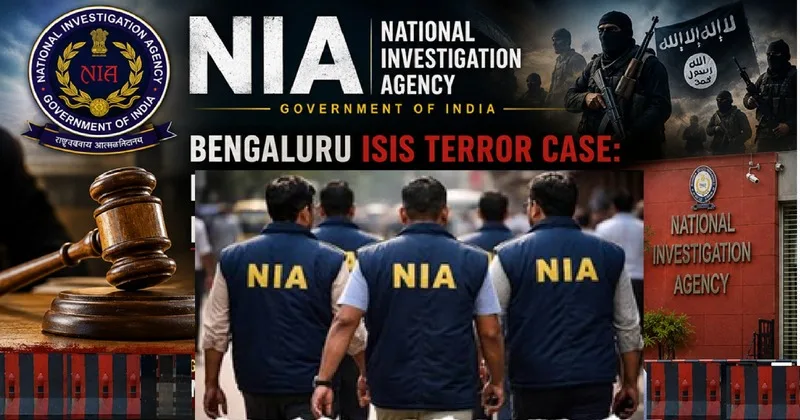
New Delhi: The National Investigation Agency (NIA) has dealt a significant blow to the ‘Al-Hind ISIS module’, a group that conspired to establish a foothold for the banned terrorist organisation Islamic State (ISIS) in India, incite communal riots, carry out targeted killings and build an organised terror network within the country.
A special NIA court in Bengaluru convicted the prime accused, Mohammad Hanif Khan, in the high-profile 2020 Al-Hind ISIS terror conspiracy case, sentencing him to seven years of rigorous imprisonment and a fine of Rs 48,000. This marks the first conviction in the case; so far, 20 individuals involved in the conspiracy have been arrested and charge sheets have been filed against them.
This verdict represents a decisive judicial blow against a meticulously planned terror conspiracy aimed at destabilising India’s internal security, spreading religious discord and establishing a permanent ISIS network within the country.
In 1st conviction in Bengaluru Al-Hind ISIS case terror conspiracy case of 2020, key accused Mohammed Haneef Khan has been sentenced to 7 years RI with Rs. 48,000 fine. He had pleaded guilty during trial. Total of 20 accused were charged & arrested in the case. pic.twitter.com/TwLMhdVHC8
— NIA India (@NIA_India) July 14, 2026
Conspiracy to Create ‘Al-Hind Wilayat’
NIA investigations revealed that the terrorists aimed to establish a so-called ‘Wilayat’ (province) of ISIS in India. To this end, plans were made to develop the dense forests of Shivanasamudra and Gundlupet in Karnataka’s Chamarajanagar district into training camps and safe havens. Mohammad Hanif Khan was a member of the reconnaissance team that surveyed these areas and identified potential sites for training camps. These forest locations were chosen to enable the conduct of terrorist activities away from the prying eyes of security agencies.
According to the NIA charge sheet, the mastermind behind the entire conspiracy was Mehboob Pasha. He organised several clandestine meetings at his residence in Guruppanapalya, Bengaluru, where the terrorists formulated detailed plans for anti-national activities. The key objectives discussed in these meetings included inciting communal riots in various areas, carrying out targeted killings of specific individuals, radicalizing and recruiting youth into ISIS, stockpiling weapons and explosives and expanding a permanent ISIS network within India. The investigation further revealed that the terrorists’ aim was to challenge the democratic system by spreading violence and creating an atmosphere of fear and mistrust in society.
Procurement of Weapons and Network Expansion
According to the NIA, Mahboob Pasha had provided two pistols and 60 live cartridges to Mohammed Hanif Khan. Additionally, he conspired with other associates to procure explosives. The investigation also revealed that Hanif had transported several accused individuals from Bengaluru to West Bengal in a rented car as part of the conspiracy; this demonstrated that the module was not limited to Karnataka but had a network spanning multiple states.
Case Registered in 2020
This case was originally registered by the Karnataka Police on January 10, 2020. After the initial investigation uncovered the extensive nature of the terror plot, the case was handed over to the National Investigation Agency (NIA). During the investigation, the NIA gathered substantial evidence, including digital data, electronic devices, details of clandestine meetings and travel, information regarding weapon availability and proof of radicalization activities.
The trial commenced in October 2025, during which Mohammed Hanif Khan pleaded guilty in court. Subsequently, the special court convicted him and sentenced him to seven years of rigorous imprisonment. However, the investigation remains ongoing; the NIA is actively searching for the online handler who orchestrated the terror module and recruited youth into the organization through digital channels.
Part of a Larger Network
The Bengaluru-based Al-Hind ISIS module is not an isolated incident. Over the past year and a half, the NIA has conducted extensive operations against various terrorist organizations active across the country. These primarily involved modules linked to organizations such as ISIS, Lashkar-e-Taiba (LeT), The Resistance Front (TRF), Al-Qaeda in the Indian Subcontinent (AQIS), Hizbul Mujahideen, Babbar Khalsa International (BKI), the banned Popular Front of India (PFI) and the CPI (Maoist).
Intensified Action from January 2025 to July 2026
It is worth noting that the NIA significantly intensified its counter-terrorism operations between January 2025 and July 2026. During this period, the agency conducted numerous raids across various states, filed a large number of charge sheets and secured convictions in several cases.
Dozens of charge sheets were filed during this period in cases involving ISIS, Lashkar-e-Taiba, TRF, Khalistani networks, Maoist organizations and international arms smuggling. In several instances, charge sheets were presented against as many as 10, 11, 18, and even 31 accused persons simultaneously. A large number of absconding accused were arrested, and special courts handed down sentences of rigorous imprisonment ranging from seven to ten years in many cases.
Targeting Pakistan-backed networks
During this period, the NIA also undertook extensive action against Pakistan-backed terror networks. Investigations were advanced in sensitive cases, such as the Pahalgam terror attack, the Amritsar temple grenade attack, the Punjab terror-gangster nexus, the Bengaluru Al-Hind ISIS module, the Mangaluru pressure cooker blast, Bengaluru jail radicalization, the Red Fort blast, Tamil Nadu ISIS radicalization and Gujarat AQIS online radicalization, leading to the arrest of new accused, the analysis of digital evidence and the identification of inter-state networks.
Beyond arrests: A rise in convictions
The NIA’s success is also evident from the fact that it did not limit itself merely to making arrests in terror and anti-national cases; it made concerted efforts, backed by evidence, to ensure the accused were punished. Consequently, the agency succeeded in securing convictions from courts in several cases based on effective investigations.
Courts handed down sentences of rigorous imprisonment for varying terms to the accused in cases such as the Lashkar-e-Taiba recruitment episode, the Mangaluru ISIS blast, Pakistan-backed radicalization, the Punjab AGH conspiracy and the Bengaluru Al-Hind ISIS module. Additionally, the agency took action against networks involved in terror financing, online radicalization, human trafficking, cyber-slavery, espionage and arms smuggling, seizing numerous assets in the process.