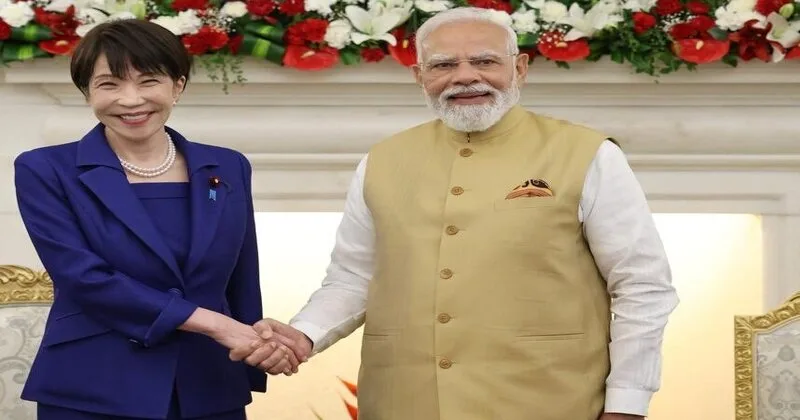
New Delhi: Prime Minister Narendra Modi and his Japanese counterpart Prime Minister Sanae Takaichi held delegation-level talks on July 2, Thursday in an effort to expand and strengthen their bilateral, strategic and global cooperation. The talks marked another step in further strengthening the special partnership built on trust and rooted in shared values. Her visit follows Prime Minister Narendra Modi’s visit to Tokyo in August 2025 for the 15th India-Japan Annual Summit and comes as both countries continue to strengthen their Special Strategic and Global Partnership in response to evolving regional and global challenges.
The 16th India-Japan Annual Summit, reviewed the full spectrum of bilateral cooperation and discuss regional and global issues of mutual interest. According to the Ministry of External Affairs (MEA), the summit provided an opportunity for both leaders to strengthen cooperation across strategic, economic, technological and security domains. The visit helped to boost investment and innovation, strengthening and enhancing resilient supply chains in critical sectors such as semiconductors and critical minerals.
List of outcomes (16 in total) : Meeting between PM @narendramodi and PM @takaichi_sanae of Japan on her Official Visit to India ⬇️
🇮🇳 🇯🇵 pic.twitter.com/jgxHibuxVW
— Randhir Jaiswal (@MEAIndia) July 2, 2026
India and Japan share a long-standing friendship rooted in centuries of cultural and civilizational exchange, spiritual affinity and shared values of freedom, democracy and respect for the rule of law.
Diplomatic relations were established in 1952; the relationship was launched as a Global Partnership in 2000, upgraded to a Strategic and Global Partnership in 2006 and elevated to a Special Strategic and Global Partnership in 2014 during the Summit between PM Modi and former PM Shinzo Abe.
As the two countries approach the 75th anniversary of the establishment of diplomatic relations in 2027, cooperation continues to deepen across a wide range of sectors, including trade and investment, economic security, defence and security, science and technology, culture and people-to-people ties.
The bilateral framework now comprises over 70 dialogue mechanisms.
Special Briefing by MEA on the Official Visit of Prime Minister of Japan to India
https://t.co/tHeQ3Lt8Sq— Randhir Jaiswal (@MEAIndia) July 2, 2026
PM Modi addresses Japan PM Sanae Takaichi as “younger sister”
Prime Minister Narendra Modi welcomed Japanese Prime Minister Sanae Takaichi to India for the 16th India-Japan Annual Summit, characterising her historic visit as the start of a “new chapter” in the global strategic partnership between two of the world’s five largest economies.
“I welcome Japanese Prime Minister Takaichi, my younger sister to India for her first visit for the India Japan Annual Summit. She is the first woman PM of Japan and also a visionary and popular leader. She is from Nara prefecture in Japan with which India has Buddhists linkages”, Pm Modi said. Reflecting on the dynamic geopolitical landscape and shifting global alliances, PM Modi reemphasised that the deep-rooted relationship between New Delhi and Tokyo remains remarkably resilient and serves as a vital anchor for regional balance.
A shared commitment for free, prosperous & rule-based Indo-Pacific
During the Summit, Japanese Prime Minister Sanae Takaichi said that Japan and India must leverage their strength and said that the initiatives launched today will pave the way for peace. “Today, both India and Japan are among the world’s largest economies. A free, prosperous and rule-based Indo-Pacific is our shared priority. As the region’s largest democratic and market economies, we have undertaken several significant initiatives today. Together, these will pave the way for peace, stability and progress across the entire region”, she said.
“To deepen the strategic cooperation between Japan and India. I recently announced the updated FOIP (Free and Open Indo-Pacific policy). We agreed to deepen the strategic cooperation between India and Japan. Japan forces and Indian naval vessel are planning to announce a joint exercise. Japan India 2+2 will be taking before the end of this year. Japan also supports India’s membership of IEA”, Sanae Takaichi further added.
“Prime Minister Modi positions the ocean as a shared space that supports regional stability and growth and is promoting the MAHASAGAR, the Great Ocean Initiative for countries across the Indian ocean to defend their sovereignty and the sea through their own efforts. This is perfectly aligned with FOIP (Free and Open Indo Pacific policy). Thus, we agreed to deepen the strategic cooperation between Japan and India to achieve such common goals. Expansion of maritime security cooperation is especially important for regional peace and stability”, Japan PM reiterated. Takaichi said that Japan and India must leverage their respective strengths to become stronger and more prosperous together.
Joint declaration on AI: Tech emerges as the strongest pillar of cooperation
During the summit, Prime Minister Narendra Modi recognised the technological partnership between India and Japan as the “strongest pillar” of the bilateral ties, affirming shared resolve to converge Japan’s precision technology with India’s software capabilities. PM Modi stated that the two nations have signed key agreements regarding cooperation in Artificial Intelligence. He expressed optimism that the shared committment and efforts by India and Japan towards technological partnership can boost global AI development.
In this direction, MoU was inked to promote collaboration in the domain of Artificial Intelligence(AI). Both countries will support development of resilient AI infrastructure, across the full AI stack. The MoU also facilitates industry-academia collaboration on AI, R&D partnership, talent mobility & human resource exchanges.
MoU was also signed between Sarvam AI & preferred networks which encourages private sector participation, joint innovation etc. to develop Large Language Modules(LLM).
India-Japan biogas initiative: A step towards energy security
During the disussions, Prime Minister Narendra Modi announced an India-Japan biogas initiative through which 1000 biogas and organic fertiliser plants will be set up in India. “Today, we have also taken several important decisions in the field of energy security. This will give new strength to sustainability, prosperity and rural livelihoods in India’s villages”, PM Modi added. “Through the India-Japan Biogas Initiative, we will get help in setting up 1000 biogas and organic fertilizer plants in India. This will further strengthen our GOBAR-Dhan initiative, PM Modi said.
With respect to sealing energy security, India & Japan will support strategic stockpiling of energy and other reserve mechanisms. Both countries will encourage joint investments for maritime energy transportation.
Defence technology partnership: Co-development of Naval radio antenna UNICORN
PM Modi hailed the agreement between India and Japan on the first co-development project involving the Naval Radio Antenna ‘UNICORN,’ describing it as a “new chapter between” in the defence technology partnership between the two nations. PM Modi said that the two nations will begin work towards joint development of defence technologies that help boost regional peace and maritime security and rule-based order.
Notably, in November 2024, a Memorandum of Implementation was signed at the Embassy of India, Tokyo, between the Government of India and the Government of Japan for the co-development of the UNICORN mast for fitment onboard Ships of the Indian Navy. The Unified Complex Radio Antenna (UNICORN) is a mast with Integrated Communication systems which will help improve the stealth characteristics of Naval Platforms.
Next-gen mobility partnership
MoU was also sealed to accelerate next-generation mobility partnership. This includes driving cleaner, safer and technology driven mobility infrastructure pertaining to roads, rails, ports, avaition and logistics system. The MoU also promotes, technical training, human-resource exchanges and capacity building for design operations and maintanance of advanced mobility systems.
The MoU also aims to position India as the epicentre of mobility manufacturing and supply chain. This aligns with the Make-in-India vision.
Cooperation on critical mineral exploration
Earlier in the day, a Memorandum of Cooperation (MOC) was signed between the Geological Survey of India and the Japan Organisation for Metals and Energy Security for geological survey and mineral exploration. This included promoting technical cooperation in upstreaming critical mineral exploration. This supports India’s long-term resource security in critical minerals.
Other MoUs include, advancing cooperation in battery manufacturing and EVs. The initiative promotes trusted, resilient and sustainable battery supply chains. Another MoU pertains to collaboration in pharmaceuticals & healthcare sector, where India and Japan will support resilience in the pharma supply chain and work on R&D, capacity building in the pharma sector. Joint declaration was also inked to promote collaboration in the semiconductor sector.