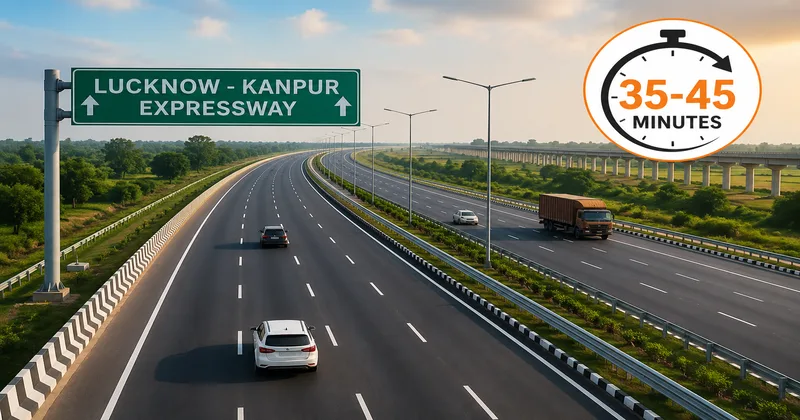
LUCKNOW: For years, commuters travelling between the state capital and Uttar Pradesh’s largest industrial city had to deal with heavy traffic congestion, frequent bottlenecks and travel times stretching up to three hours during peak periods. Uttar Pradesh has added another major chapter to its rapidly expanding road infrastructure with the inauguration of the Lucknow-Kanpur Expressway (National Expressway-6). The 63-kilometre expressway has now been opened to the public. It promises to make travel between Lucknow and Kanpur faster, smoother and safer than ever before.
The expressway is built at an estimated cost of Rs 4,500 crore and is expected to benefit office-goers, students, traders, transporters, industrial workers and businesses that rely on quick movement between the two cities. Officials believe the project will also strengthen regional connectivity and support Uttar Pradesh’s growing industrial and investment ecosystem.
A Project Planned in 2018 Finally Becomes Reality
The idea of a dedicated expressway connecting Lucknow and Kanpur was first proposed in 2018, when increasing traffic on the existing highway was making daily travel difficult for commuters. As Lucknow and Kanpur continued to grow, more people began travelling between the two cities every day. This created the need for a faster and better road connection. After nearly 1,648 days of planning, land acquisition, engineering and construction, the project has finally been completed. The expressway is expected to make travel easier by cutting traffic congestion and reducing travel time between Lucknow and Kanpur. Alongside helping passenger movement, this will also help in commercial transportation between two of Uttar Pradesh’s most important economic centres.
The foundation stone of the project was laid in March 2019 by Defence Minister Rajnath Singh, Chief Minister Yogi Adityanath and Union Minister for Road Transport and Highways Nitin Gadkari.mRecognising its strategic importance, the Central Government granted the project the status of National Expressway-6 (NE-6) in December 2020. The National Highways Authority of India (NHAI) was entrusted with implementing the project and divided the construction into two separate packages to ensure faster execution.
Construction work was assigned to infrastructure company PNC Infratech, which carried out the project using modern engineering methods and advanced construction technologies.
Built in Two Phases to Speed Up Construction
The expressway consists of two major stretches. The first is an 18 kilometre elevated section that connects Amausi and Shaheed Path in Lucknow. This stretch was considered technically challenging because it passes through densely populated urban areas where construction had to continue alongside regular traffic movement. Engineers also had to overcome hurdles like land acquisition, utilities and existing infrastructure.
The second package comprises a 45 kilometre greenfield corridor developed on newly acquired land. The route passes through 11 villages in Lucknow district and 31 villages in Unnao district.
Following the completion of land acquisition, work on the greenfield section accelerated in 2022. By October 2025, the 45 kilometre stretch was completed, while the remaining ramps and girders on the Lucknow elevated section were finished early this year. A successful trial run was conducted in June before the expressway was officially opened for traffic.
One of the biggest attractions of the Lucknow-Kanpur Expressway is its advanced toll collection system. Unlike traditional highways, the expressway does not require vehicles to stop at conventional toll plazas. Instead, it uses a Multi-Lane Free Flow (MLFF) tolling system that will allow vehicles to continue moving while toll charges are deducted automatically through FASTag and Automatic Number Plate Recognition (ANPR) technology. The new system will reduce the passenger waiting time, prevent congestion near toll collection points, lower fuel consumption and also provide a smoother driving experience.
AI-Based Monitoring to Improve Road Safety
The expressway has also been equipped with intelligent traffic management systems to make travel safer for commuters. More than 80 high-definition CCTV cameras, 16 video incident detection systems, and speed radar devices have been installed along the entire 63-kilometre route. These systems will keep an eye on the traffic round the clock and will help in monitoring the vehicle movement.
If a vehicle exceeds the prescribed speed limit, authorities can automatically generate an electronic challan from the control room. The cameras will also help authorities to quickly detect accidents, traffic jams, or vehicle breakdowns and will allow emergency teams to reach the spot faster and provide assistance whenever required.
Thanks to its AI-based traffic monitoring and modern safety systems, the expressway is one of the most technologically advanced highways in Uttar Pradesh.
Green Corridor Developed Along the Route
Apart from improving connectivity, the project also focuses on environmental sustainability. More than 46,000 trees and plants have been planted along both sides of the expressway in collaboration with the Forest Department. The government has also planted more than 46,000 trees along both sides of the expressway. This will make the route greener, help improve the environment and provide a more pleasant journey for travellers.
The new road is expected to play an important role in the proposed State Capital Region (SCR) by bringing the two cities closer and improving connectivity with nearby areas. At present, the expressway has six lanes, but it has been designed in a way that it can be expanded to eight lanes in the future if traffic increases.