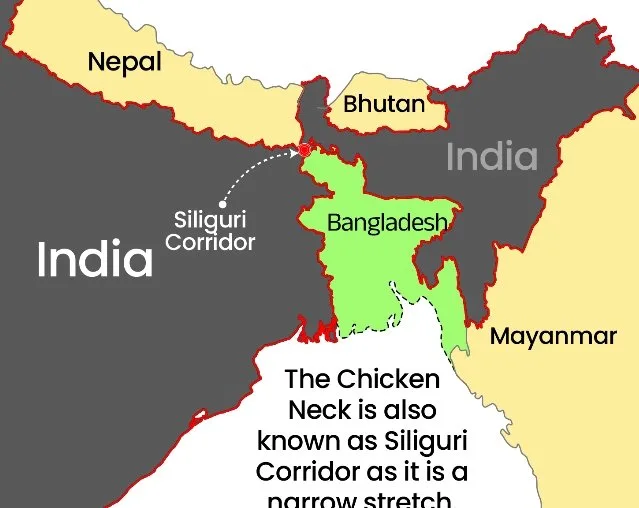
The Union government’s proposal to construct an underground railway line through the Siliguri Corridor, popularly known as the “Chicken’s Neck,” marks one of the most strategically significant infrastructure initiatives undertaken in recent years. The corridor, which connects India’s eight northeastern states with the mainland, is not only a logistical lifeline but also a critical national security artery.
At its narrowest point, the Siliguri Corridor measures just 20 to 25 kilometres in width. Flanked by Nepal, Bhutan and Bangladesh, and located in close proximity to China, the region has long been regarded by defence and strategic experts as one of India’s most geopolitically sensitive zones. Any disruption, whether due to natural calamities, sabotage or heightened military tensions, could potentially isolate the Northeast from the rest of the country.
Assam Chief Minister Himanta Biswa Sarma has termed the underground rail project a “major strategic breakthrough,” underlining its importance beyond conventional infrastructure development. For decades, India’s dependence on surface-level rail and road networks in this vulnerable stretch has been seen as a serious weakness, particularly during emergencies or conflict scenarios.
Union Railway Minister Ashwini Vaishnaw recently announced plans for a specially designed underground railway corridor spanning nearly 40 kilometres. A crucial segment of this proposal includes a 22-kilometre underground stretch between Tin Mile Haat and Rangapani in West Bengal, to be constructed 20-24 metres below ground. Officials from the Northeast Frontier Railway have noted that the alignment, largely passing through plain terrain, is especially significant from a security standpoint as it reduces exposure to external threats and disruptions.
In addition to the underground corridor, the Centre has proposed expanding existing surface railway lines in the Siliguri Corridor to four tracks. This expansion aims to enhance redundancy, increase carrying capacity and ensure operational resilience. Together, the underground route and the expanded surface network are expected to guarantee uninterrupted movement of civilians, essential supplies and strategic assets, even during adverse conditions.
The timing of the project further amplifies its importance. With evolving border dynamics, intensifying regional competition and the growing economic and strategic relevance of the Northeast under India’s Act East policy, the risks associated with maintaining the status quo have increased substantially.