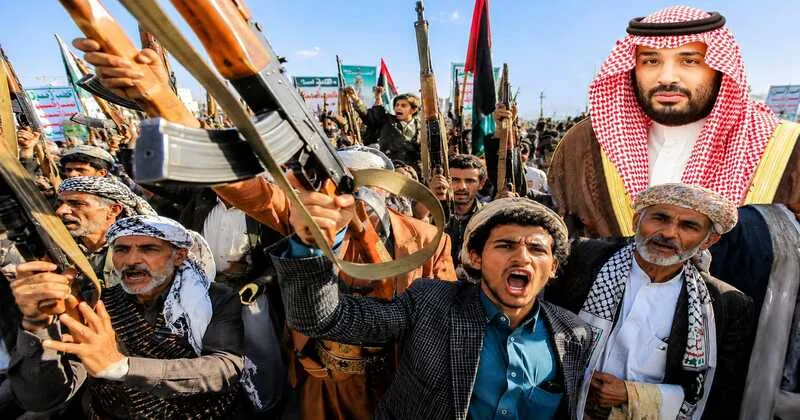
New Delhi: The Iran-backed Yemeni Shia terror group Houthis has resumed missile attacks on Saudi Arabia, ending a four-year period of relative calm between the Kingdom and the militant organisation. The fresh escalation began on 13 July when the Houthis launched missiles towards southern Saudi Arabia after accusing Riyadh of carrying out airstrikes on Sanaa International Airport, which remains under Houthi control.
Saudi Arabia confirmed that its air defence systems successfully intercepted the incoming missiles. A spokesperson for the Saudi-led military coalition said on X that the Kingdom had thwarted missiles fired by the “terrorist Houthi militia” towards the country’s southern region.
Houthi military spokesperson Yahya Saree later claimed responsibility for the operation, stating that the group’s missiles had targeted Abha International Airport in Saudi Arabia. Abha, the capital of the mountainous Asir Province bordering Yemen, is a popular summer destination for Saudi citizens because of its relatively cool climate.
The attack marks the first publicly claimed Houthi strike on Saudi territory since the informal truce that came into effect in March 2022, following years of Houthi missile and drone attacks on Saudi oil facilities and civilian infrastructure. The latest exchange therefore represents the collapse of a four-year de-escalation between Riyadh and the Iran-aligned terror group.
The renewed hostilities also come after tensions in the wider region had eased following an April truce that significantly reduced Iranian missile and drone attacks on Saudi Arabia’s eastern provinces and the capital, Riyadh.
Airport strike sparks fresh escalation
Earlier on Monday, the Houthis accused Saudi Arabia of carrying out airstrikes against Sanaa International Airport, describing the operation as “blatant aggression.” Declaring that the previous phase of de-escalation had ended, the group vowed retaliation and warned international airlines against operating in Saudi airspace until what it called the “siege” on Sanaa airport was lifted.
However, responsibility for the strike on Sanaa airport was claimed by Yemen’s internationally recognised government, which is strongly supported by Saudi Arabia and whose leadership is largely based in Riyadh.
According to Yemen’s Defence Ministry, government forces deliberately targeted the runway at Sanaa International Airport to prevent an Iranian aircraft from landing. The ministry alleged that the flight would have violated Yemeni sovereignty and warned that any hostile aircraft entering Yemeni airspace would be confronted “by all available means.” It also placed responsibility on Iran for the attempted flight.
A military spokesperson later confirmed that the Iranian aircraft ultimately landed instead at Hodeidah Airport, located about 150 kilometres (93 miles) southwest of Sanaa on Yemen’s Red Sea coast. Officials did not clarify whether any attempt had been made to prevent the aircraft from reaching Hodeidah.
The conflict also affected humanitarian operations. Another Yemeni government minister alleged that the Houthis were holding an aircraft belonging to the International Committee of the Red Cross (ICRC) at Sanaa airport. Hachem Osseiran, the ICRC’s spokesperson for the Middle East, confirmed that all Red Cross personnel and the aircraft’s crew were safe and accounted for but declined to provide additional details.
Regional security concerns grow
The renewed missile campaign has revived concerns over security across the Arabian Peninsula and the Red Sea. During previous phases of the conflict, the Houthis repeatedly targeted Saudi energy infrastructure as well as commercial shipping in the Red Sea.
Although Saudi Arabia’s geography allowed it to mitigate some of the disruption by transporting crude oil from its eastern production fields to ports on the Red Sea through an east-west pipeline, thereby avoiding the Strait of Hormuz, analysts warn that a prolonged confrontation with the Houthis could once again threaten maritime trade and regional energy security. The Houthis have previously demonstrated their ability to disrupt international shipping routes through missile and drone attacks.
The deterioration in relations comes amid increasing instability inside Yemen itself. In recent days, an ICRC-mediated prisoner exchange between the Houthis and Yemen’s internationally recognised government collapsed, with both sides accusing each other of responsibility, signalling that tensions had already been rising before the latest missile exchange.
Yemen has remained engulfed in civil war for more than a decade since the Houthis seized the capital, Sanaa, forcing the internationally recognised government to relocate to the south. In 2015, Saudi Arabia led a military coalition to restore the recognised government, beginning a conflict that evolved into one of the world’s worst humanitarian crises.
The security situation became even more complicated late last year when a separatist movement backed by the United Arab Emirates expanded its control across parts of southern Yemen, creating fresh divisions within the Saudi-led coalition that had originally united against the Houthis.
Despite repeated regional tensions linked to the Israel-Gaza war, during which the Houthis launched attacks against numerous vessels in the Red Sea, and the broader confrontation involving Iran, the March 2022 truce between Saudi Arabia and the Yemeni Shia terror group had largely remained intact until Monday’s missile strikes.
The latest attacks therefore mark a significant turning point, raising fears that the Yemeni conflict could once again spill across Saudi Arabia’s borders and reopen a major front in an already volatile West Asia.