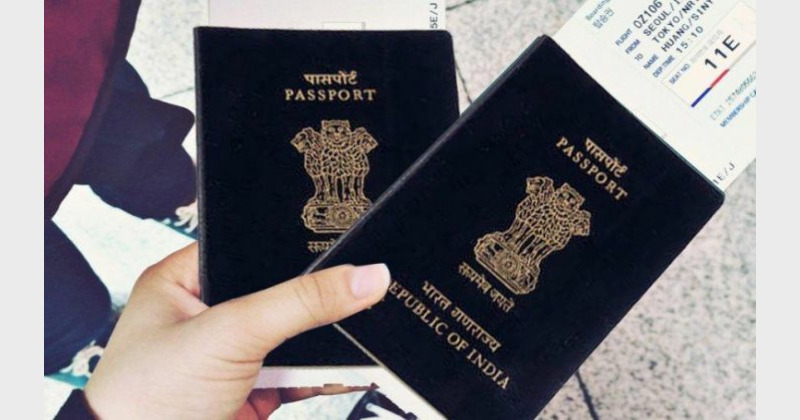
The Ministry of External Affairs (MEA) has clarified that an Indian passport is primarily a travel document issued by the Government of India to regulate the departure of Indian citizens from the country and is not intended to function as a standalone proof of citizenship.
The clarification was issued by MEA spokesperson Randhir Jaiswal amid an ongoing political debate over the status of passports as proof of citizenship, particularly in the context of electoral roll verification exercises being undertaken in various states.
Addressing media queries on Tuesday, Jaiswal said that passports are issued only after a prescribed verification process and in accordance with the legal framework established under the Passports Act, 1967, and the Passports Rules, 1980.
Explaining the government’s position, Jaiswal stated that the passport’s primary purpose is linked to international travel.
“An Indian passport is a document that, as per the Passports Act, 1967, is issued by the Government of India to regulate the departure from India of citizens of India,” he said.
The MEA spokesperson emphasised that the issuance of passports follows a structured verification process carried out under established procedures.
“It is issued after due verification laid out by an established process. The issue of passports to Indian citizens or any other individual is governed by the Passports Act, 1967 and the Passports Rules, 1980,” he added.
Jaiswal also pointed out that less than eight per cent of India’s population currently possesses a passport, highlighting that a majority of citizens do not hold the document.
The issue gained political attention following remarks made by senior MEA officials during Passport Seva Divas celebrations on June 24.
During an interaction with the media, officials had described the passport as a travel document rather than a document specifically designed to establish citizenship.
The comments came in response to questions regarding whether passports could be accepted as proof of citizenship during the Election Commission’s Special Intensive Revision (SIR) of electoral rolls.
Officials had maintained that while passports are issued for international travel purposes, they are not intended to serve as definitive proof of citizenship in all administrative or legal contexts.
The remarks triggered criticism from several opposition parties, particularly the Congress, which questioned how a document issued by the Government of India after extensive verification could be viewed as anything other than evidence of citizenship.
Congress leaders accused the Centre of creating ambiguity around citizenship documentation and alleged that such interpretations could potentially be used to deny legitimate citizens their rights in future verification exercises.
The party argued that if passports are granted only after verification of identity and nationality, they should naturally be considered evidence of citizenship.
Reaffirming the government’s position, the MEA stressed that passport issuance remains a legally regulated process governed by statutory provisions.
Officials maintained that passports are issued only after verification of documents and applicant credentials, but reiterated that the purpose of the passport under existing law is to facilitate and regulate international travel.
The clarification comes at a time when discussions around citizenship documentation, voter roll verification and identity records have become politically sensitive issues, with opposition parties and civil society groups closely scrutinising government statements on the matter.
While the debate continues, the MEA has maintained that the legal status and purpose of an Indian passport are clearly defined under the Passports Act, 1967, and the Passports Rules, 1980, under which the document is issued and regulated.