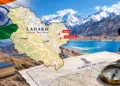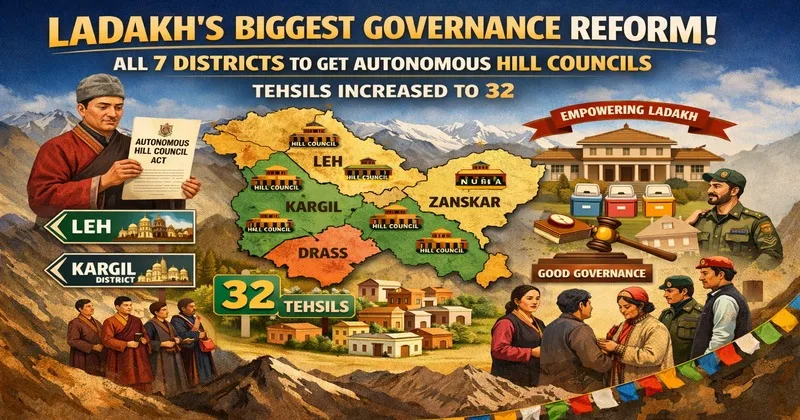
Ladakh: All seven districts in the Union Territory (UT) of Ladakh will have autonomous hill development councils raising their number by five as presently there are only two councils in Leh and Kargil. The Centre has already agreed that Ladakh will have UT-level elected body with legislative, financial, executive and administrative powers and a broader framework for this is being worked out by the Union Ministry of Home Affairs (MHA).
Non inclusion of points about elected body and its power in the draft prepared by the MHA had led to hiccups. This had threatened to derail discussions between senior MHA officials and Ladakhi leaders some time ago. Those issues seem to have been sorted out though extent of powers of the elected body are not yet clear.
The MHA had increased number of two districts in Ladakh to seven in August 2024 but they were finally made operational in April, 2026. An agitation by Kargil and Leh leaders regarding conferment of status of a state on Ladakh with an elected legislature had stalled the operationalisation.
New districts to have autonmous hill councils
Chief Secretary Ashish Kundra made a formal announcement regarding all seven districts having autonomous councils at a press conference in Leh on July 14, Monday. The decision means there will be elected local self-governance in new districts of Sham, Nubra, Changthang, Zanskar and Drass. Incidentally, these districts have been carved out of Leh and Kargil districts only.
Presently, Leh and Kargil districts have the councils but it is in place in Kargil district only. The LAHDC-Leh completed its five-year term in October 2025 and fresh elections were not held because of a host of factors.
Elections to seven councils will happen once things are clear about the UT-level elected body for Ladakh. Leh and Kargil councils had 30 members each (26 elected plus four nominated). It will, however, be seen how many members the new seven councils will have. In the two districts, the present strength of councillors is 60 (30 each in two districts).
It is unlikely that the new districts will have same number of councillors as the total number will then reach 210. It is more likely that the LAHDC-Leh and LAHDC-Kargil will have less than 30 councillors when the new set-up comes into being.
Article 371 will guide devolution of powers
The proposed UT-level body under Article 371 framework will be over and above the seven councils. It will exercise legislative, executive, financial and administrative powers, a novel model tailored for Ladakh to accommodate the demands of Ladakh leadership. “The Ladakh Administration has decided to constitute an autonomous hill development council in each of the seven districts. It is a major step towards democratic decentralisation and grassroots governance,” Mr Kundra told reporters.
Explaining the legal framework, Kundra said Section 3(1) of the Ladakh Autonomous Hill Development Council (LAHDC) Act already provides for the constitution of a council in every district through a government notification. He said only the necessary amendments to the Act, wherever required, and the delimitation of constituencies remain before the new councils are constituted.
Kundra said each of the seven cwill carry the full powers set out in the LAHDC Act. “The new districts get the same authority that Leh has held since 1995 and Kargil since 2003, not a reduced version of it,” he said.
More Teshsils to improve service delivery
A day earlier, in a major administrative reform, Lieutenant Governor V K Saxena approved the creation of 17 new tehsils in Ladakh. This significantly restructures the revenue administration and strengthens governance at the grassroots level and improve the delivery of public services. With the latest decision, the total number of tehsils in Ladakh has increased from 15 to 32.
Incidentally, Ladakh was carved out as a separate Union Territory out of the state of Jammu & Kashmir in August 2019 when Article 370 was whittled down and Article 35-A was abrogated. This new UT came into existence on November 1, 2019, under the reorganisation of J&K.
According to the official announcement, the restructuring has been undertaken to ensure that every revenue village is mapped to a single tehsil. Besides, every tehsil falls under a single district, thereby eliminating the administrative and jurisdictional overlap that existed earlier. The move is expected to streamline governance, improve efficiency, and make government services more accessible, particularly in remote and border areas.
Under the new administrative framework, Leh district will have five Tehsils, Kargil seven, Changthang four, Nubra six, Zanskar four, Sham five and Drass one tehsil each.
Modi’s vision guides administrative structure
LG Saxena said the exercise is in line with Prime Minister Narendra Modi’s vision of a developed and prosperous Ladakh, which was envisioned after the region attained UT status in 2019. He said the strengthened administrative structure will improve public service delivery and ensure that citizens, especially those residing in far-flung and border regions, have easier and more effective access to government services.
Officials believe the decision will improve administrative efficiency, strengthen local governance, and accelerate socio-economic development across Ladakh by bringing governance closer to the people. The UT of Ladakh is spread over very large geographical area but has a very small population spread in a few villages with very few urban centres.
Even today, connectivity with mainland India remains an issue as during winters. The land routes from the eastern side Himachal Pradesh and from south side beyond Sonamarg in Ganderbal district of UT of Jammu & Kashmir gets blocked. However, the Border Roads Organisation (BRO) has significantly reduced the period of this disruption from almost six months (from November to May every year) to a couple of months. Even that is all set to change as the under construction Jozila tunnel will make it possible to travel round the year to Ladakh.