Economic Survey 2026: Swadeshi & return of integral humanism
June 29, 2026
  • Read Ecopy
  • Circulation
  • Advertise
  • Careers
  • About Us
  • Contact Us
Android AppiPhone AppArattai
Organiser
  • ‌
  • Bharat
    • Assam
    • Bihar
    • Chhattisgarh
    • Jharkhand
    • Maharashtra
    • View All States
  • World
    • Asia
    • Europe
    • North America
    • South America
    • Africa
    • Australia
  • Editorial
  • International
  • Opinion
  • RSS @ 100
  • More
    • Op Sindoor
    • Analysis
    • Sports
    • Defence
    • Politics
    • Business
    • Economy
    • Culture
    • Special Report
    • Sci & Tech
    • Entertainment
    • G20
    • Azadi Ka Amrit Mahotsav
    • Vocal4Local
    • Web Stories
    • Education
    • Employment
    • Books
    • Interviews
    • Travel
    • Law
    • Health
    • Obituary
  • Subscribe
    • Subscribe Print Edition
    • Subscribe Ecopy
    • Read Ecopy
  • ‌
  • Bharat
    • Assam
    • Bihar
    • Chhattisgarh
    • Jharkhand
    • Maharashtra
    • View All States
  • World
    • Asia
    • Europe
    • North America
    • South America
    • Africa
    • Australia
  • Editorial
  • International
  • Opinion
  • RSS @ 100
  • More
    • Op Sindoor
    • Analysis
    • Sports
    • Defence
    • Politics
    • Business
    • Economy
    • Culture
    • Special Report
    • Sci & Tech
    • Entertainment
    • G20
    • Azadi Ka Amrit Mahotsav
    • Vocal4Local
    • Web Stories
    • Education
    • Employment
    • Books
    • Interviews
    • Travel
    • Law
    • Health
    • Obituary
  • Subscribe
    • Subscribe Print Edition
    • Subscribe Ecopy
    • Read Ecopy
Organiser
  • Home
  • Bharat
  • World
  • Operation Sindoor
  • Editorial
  • Analysis
  • Opinion
  • Culture
  • Defence
  • International Edition
  • RSS @ 100
  • Magazine
  • Read Ecopy
Home Bharat

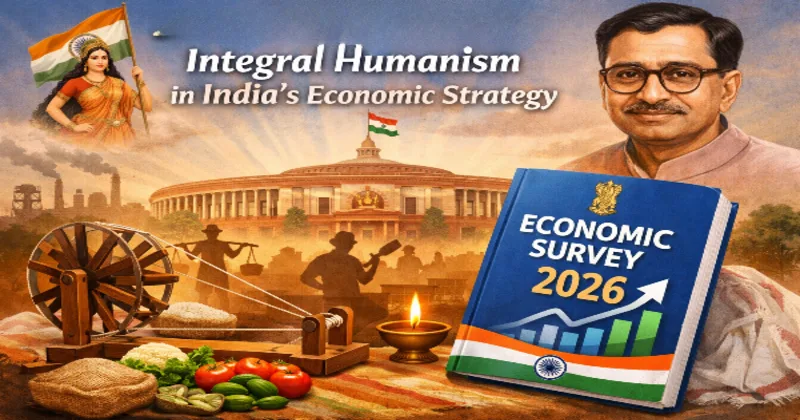
Resilience — Swadeshi and the return of integral humanism in India’s economic strategy

Economic Survey 2026 echoes Pandit Deendayal Upadhyaya’s Integral Humanism—one that re-centres the human being, values Swadeshi as strategic self-reliance rather than isolation, and seeks balanced development rooted in India’s civilisational ethos

Dr Jagmohan Singh RajuDr Jagmohan Singh Raju
Jan 30, 2026, 07:30 pm IST
in Bharat, Opinion, Culture, Business, Economy
Follow on Google News
Representative Image

Representative Image

FacebookTwitterWhatsAppTelegramEmail

The Economic Survey 2025–26 does not read like a manifesto, nor does it indulge in celebratory rhetoric. Its tone is sober, even restrained. Yet beneath its careful language lies a significant shift in India’s economic thinking—one that resonates strongly with Pandit Deendayal Upadhyaya’s doctrine of Integral Humanism.

At its core, the Survey suggests that India is moving away from a narrow obsession with speed and scale towards a more balanced idea of development—one rooted in resilience, self-strengthening, and long-term national capability. In an era of global instability, this is not merely a policy adjustment; it is a philosophical recalibration.

Integral Humanism and the limits of imported models

Pandit Deendayal Upadhyaya had argued that economic systems borrowed wholesale from foreign contexts inevitably create imbalance—between growth and equity, markets and society, material prosperity and human dignity. Development, he insisted, must be rooted in a nation’s civilisational ethos and social realities.

Also Read: NIA raids 20 locations across Kerala in crackdown on PFI–SDPI underground network

The Survey’s implicit critique of excessive global dependence echoes this insight. The global economic order today is marked by fractured supply chains, weaponised trade, and strategic control over technology and capital flows. In such a world, uncritical dependence on external systems becomes a source of vulnerability.

By reframing the central economic question—from how fast India can grow to how securely it can progress—the Survey aligns with Deendayal ji’s emphasis on Swadeshi not as isolation, but as self-reliant participation in the world.

The state as a facilitator of national capability

Integral Humanism rejected both unrestrained capitalism and statist centralisation. It envisaged a state that enables social harmony, economic balance, and decentralised strength. The Survey’s portrayal of the state closely mirrors this vision.

Public capital expenditure is not presented as short-term stimulus, but as long-term nation-building. Investments in roads, railways, ports, logistics, power, and digital public infrastructure are framed as productivity multipliers and shock absorbers. These assets strengthen the economic body of the nation, much as Deendayal ji spoke of harmony between the individual, society, nation, and humanity.

Fiscal discipline alongside sustained investment reinforces this approach: growth anchored in prudence, not excess.

Human beings at the centre of economics

A defining feature of Integral Humanism is its insistence that the human being—not capital or the state—must remain at the centre of economic life. The Survey’s treatment of education, health, nutrition, and skills reflects this principle.

Social sectors are no longer framed solely as welfare obligations. They are integrated into a productivity and capability narrative. Improvements in foundational learning, health outcomes, and labour participation—especially among women—are seen as investments in human potential.

This is a departure from both charity-driven welfare and purely market-driven efficiency. It reflects Deendayal ji’s belief that economic policy must serve the holistic development of the individual, while strengthening society and the nation.

Swadeshi through institutional strength

The emphasis on formalisation and financial deepening further reinforces the Integral Humanist worldview. A broader tax base, a stabilised GST regime, improved access to institutional credit for small enterprises, and healthier banks are not merely technocratic goals. They represent the strengthening of the nation’s economic spine.

Deendayal ji viewed decentralised enterprise, small producers, and local entrepreneurship as essential to social balance. The Survey’s approach supports this vision—not through protectionism, but by integrating these actors into formal systems that provide stability, credit, and opportunity.

Swadeshi, in this sense, is about empowering domestic enterprise within a strong national framework.

Strategic openness with civilisational confidence

Integral Humanism does not reject engagement with the world; it cautions against dependence without self-strength. The Survey reflects this balance. It does not argue for withdrawal from global trade or capital flows. Instead, it emphasises diversification, buffers, and strategic preparedness.

Services exports, remittances, and foreign exchange reserves are treated as instruments of stability rather than symbols of global submission. This is openness with confidence—engagement on India’s terms, grounded in domestic capability.

Preparing for the future without losing balance

The Survey’s cautious stance on emerging domains such as artificial intelligence, energy transition, and urbanisation also reflects Integral Humanist thinking. Rather than chasing fashionable global narratives, it stresses sequencing, institutional readiness, and alignment with national capacity.

Deendayal ji warned against development paths that disrupt social harmony or create new dependencies. The Survey’s realism suggests an awareness of these risks.

Resilience as modern Integral Humanism

Taken together, the Economic Survey 2025–26 reveals a deeper transformation in India’s economic philosophy. Growth remains essential, but it is no longer pursued in isolation from stability, dignity, and national self-reliance. The organising principle has become resilience—economic staying power rooted in infrastructure, human capability, institutional depth, and strategic autonomy.

This is Integral Humanism adapted to a 21st-century economy.

Swadeshi, in this context, is not nostalgia or retreat. It is the practical expression of a civilisational idea: that true prosperity emerges when development is balanced, rooted, and humane.

In an unsettled world, the Survey quietly affirms a timeless insight articulated by Pandit Deendayal Upadhyaya decades ago—that a nation which strengthens its inner foundations can engage the world without losing itself.

Topics: Pandit Deendayal UpadhyayaIntegral HumanismEconomic Survey 2026
ShareTweetSendShareSend
✮ Subscribe Organiser YouTube Channel. ✮
✮ Join Organiser's WhatsApp channel for Nationalist views beyond the news. ✮
Previous News

Rapes and killings rock Tamil Nadu: Bihar migrant family murdered, govt college canteen worker assaulted; CM silent

Next News

India has diplomatic leverage to drive Israel-Gaza peace, says Palestine Minister; Hails humanitarian aid of New Delhi

Related News

India’s first made-in-India C-295 aircraft marks a shift from state control to nation-building through public-private partnership

From Nationalisation to Nation Building: The difference between socialism and integral humanism

BJP Sthapna Diwas: Bharatiya Janata Party’s journey of ideology, dedication, and national transformation

B.L. Santhosh, National General Secretary (Organisation) of the Bharatiya Janata Party

Our society must transition from rule-based to value-based: B.L. Santhosh

C. P. Radhakrishnan , Vice President; Dr. Pradeep Bharadwaj, Prajna Pravah Karnataka South Coordinator; Pujya Jagadguru Sri Shivarathri Deshikendra Mahaswamiji Thaawarchand Gehlot, Karnataka Governor; Prof. Sharanappa Halase, VC of KSOU

Karnataka: VP Radhakrishnan inaugurates ‘Ekatma Manava Darshan’ Conference, calls for applying Integral Humanism

Karnataka High Court stays move to cancel ‘Ekatma Manava Darshana’ conference; victory for freedom of expression

West Asian War: Wave of uncertainty

Load More

Latest News

Keralam: BJP complains to Kannur Collector over oath taken in the name of Allah by UDF, SDPI councillors; seeks action

Reawakening of Bengal

Civilians injured in Afghanistan after Pakistan airstrike

Afghan Govt says Pakistani air strikes kill 36 Civilians, injure 163 amid escalating border tensions

Chinese President Xi Jinping

From Economic Miracle to Authoritarian Revival: Why Xi is rewriting China’s social contract

Malkangiri police recover large cache of Maoist arms and explosives

Major Maoist arms cache recovered in Malkangiri; Odisha records seventh anti-insurgency seizure within three weeks

PM Modi attended the National Day celebrations marking the 50th anniversary of Seychelles’ Independence as the Guest of Honour

PM Modi in Seychelles 50th National Day as Guest of Honour; Indian Army marches, reflecting stronger security ties

The Ghaziabad administration demolished an alleged illegal two-storey 'Mazar' on UPSIDA land in Loni, citing government land encroachment

Bulldozer Action in Ghaziabad: Alleged illegal two-storey ‘Mazar’ on UPSIDA land razed in Loni

Gadchiroli Police, CRPF destroy massive maoist weapons manufacturing facility and buried arms cache in Maharashtra

Gadchiroli police & CRPF destroy Maoist weapons manufacturing facility, recover buried arms cache in Maharashtra

Pak intruder arrested in Poonch after crossing border

Another Border Breach: Pakistani man Rayees Khan held after crossing LoC in Poonch; Third such incident in a month

'Missing' Posters Surface in Delhi

‘Rahul Gandhi missing’ posters appear across Delhi; BJP steps up attack over reported foreign visit

Load More
  • Privacy
  • Terms
  • Cookie Policy
  • Refund and Cancellation
  • Delivery and Shipping

© Bharat Prakashan (Delhi) Limited.
Tech-enabled by Ananthapuri Technologies

  • Home
  • Search Organiser
  • Bharat
    • Assam
    • Bihar
    • Chhattisgarh
    • Jharkhand
    • Maharashtra
    • View All States
  • World
    • Asia
    • Africa
    • North America
    • South America
    • Europe
    • Australia
  • Editorial
  • Operation Sindoor
  • Opinion
  • Analysis
  • Defence
  • Culture
  • Sports
  • Business
  • RSS @ 100
  • Entertainment
  • More ..
    • Sci & Tech
    • Vocal4Local
    • Special Report
    • Education
    • Employment
    • Books
    • Interviews
    • Travel
    • Health
    • Politics
    • Law
    • Economy
    • Obituary
  • Subscribe Magazine
  • Read Ecopy
  • Advertise
  • Circulation
  • Careers
  • About Us
  • Contact Us
  • Policies & Terms
    • Privacy Policy
    • Cookie Policy
    • Refund and Cancellation
    • Terms of Use

© Bharat Prakashan (Delhi) Limited.
Tech-enabled by Ananthapuri Technologies