The successful maiden flight of India’s first domestically manufactured C-295 aircraft marks far more than a milestone in defence production. It represents the beginning of a long-term national strategy , one that could eventually transform India from one of the world’s largest aviation markets into one of the world’s major aviation manufacturers. To understand why this project is important, one must first understand what the C-295 programme actually is. In 2021, the Government of India signed a landmark agreement to acquire 56 Airbus C-295 military transport aircraft for the Indian Air Force.
Under the arrangement, the first 16 aircraft would be delivered in fly-away condition from Spain, while the remaining 40 aircraft would be manufactured in India. For this purpose, Airbus partnered with Tata Advanced Systems Limited to establish a complete aircraft manufacturing ecosystem in India. This is not merely an assembly operation.
The project involves aircraft manufacturing, component production, supply-chain development, testing, certification, maintenance capability, and the creation of a highly skilled aerospace workforce. For the first time, a private Indian company is participating in the complete manufacturing of military transport aircraft within India. The significance of this project extends beyond the aircraft themselves. It is creating the technological foundation, industrial ecosystem, supplier network, and human capital necessary for India’s future aerospace ambitions.
In many ways, the C-295 programme is not the destination. It is the beginning of a journey. To appreciate the significance of this shift, it is necessary to look at India’s past. In 1932, J.R.D. Tata founded Tata Airlines, which later evolved into Air India. Built through entrepreneurship, innovation, and commercial excellence, it became one of India’s most respected institutions and a symbol of Indian capability. However, post-independence India increasingly adopted socialist economic policies.
The prevailing belief was that government ownership was superior to private ownership and that strategic sectors should be controlled by the State. Economic power was viewed with suspicion when held by entrepreneurs but considered acceptable when concentrated within government institutions. This philosophy culminated in the nationalisation of Air India in 1953. During the Indira Gandhi era, socialist policies expanded even further. Banks were nationalised. Government control over industry increased. The licence-permit-quota system became deeply entrenched.
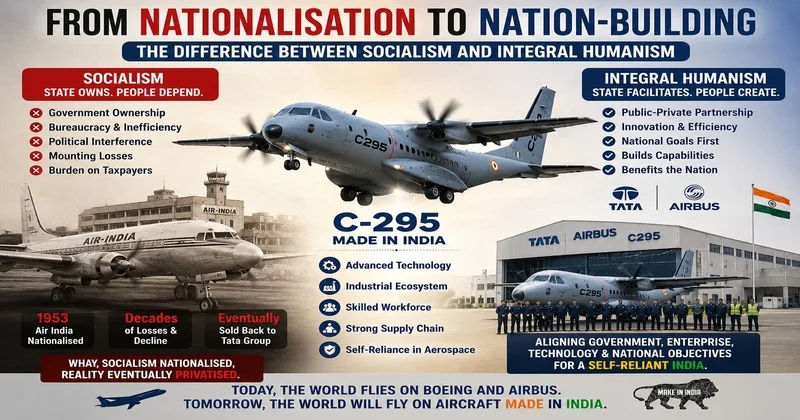
The State increasingly assumed responsibility for economic activity that had previously been driven by private initiative. Air India became one of the most visible examples of the consequences of this approach. What had once been a world-class airline gradually became burdened by bureaucracy, political interference, inefficiency, and mounting debt. Commercial decision-making was increasingly replaced by political considerations. Taxpayers repeatedly paid the cost of keeping the airline operational. The irony is striking. Air India was taken from the Tata Group in the name of socialism. After decades of losses, the government eventually sold it back to the Tata Group. What had been acquired from Tata without a voluntary market transaction had to be purchased back by Tata through a commercial transaction involving thousands of crores of rupees. History delivered its verdict. What socialism nationalised, reality eventually privatised. Yet the India of today is increasingly guided by a different philosophy. That philosophy is Integral Humanism. Articulated by Pandit Deendayal Upadhyaya, Integral Humanism rejects the notion that the State must own productive assets in order to advance society. Instead, it views society, enterprise, and government as complementary institutions that should work together toward national development. Under socialism, the State becomes the owner.Under Integral Humanism, the State becomes the facilitator. Under socialism, private enterprise is viewed as something to be controlled. Under Integral Humanism, private enterprise is viewed as a national asset when aligned with national goals. The Tata-Airbus C-295 programme reflects this philosophy in practice.
The government is not attempting to manufacture aircraft itself. Nor is it surrendering national interests to private corporations. Instead, it is aligning state policy, private-sector capability, foreign technology, and national objectives toward a common purpose. The result is not merely forty transport aircraft. The result is the creation of national capability.
Prime Minister Narendra Modi has repeatedly articulated a larger vision behind such initiatives. India, he argues, should not remain merely a buyer of aircraft manufactured elsewhere. Indians should one day travel in aircraft manufactured in India. This vision extends beyond defence production. It concerns India’s place in the global industrial order. Today, the global commercial aviation industry is dominated by two giants—Boeing and Airbus.
For decades, the world has relied upon aircraft produced by these companies. They represent one of the most sophisticated manufacturing ecosystems ever created. The significance of the C-295 programme lies in the fact that it begins building similar capabilities within India. Aircraft manufacturing cannot emerge overnight. It requires decades of technological development, precision engineering, skilled manpower, supplier networks, certification expertise, and industrial experience.
The C-295 programme is helping India acquire precisely those capabilities. Socialism sought development through government ownership. Integral Humanism seeks development through national capability. One philosophy took a successful enterprise from its creators and weakened it. The other seeks to create entirely new industries capable of serving the nation for generations. One concentrated power in the State. The other mobilises the strengths of government, society, and enterprise together. The aspiration is clear. Today, the world flies primarily on Boeing and Airbus aircraft. Tomorrow, the world may also fly on aircraft designed, manufactured, and exported by India. That is the difference between nationalisation and nation-building. That is the difference between socialism and Integral Humanism.