Some journeys are not really about getting anywhere. They end up in conversation with their own moment, and turn into a bridge of sorts between what a people were, what they are, and what they are trying to become. I am aware of how quickly a sentence like that becomes decoration. Bear with it, because I think this particular journey earns it.
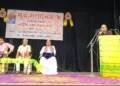
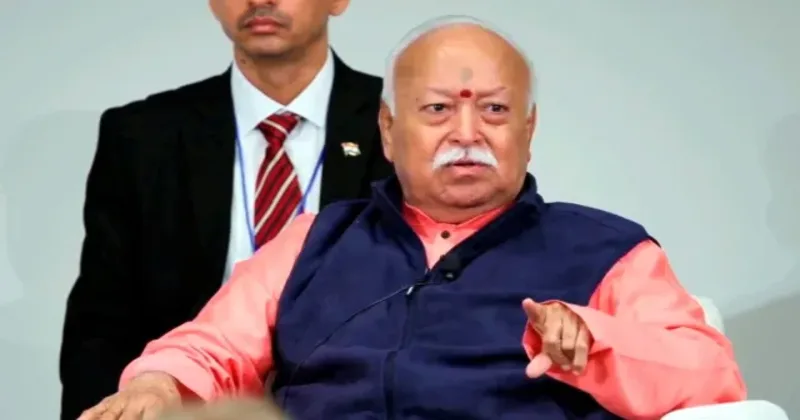
The Rashtriya Swayamsevak Sangh completes a hundred years, and a part of the centenary has been spent outside India rather than at home. The revered Sarsanghchalak Dr Mohan Bhagwat has been in conversation with audiences in the United States, in Canada and in the United Kingdom.
Read it as a foreign tour and you have read about half of it. Read it as an evening with the diaspora and you have read rather less. What has been carried into those halls is an attempt at self-introduction: an account of a civilisation that has, over a very long stretch of time, preferred coexistence to conflict and cooperation to dominance, at least as its stated ideal. Whether it has always lived up to that is a separate argument, and a fair one.
A world that grew closer without growing warmer
Technology has shortened every distance, and trust has shrunk along with it. We have more ways to communicate than any generation before us and less capacity for actual conversation. Nations depend on one another economically while mistrusting one another politically, frequently at the same time and over the same things. Science has handed us extraordinary power. The moral sense required to use it well has not kept pace, and I do not think anybody seriously argues otherwise.
That is the contradiction we live inside. A species that can reach space is still looking for the road to peace on ground it already owns. It has built artificial intelligence and has not worked out how to protect ordinary human feeling from what it built. It has learned to control nature and lost its balance with nature in the process.
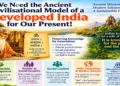
Put in that setting, Vasudhaiva Kutumbakam stops being a cultural flourish. It starts to look like a serious proposal about the future, which is not usually how the phrase gets used from a stage.
Unity is not sameness
The phrase has never meant making the world alike. India has been a poor advocate for uniformity, having never managed it at home. Travel a few hundred kilometres in any direction, and the language changes, and with it the food, the clothes, the festivals and the form that worship takes. Our philosophical traditions disagree with one another deeply and have never bothered to hide it. Underneath all of that has run a long attempt to locate a cultural relationship that holds anyway.
A family is not a set of identical people either. Its members differ in temperament, in ability, in what is asked of them, and what joins them is the relationship rather than the resemblance. That is the whole of the claim. Nations can keep their identities, societies can protect what is particular to them, and civilisations can go forward carrying their own experience. What the phrase asks is only that humanity not be turned into permanent ground for a fight.
Nobody is being asked to surrender an identity here. The ask is narrower and considerably harder. That an identity stops functioning as a reason to despise somebody.
The revered Sarsanghchalak has returned to this point repeatedly. A society should be confident about its cultural inheritance, he has argued, without allowing that confidence to turn into hostility towards anyone else. He holds that a person can stand firmly inside his own faith and still respect the dignity of somebody standing somewhere quite different. Ekatmata, in its modern sense, means roughly that. Not sameness imposed from above, but a consciousness of relationship.
The obvious objection will be raised, and I would be surprised if it was not raised in some of the halls he spoke in. Can an organisation so closely identified with one civilisational assertion be a credible carrier of a message about plurality? It is a fair question, and it deserves a better answer than irritation. My own view is that claims of this kind are never settled by declaration. They are settled slowly, by conduct, over decades, and the record gets examined by people with no particular wish to be impressed. A dialogue that cannot absorb the objection is not a dialogue. It is publicity with better manners.
What a hundred years is for
Nagpur, 1925. A century is long enough to test an idea properly. Long enough to watch the political weather turn several times over, to face sustained opposition, and to hand an organisation to people who had no part in building it. In the Sangh’s own account of itself, the concern from the start was the inner strength of society rather than the capture of the state. Political authority alone, on that reading, cannot make a nation durable. What makes it durable is the character of its people, their capacity to organise, the trust they extend one another, and the habit of service. Those, and not the ministries, are treated as the real capital.
There is a sequence in Indian thought that the Sangh took seriously. A person belongs to a family, the family to a society, the society to a nation, and the nation, in the end, to humanity. The self keeps widening until it has taken in everyone. Sva to sarva. Easy to recite. Extremely difficult to practise, and the difficulty is rather the point of it.
It is at the word service that the claim gets paid for. Saying the world is one family costs nothing at all. Behaving as though a stranger’s trouble has some claim on you is expensive. Hunger belongs to no religion. Pain belongs to no caste. A disaster does not check anybody’s politics before arriving. Service, when there is genuinely nothing in it for the person offering it, is understood without translation, and it raises a question larger than any single organisation’s record. Can citizenship be made of rights alone, or does it have to carry obligations too? We have become admirably alert to rights. Societies also survive because people look after one another, and that half is much harder to legislate.
The diaspora makes the point better than argument does. Indians abroad have done conspicuously well in science, medicine, engineering, business and university life, and they belong at once to the countries they live in and to an inheritance a good deal older than those countries. This is usually called a tension. I am not sure it needs to be. Someone can be rooted in Indian civilisation and be a thoroughly responsible citizen of Canada or Britain with no contradiction at all. And the best ambassadors any culture gets are never the ones announcing its superiority. They are the ones whose ordinary conduct makes somebody else curious about where it came from. Civilisations do not travel through books alone. They become credible through people.
The person is not a market segment
Deendayal Upadhyaya delivered the four lectures that became Integral Humanism at Bombay in April 1965. They have lasted for an unhappy reason, which is that the habit they were written against has only got worse since. The citizen is a voter. The worker is an input. The consumer is an opportunity, and the individual is now a data profile with a prediction attached to it. Each description is accurate as far as it goes, and that is exactly the trouble with them. A person is body, and also mind, intellect, consciousness and a moral world, and none of those parts can be managed separately from the others.
None of this is an argument against material progress, and I want to be clear about that, because the argument is often made badly. India has never held that poverty is spiritual and it should not start now. Dignity needs economic security underneath it. But if the economy strengthens while people grow lonelier, if technology advances while trust in society thins out, if incomes rise while families and neighbourhoods come apart, it is difficult to call the result full development. The point is not to reject modernity. It is to insist that modernity be made more human than it currently is.
Nature was never a warehouse
Climate change, water stress, the erosion of biodiversity and the overuse of what is left are not only scientific or political questions. They are questions about consciousness. Modern life has treated nature mainly as a supply of resources. The Indian tradition built a relationship with it instead, and the vocabulary shows it. The earth was called mother. Rivers were held to be life-giving. Trees were worshipped, and birds and animals were counted as part of a wider family of living things.
None of which is an argument against development, and the romantic version of it does real damage. What it asks is that we learn the difference between use and exploitation. A person’s needs can be finite. A person’s wants are not, and a civilisation that never learns to tell the two apart will go on eating its own foundations. Enough for our need and not for our greed, as it was put during the engagements abroad. We are not the owners of the natural world. We are one part of it, and a fairly recent part at that.
Peace is not the absence of strength
Arjuna stands on the field with his bow lowered. He can see his teachers on the other side, and his cousins, and he does not want to fight. What follows is not a pep talk. Krishna does not tell him that the killing is fine, or that his doubts are a weakness to be got over. He asks him to look at his duty, at his doubt, and at what his choices are going to cost. That is why the Gita is a hard book. It never lets him off.
So when people hear India speak of peace and take it for a preference for weakness, they have misread us. Badly. There is the compassion of the Buddha in this tradition and there is the sense of duty in the Gita, and the two have coexisted here for a very long time. Ahimsa is an ideal. So is the courage to stand against injustice. Peace on this reading is not strength given up. It is strength held under restraint.
Which leads to three propositions worth stating plainly. Strength is necessary, and so is the discipline to go with it. Security is necessary, but frightening other people is not what it is for. And national interest is necessary, though a nationalism that has cut itself off from any sense of humanity eventually becomes a danger to the nation holding it.
This matters more now than it did twenty years ago, because Bharat is changing. The economy grows. Technological capacity improves. Our voice carries further than it used to. All of it true, and all of it beside the point. Becoming powerful is the easy half.
The world is not short of powerful countries. Look around. What it is short of is responsible ones, and India has an opening here to say something about what power actually consists of. Military capacity is one part. Trust is another. So is moral credibility, and so is the willingness to stand with somebody when things go wrong for them. A country that only wants to be one more great power will end up as one more competitor. A country that brings a moral vocabulary along with its strength might change the terms of the conversation. That conversation has to be conducted as a conversation, though. The world is not waiting for another announcement of cultural superiority. India does not need to claim final answers to anything. It can say that it has a long experience of certain human questions and would like to talk about them, which is what confidence actually sounds like. Confidence does not shout. It converses. And conversation is not the same as agreement. There will be disagreement, questions, criticism. The value lies in the talking continuing anyway.
The next hundred years
Surviving a hundred years proves nothing by itself. Plenty of things survive. The questions ahead are harder than the ones behind. Artificial intelligence is already rearranging work, and it will get to how we learn and think and make things. Technology will reshape social relationships. The structure of the family will change again, as it has before. Climate pressure will move people, and wherever people move politics follows them. New tensions will open between human freedom and technological control, and I am not persuaded we have thought carefully about what happens when they do.
In that setting our civilisational tradition cannot be kept as a memory of the past. It has to be capable of answering questions the past never faced. Which means not keeping it the way we keep the good crockery, taken out on anniversaries, admired for an evening, put back. It has to be used. Argued with. Applied to problems it was never written for. India’s strength was never its antiquity anyway. It is whatever continuing relevance it can earn.
An invitation, not a doctrine
I do not think we should be in the business of exporting a doctrine, and I say that as somebody who believes in this one. Bharat has never needed to stand in front of the world and announce that it is better. The civilisations that keep announcing it are usually the ones least sure of themselves.
Our proof will not come from a stage anyway. It comes from a shakha ground at six in the morning in some district town that nobody writes about, where thirty boys turn up because they said they would. It comes from volunteers who reach a flooded village before the trucks do and who do not ask anybody’s name before handing over the food. That is where an idea like ours is either true or it is not. The halls abroad matter only if that ground holds.
None of this makes the nation smaller, and national interest is not something we need to be embarrassed about. I have never understood why people assume it must be one or the other. What our tradition asks is harder and more particular than that. When we look after our own, we are not to behave as though nobody else is there.
If I had to keep one sentence out of all of this and throw away the rest, it would be this. There is a difference between holding an identity and using it against somebody. Everything else written here is commentary on that line. A man can be entirely certain of who he is without needing his neighbour to be less.
Vasudhaiva Kutumbakam asks for that and not a great deal more. It does not ask the world to become Indian. It asks all of us to become a little more human than we are, which sounds like a small thing until you try it on an ordinary Tuesday with a person you cannot stand. So yes, the halls in New York and Toronto and London were worth filling. A question was carried into three countries and left behind in each of them. The answer will not be written there. It will be written on our own streets, in how we treat the people we live beside, over years, mostly by people who were never invited to any of it. That is the invitation. It has been open a very long time and it costs nothing to accept. Keeping it open is what costs, and that is the work of the next hundred years.