MUMBAI: At a time when many young professionals leave villages in search of opportunities in cities, Nileema Mishra chose the opposite path. After completing her postgraduate studies in clinical psychology and gaining experience at Vigyan Ashram, she returned to her native Bahadarpur village in Maharashtra with a simple conviction: rural communities could find solutions to their problems if they were given the opportunity and resources to do so themselves.
What began as a grassroots initiative in one village eventually grew into a movement involving more than 200 villages across four districts of Maharashtra, with women, farmers and other rural communities becoming active participants in their own economic development.
From village roots to a life of service
Born in Bahadarpur in Maharashtra’s Jalgaon district, Mishra grew up witnessing the difficulties faced by poor rural families. Her concern for disadvantaged people reportedly began at a young age. At 13, she had already expressed her determination to devote her life to helping the poor.
She later pursued a master’s degree in clinical psychology at Pune University. Instead of choosing an urban professional career, she spent eight years working with Vigyan Ashram in Pabal under Dr S. S. Kalbag, an experience that shaped her understanding of rural development, self-reliance and locally developed solutions.
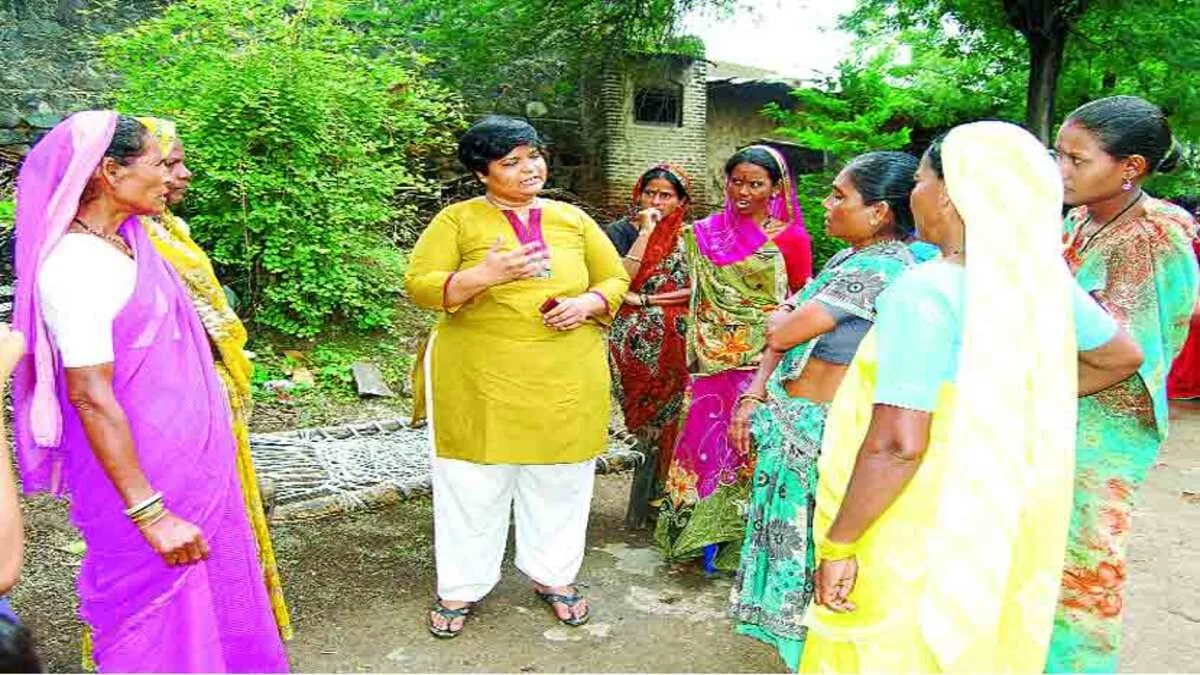
When she eventually returned to Bahadarpur, Mishra did not arrive with a conventional top-down development model. Her approach was to listen to villagers and help them develop their own solutions. This philosophy became the foundation of the Bhagini Nivedita Gramin Vigyan Niketan (BNGVN), or Sister Nivedita Rural Science Centre. The organisation describes itself as non-political and non-religious and focuses on strengthening rural economies and helping villagers become self-reliant.
Empowering women through self-help groups
One of Mishra’s biggest areas of focus was rural women. The initial work included helping women acquire skills through activities such as computer training, sewing and other livelihood-oriented programmes. These efforts gradually developed into self-help groups that encouraged women to save, access credit and develop small businesses.
The model expanded rapidly. According to the 2011 Ramon Magsaysay Award citation, BNGVN had formed 1,800 self-help groups across 200 villages in Maharashtra. The women were not simply recipients of assistance; they became involved in producing, marketing and selling their own products.
The initiative also helped women develop management and entrepreneurial skills. Some groups came together to purchase raw materials in bulk, reducing costs, while others created outlets to sell their products across several districts.
For women who had traditionally remained confined largely to their homes, the change went beyond income. They gained greater confidence, financial independence and a stronger voice in decisions affecting their families and communities.
When poverty threatened farmers
Mishra’s work also expanded beyond women’s self-help groups. Rural Maharashtra faced serious economic distress, including a wave of farmer suicides. BNGVN responded by developing community-based financial mechanisms to help farmers deal with urgent needs and reduce dependence on exploitative moneylenders.
The organisation created a village revolving fund, through which farmers and other disadvantaged residents could access credit for agricultural inputs and emergency requirements.
The idea was straightforward: instead of creating permanent dependence on outside assistance, communities should have access to mechanisms that allow them to address their own financial needs. That philosophy remains central to BNGVN’s approach. Its stated mission includes providing affordable credit, creating marketing opportunities for village industries and offering vocational training that can lead to sustainable livelihoods.
Building villages from within
Mishra’s model was based on a belief that rural development cannot succeed if villagers are treated merely as beneficiaries. Her organisation encouraged villagers to participate in identifying problems and developing solutions. Village-level institutions, women’s groups and community funds became important components of the model.
BNGVN also worked on sanitation, including the construction of hundreds of private and community toilets, while encouraging village assemblies to discuss local problems and decide how available resources could be used. The objective was not simply to bring outside assistance into villages but to strengthen the ability of the villages themselves to manage their development.
From one village to more than 200
The transformation that began in Bahadarpur gradually spread beyond its borders. The success of the initial work encouraged Mishra and her team to expand the model to other parts of Maharashtra. Within a decade, the initiative had reached 200 villages across four districts, with thousands of women organised through self-help groups.
The organisation’s later work has continued to focus on creating livelihood opportunities, savings mechanisms and access to loans for rural women and communities. Its own account says the initiative has grown into a 20,000-women-strong network focused on savings, livelihoods and access to credit through self-help groups.
Recognition without chasing the spotlight
Mishra’s work eventually attracted international attention. In 2011, she received the Ramon Magsaysay Award for Emergent Leadership for her grassroots work with villagers in Maharashtra. The award citation recognised her efforts to organise rural communities and help them collectively address their aspirations and difficulties.
Two years later, she was awarded the Padma Shri in 2013 for Social Work. Yet Mishra has repeatedly maintained that recognition was never the purpose of her work. In an interview, she explained that she had deliberately avoided seeking awards, media attention and government funding because she believed these could distract from grassroots work. She also donated her Ramon Magsaysay Award prize money towards the work of BNGVN.
A different model of rural development
Nileema Mishra’s story stands out because her approach does not centre on one large project or a single dramatic intervention. Instead, it is about creating systems within villages, helping women save and earn, giving farmers access to credit, developing skills, improving sanitation and encouraging communities to participate in solving their own problems.
The journey from Bahadarpur to more than 200 villages demonstrates how a small grassroots experiment can develop into a wider rural movement when communities are given the confidence and tools to become self-reliant. Mishra’s work offers a simple message: rural development is strongest when villagers themselves become the drivers of change.