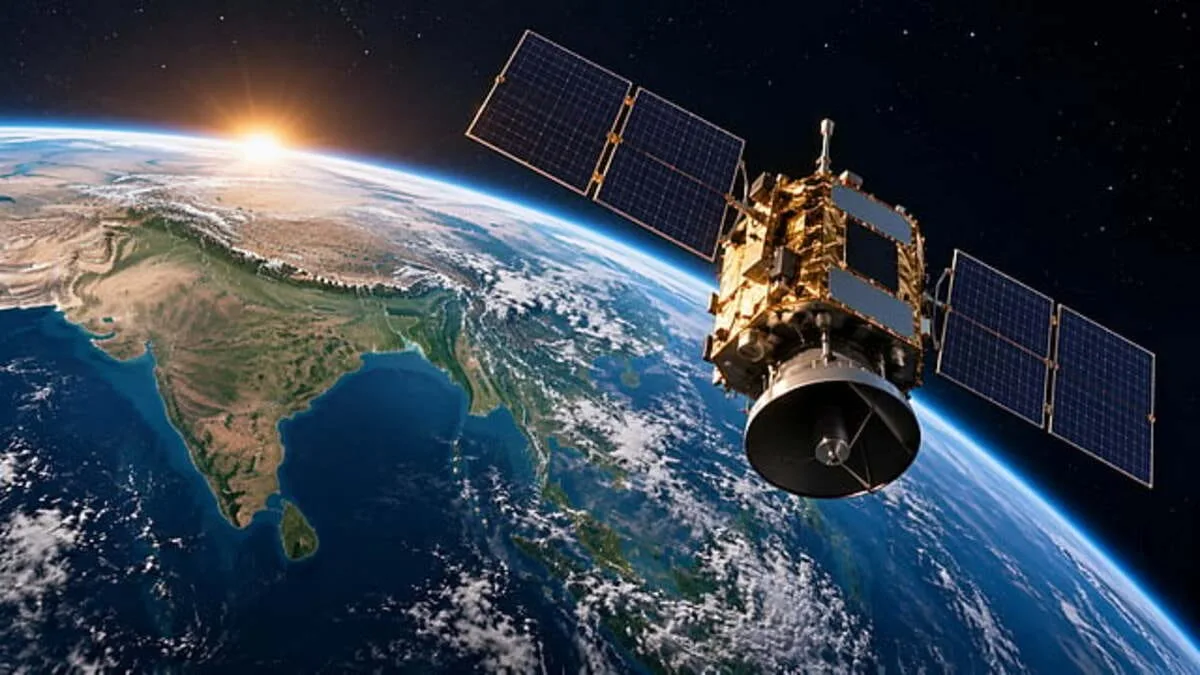
NEW DELHI: Indian space-tech startup GalaxEye has secured a US patent for its OptoSAR satellite imaging technology, marking a significant milestone for India’s rapidly expanding private space and deep-tech ecosystem.
The patented technology combines optical imaging and Synthetic Aperture Radar (SAR) on the same spacecraft and synchronises data from both sensors. The approach is designed to provide a more comprehensive and reliable view of the Earth by combining the strengths of two different imaging technologies.
🚀🇮🇳 BIG NEWS FOR INDIA’S PRIVATE SPACE SECTOR!
Indian space-tech startup #GalaxEye has secured a US patent for its OptoSAR satellite imaging technology — a major milestone for India’s growing deep-tech and commercial space ecosystem. 🇮🇳🛰️
🔹 What makes #OptoSAR special?
It… pic.twitter.com/srjpVofdNA— Zest (@Zest328117) September 10, 2026
Combining optical and radar imaging
Traditional optical satellite imaging can produce highly detailed images of the Earth’s surface. However, optical sensors depend on sunlight and can be affected by cloud cover, making them less effective during nighttime or under cloudy conditions.
SAR, on the other hand, uses microwave signals to observe the Earth’s surface. Since the technology does not depend on sunlight, SAR can capture imagery during both day and night and can operate even when clouds obstruct conventional optical sensors.
GalaxEye’s OptoSAR approach seeks to bring these capabilities together on a single satellite. By synchronising the optical and SAR data, the technology aims to generate spatially and temporally aligned information that can provide a richer picture of changes and activities on the Earth’s surface.
Wide range of applications
The technology could have applications across several sectors, including defence and national security, agriculture, disaster management, insurance, infrastructure monitoring and environmental observation.
For defence and security agencies, the combination of optical and radar imagery could provide more consistent observation capabilities in varying weather and lighting conditions.
In agriculture, such data could assist with monitoring farmland and changes in land conditions. During natural disasters, the ability of SAR to operate through cloud cover could help provide imagery when conventional optical satellites face limitations.
The technology could also support infrastructure and environmental monitoring by providing complementary information from optical and radar sensors.
GalaxEye demonstrated its technology through Mission Drishti, which was launched in May 2026. The mission was intended to demonstrate the company’s approach to combining optical and SAR imaging. However, the spacecraft was subsequently lost following a geomagnetic storm. Despite the setback, GalaxEye has continued to pursue its broader vision of developing an OptoSAR satellite constellation.
Plans for a 30-satellite constellation
The Bengaluru-based startup plans to develop a constellation of 30 satellites over five years. If realised, the constellation could significantly increase the frequency with which areas on Earth can be observed.
A larger constellation would potentially enable more continuous monitoring and provide users with more frequently updated Earth-observation data.
The company’s long-term objective reflects the growing ambitions of India’s private space sector, which is increasingly moving into areas beyond launch services and satellite manufacturing to develop advanced space-based technologies and commercial applications.
The US patent represents an important step for GalaxEye as it seeks to commercialise its technology internationally.
Patent protection provides legal safeguards for the company’s specific technological architecture in the US market. It can also strengthen the startup’s intellectual-property position as it explores partnerships, customers and opportunities in the global Earth-observation market. For India’s private space ecosystem, the development also highlights a broader shift towards indigenous intellectual property and globally differentiated space technologies.
From India to the global space market
India’s space sector has undergone a major transformation in recent years, with private companies increasingly contributing to satellite technology, launch systems, Earth observation and other areas of the space economy.
GalaxEye’s OptoSAR technology represents this emerging trend, combining different sensing technologies to address limitations faced by conventional satellite imaging systems. The US patent, despite the setback faced by Mission Drishti, gives the company another important milestone as it works towards its larger constellation vision.
If GalaxEye succeeds in deploying its planned satellite network, the company could become an important player in the global Earth-observation market while further strengthening India’s position as a developer of advanced commercial space technology.