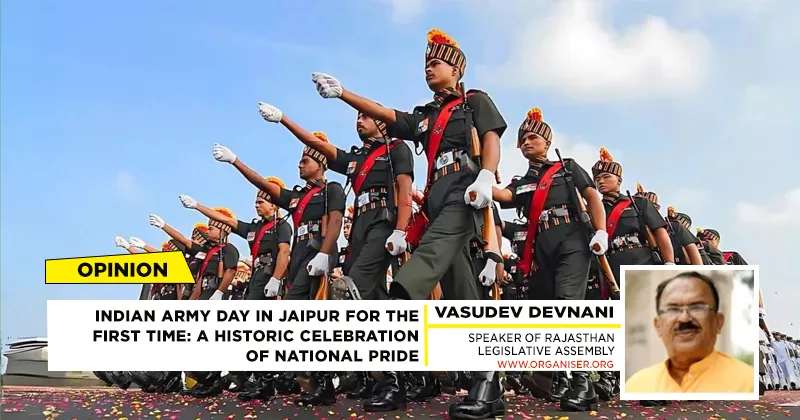
Indian Army Day is celebrated every year on January 15th to honour the indomitable courage, discipline, and sacrifice of the Indian Army. This year, this grand and impressive event is being held for the first time in Jaipur, the capital of Rajasthan. This will be a historic and unforgettable occasion for Rajasthan. January 15, 1949, is a significant date in Indian military history. On this day, Lieutenant General K.M. Cariappa assumed office as the first Commander-in-Chief of the Indian Army of independent India. This event freed the Indian Army from colonial influence and laid the foundation for indigenous leadership and a self-reliant military tradition. Since then, January 15th has been celebrated as Army Day to honour the sacrifice, discipline, and patriotism of the soldiers.
The Indian Army is not merely a military force, but a living symbol of India’s sovereignty, unity, and integrity. From defending the country’s borders to disaster management, peacekeeping, and nation-building, the role of the Indian Army has been multifaceted and glorious. India’s history is full of unique tales of valor, sacrifice, and national defence. There have been many wars and military conflicts that every Indian is proud of. In its history, India has always followed the policy of “Vasudhaiva Kutumbakam” (the world is one family), peace, and non-violence, and has never adopted a policy of aggression. However, whenever the country’s sovereignty, honor, and security were threatened, the Indian armed forces achieved victory with indomitable courage, strategy, and sacrifice. Every Indian is proud of these wars and strategic campaigns.
Among the wars that make us proud is the 1857 uprising, which was India’s first organised mass revolt against British rule. Heroes like Rani Lakshmibai, Mangal Pandey, Tantya Tope, and Bahadur Shah Zafar ignited the flame of freedom in the country. Although this struggle was not successful, it laid the foundation for India’s independence. Immediately after independence, Pakistan attacked Kashmir. The Indian Army, displaying extraordinary courage, defended Srinagar and secured a large part of Kashmir. This is where the world first saw the Indian Army’s professional capabilities. In 1962, the circumstances were difficult, and resources were limited, yet Indian soldiers displayed indomitable courage against China in the high altitudes of the Himalayas. Battles like Rezang La remain examples of supreme sacrifice. In the 1965 Indo-Pak war, India repelled Pakistan’s aggression with full force. On the Lahore front, at Asal Uttar and Phillora, the Indian Army demonstrated its superiority.
The Indo-Pak War of 1971 (Bangladesh Liberation War) is considered India’s greatest military victory. In just 13 days, the Pakistani army surrendered, and Bangladesh was born as a new nation. The surrender of over 90,000 Pakistani soldiers to the Indian Army is unparalleled in world history.
Similarly, in the Kargil War of 1999, driving out Pakistani infiltrators from the Himalayan peaks and high-altitude areas was extremely difficult. Heroes like Captain Vikram Batra, Lieutenant Manoj Pandey, and Grenadier Yogendra Singh Yadav made the supreme sacrifice, and India once again hoisted the tricolour flag on all the peaks of Kargil. After the Uri attack in Kashmir, the Indian Army conducted a surgical strike (2016) across the border, destroying terrorist hideouts. This became a symbol of India’s new security policy and its bold decision-making. Furthermore, after the Pulwama attack, the Indian Air Force conducted the Balakot airstrike (2019), penetrating Pakistani territory and destroying terrorist training camps. This action sent a clear message to the world about India’s military and strategic capabilities.
India’s military tradition is not limited to brave soldiers alone; many of our great army chiefs have led the country’s armed forces, and India is proud of their strategy, courage, and national devotion. Among India’s prominent Army Chiefs, General KM Cariappa, the country’s first Army Chief (1949), remains an ideal for the army to this day.
Along with him, the names of General K. Sundarji, Field Marshal Sam Manekshaw, General V. N. Sharma, General Deepak Kapoor, General Bipin Rawat, etc., are prominent. Besides these, the names of Air Chief Marshal Arjan Singh, a glorious chief of the Indian Air Force, and Admiral R. D. Katari, a pride of the Indian Navy, are also particularly noteworthy. These illustrious army chiefs of India not only fought wars but also set a new direction for the Indian Army, strengthened national security, and elevated India’s self-respect on the world stage. Their capable leadership, sacrifice, and vision are an inspiration for future generations.
Prime Minister Narendra Modi’s self-reliant Defence initiatives
Under Prime Minister Narendra Modi’s leadership, India has witnessed a historic transformation in the defence sector. Under the “Atmanirbhar Bharat” (Self-Reliant India) vision, numerous remarkable and far-reaching efforts have been made to make the Indian Army, Navy, and Air Force indigenous, modern, and capable. After Narendra Modi became Prime Minister in 2014, defence production was made a national priority. The Indian government set a clear goal: to become a weapons manufacturer instead of a weapons importer. This vision has made India’s defence sector a crucial pillar of the “Make in India” initiative. For the first time in the country, more than five negative import lists were issued. The import of hundreds of weapons, platforms, and components was banned, and the armed forces were mandated to adopt indigenous alternatives, providing significant opportunities to the domestic industry in the defence sector. A large portion of the defence budget was reserved for procurement from Indian companies.
Up to 75 per cent of capital procurement was sourced from Indian companies, and startups were encouraged to enter defence production. DRDO (Defence Research and Development Organisation) was given greater autonomy, funding, and targets. The Tejas fighter aircraft, Akash, BrahMos, and Nag missiles, and state-of-the-art radar and electronic warfare systems were developed domestically, and Defence Public Sector Undertakings (DPSUs) were corporatised to make them more competitive. For the first time, private companies were involved in defence production on a large scale. Companies like Tata, Larsen & Toubro, and Bharat Forge participated. The iDEX (Innovations for Defence Excellence) scheme provided startups with opportunities for defence innovation, bringing youth-led technology to the armed forces.
Before 2014, India’s defence exports were negligible. Now, India exports defence equipment to more than 80 countries. The country has set an export target of over ₹50,000 crore. BrahMos missiles, helicopters, patrol boats, and ammunition are among the items being exported. Establishment of the CDS
The Government of India has created the post of Chief of Defence Staff (CDS) to ensure integrated operations of the three armed forces, leading to better utilisation of resources. This revolutionary step is also considered a strategic reform towards self-reliance.
Improvements and development of roads in border areas, along with the construction of tunnels, airfields, and other infrastructure, are underway. Steps have been taken to reduce dependence on foreign sources for rapid military deployment and supplies in Ladakh and Arunachal Pradesh. The production of indigenous military equipment and uniforms has increased the availability of bulletproof jackets, modern helmets, assault rifles, and indigenous combat uniforms for soldiers. This has significantly enhanced both the safety and confidence of the soldiers.
The strong policies of the Modi government have made surgical strikes and air strikes possible, and India’s zero-tolerance policy against terrorism has sent a message to the entire world that India is not only capable of making its own decisions but is also self-reliant. Under Prime Minister Narendra Modi’s leadership, self-reliance is not just a slogan for India but a policy, a budget, and a reality on the ground. Today, the Indian Army is not only powerful but is also becoming indigenous, modern, and globally respected. The slogan of a self-reliant army and a secure India is one of Prime Minister Narendra Modi’s greatest strategic contributions to the nation.
A grand event held in Jaipur for the First Time
The land of Rajasthan has always been a symbol of valour, self-respect, and sacrifice. The heroic tales of the Rajputs, the remarkable participation of soldiers from border regions, and the tradition of army service in every village make this state unique. The decision to hold Army Day in Jaipur, the capital of this land of heroes, is a significant step towards honouring this historic state and further strengthening the bond between the army and the general public. Army Day’s main events are usually held in Delhi or military cantonments, but its first-ever staging in Jaipur reflects the Indian Army’s new approach, which involves connecting with the country’s cultural and historical cities to strengthen its public relations.
The ceremony in Jaipur proved that the army is not limited to the borders but is a glorious institution deeply connected to every segment of society. The grand parade ceremony, being held for the first time in Jaipur’s Pink City on Army Day, will be a major draw for the general public. At this ceremony, the excellent display of discipline, dedication, and uniformity by various contingents of the Indian Army, along with precise marching, military salutes, and a traditional military parade, will fill spectators with a sense of pride. In addition, the exhibition of modern weapon systems, armoured vehicles, and communication equipment will demonstrate that the Indian Army is continually strengthening its technological capabilities and is fully prepared for future challenges.
The most emotional aspect of the Army Day ceremony will be paying tribute to the martyrs. Wreaths will be laid, and a two-minute silence will be observed to honour the brave soldiers who sacrificed their lives in the defence of the country. This grand event and tribute will be even more meaningful on the soil of Rajasthan, which has given the nation countless brave sons. This moment will remind every citizen that the country’s freedom and security are possible only because of the sacrifice and dedication of our soldiers. The event will not be limited to a display of military power; it will also showcase beautiful, captivating glimpses of Indian culture and folk traditions. The parade, accompanied by patriotic tunes from the military band, will be enhanced by Rajasthani folk music, dance, and traditional performances. This military and cultural synergy will symbolise how the Indian Army strengthens the spirit of unity in the country’s diversity.
This Army Day parade will be particularly inspiring for young people and students. Through these programs, participants will gain an understanding of career opportunities in the army, discipline, leadership, and the importance of national service.
Information related to army recruitment, including the “Agniveer” scheme, will be shared, further increasing the interest and respect of young people towards the army. This event in Jaipur, a historical, educational, and cultural centre, will serve as a guiding light for the next generation. It will also create a deep emotional connection between the Indian Army and civil society. The enthusiastic participation of the general public, the resounding applause, and the patriotic slogans will send a message everywhere that the Indian Army enjoys the full support and respect of the countrymen. This event will also serve to bring the army closer to the public and strengthen transparency and trust.
In addition to protecting the country’s borders, the three branches of the Indian Army make significant contributions to disaster management, humanitarian assistance, and internal security across the country. The Indian Army’s role in international peacekeeping operations has also been commendable.
This important event in Jaipur will convey the Indian Army’s multifaceted role to every citizen. This event will also convey that the Indian Army is not only the guardian of the borders but also the bedrock of the nation’s soul, unity, and security. There is no doubt that this echo rising from the land of Jaipur will further strengthen the feelings of pride, gratitude, and patriotism in the heart of every Indian. May the Indian Army live forever – this slogan should resonate in the minds of every citizen; this should be the message of Indian Army Day.