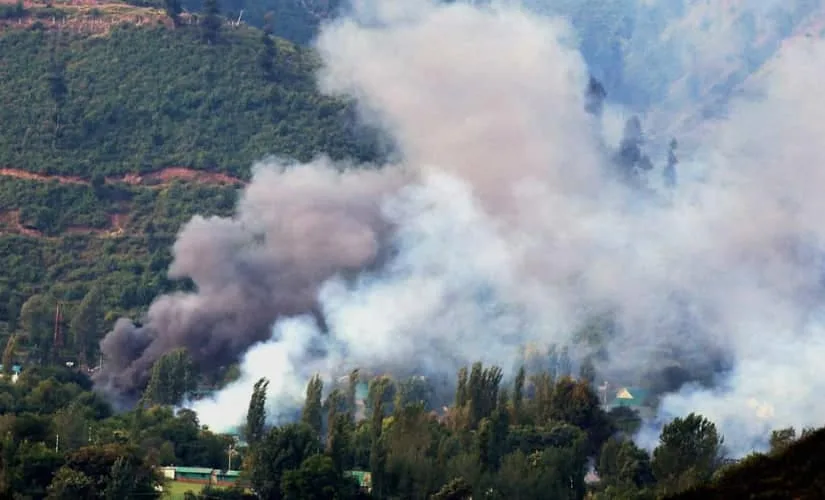
A decade ago, India marked a significant shift in its counter-terrorism response when Indian Special Forces carried out surgical strikes against terrorist launch pads along the Line of Control (LoC) in Pakistan-occupied Jammu and Kashmir (PoJK). The operation, announced by the Director General of Military Operations (DGMO) on September 29, 2016, came days after the deadly Uri terror attack and was described by the government as a pre-emptive action against teams preparing to infiltrate into Jammu and Kashmir and carry out attacks.
10 YEARS OF SURGICAL STRIKES
10 years ago, Indian Special Forces crossed the LoC and struck terror launchpads in Pakistan-occupied Jammu & Kashmir following the Uri terror attack.
2016 marked a clear shift: India would respond to terrorism with decisive action.
From the 2016… pic.twitter.com/veQiqNbA70
— Shadow IND (@ShadowIND_IN) September 28, 2026
The 2016 operation became an important milestone in India’s publicly articulated approach towards cross-border terrorism. In the years that followed, India demonstrated that its military response could take different forms depending on the nature of the threat — from ground-based action across the LoC in 2016, to an air strike at Balakot in 2019, and eventually the multi-site precision strikes conducted under Operation Sindoor in 2025.
2016: The Uri attack and the surgical strikes
On September 18, 2016, terrorists attacked an Army camp in Uri, Jammu and Kashmir, killing 19 Indian soldiers. The attack intensified concerns over infiltration and terrorist launch pads located across the LoC.
Eleven days later, on September 29, the Indian Army announced that it had conducted surgical strikes against several launch pads along the LoC.
According to the DGMO’s official statement, the Army had received specific and credible information that terrorist teams had positioned themselves at launch pads to infiltrate into Jammu and Kashmir and carry out attacks in the region and elsewhere in India. The operation was therefore described as an effort to pre-empt infiltration and prevent attacks on Indian citizens.
The announcement was significant not merely because of the operation itself, but because India publicly acknowledged the action. The DGMO also informed his Pakistani counterpart about the operation and stated that India wanted peace and tranquillity in the region while making clear that it would not permit terrorists to operate across the LoC with impunity. The 2016 strikes consequently became a reference point in discussions about India’s changing counter-terrorism doctrine.
From ground operations to air power
The next major demonstration of this approach came after the Pulwama terror attack in February 2019.
On February 14, 2019, a suicide bomber belonging to Pakistan-based Jaish-e-Mohammed attacked a CRPF convoy in Pulwama, killing 40 personnel.
Twelve days later, on February 26, India carried out an air strike on a Jaish-e-Mohammed training camp at Balakot in Pakistan. The Ministry of External Affairs described the operation as a “non-military pre-emptive action” based on intelligence indicating that JeM was preparing further suicide attacks against India.
The Balakot operation represented a further expansion of India’s military response. Unlike the 2016 operation, which involved Special Forces action across the LoC, the 2019 operation used air power to strike a terrorist training facility deeper inside Pakistani territory.
The government stated that the target was selected to avoid civilian casualties and that the facility was located away from civilian presence. The significance of Balakot extended beyond the immediate military operation. It demonstrated that India’s response to a major terror attack could extend beyond the traditional LoC theatre.
At the same time, the events of 2019 also underscored the risks associated with military escalation between two nuclear-armed neighbours. The Balakot episode was followed by heightened military tensions between India and Pakistan. Thus, the trajectory from Uri to Balakot was not simply about the increasing use of military force. It reflected a broader evolution in the instruments India employed against terrorism — from special operations to air power, alongside diplomatic and security measures.
Operation Sindoor: A new phase
The evolution continued in 2025 following the Pahalgam terror attack. On May 7, 2025, India launched Operation Sindoor, striking what the Ministry of Defence described as terrorist infrastructure in Pakistan and Pakistan-occupied Jammu and Kashmir. The government said nine sites were targeted and described the action as focused, measured and non-escalatory. It also stated that Pakistani military facilities were not targeted.
The operation followed the Pahalgam terrorist attack in which 25 Indian citizens and one Nepali citizen were killed, according to the government’s statement announcing Operation Sindoor. Operation Sindoor therefore became another major chapter in India’s stated policy of responding directly to terrorist infrastructure linked to attacks against India.
Three operations, different capabilities
The three episodes- the 2016 surgical strikes, the 2019 Balakot air strike and Operation Sindoor in 2025- differed in their military circumstances, targets and methods. The 2016 surgical strikes involved Special Forces targeting launch pads along the LoC, with the stated objective of preventing infiltration and terrorist attacks.
The 2019 Balakot strike involved the Indian Air Force targeting a Jaish-e-Mohammed training facility in Pakistan following the Pulwama attack. India described it as a pre-emptive, non-military action intended to prevent an imminent terrorist attack.
Operation Sindoor in 2025 involved precision strikes against multiple terrorist infrastructure sites in Pakistan and PoJK following the Pahalgam attack. India said the operation deliberately avoided Pakistani military facilities. Together, these episodes illustrate the expansion of India’s publicly acknowledged military responses to terrorism across different domains.
From restraint to calibrated response
India has traditionally faced the challenge of responding to cross-border terrorism while avoiding uncontrolled escalation with Pakistan. The official statements surrounding all three operations emphasised the distinction between targeting terrorist infrastructure and pursuing a broader military confrontation.
In 2016, the DGMO explicitly stated that India wanted peace and tranquillity in the region while asserting that terrorists could not be permitted to operate across the LoC with impunity.
In 2019, the government described the Balakot action as a non-military pre-emptive strike and stressed that the target selection was intended to avoid civilian casualties. In 2025, the government similarly described Operation Sindoor as focused, measured and non-escalatory and stated that Pakistani military facilities were not targeted.
The common thread in these official descriptions has therefore been the attempt to combine military action against identified terrorist infrastructure with limits intended to prevent a wider conflict.
A decade that changed the strategic conversation
Ten years after the 2016 surgical strikes, the operation remains a defining moment in India’s counter-terrorism narrative. The significance of September 2016 lies not only in the military action itself but also in the fact that the operation was publicly acknowledged by India’s military leadership. It established a precedent for openly communicating a cross-border counter-terror operation rather than treating such action solely as an undeclared military activity.
Balakot subsequently demonstrated the use of air power against a terrorist facility beyond the immediate LoC area. Operation Sindoor later expanded the scope to multiple sites following another major terrorist attack. The three episodes also show that India’s response has not followed a single military template. The nature of the response has varied according to the circumstances, intelligence inputs, targets and operational requirements.
From Uri to Balakot and from Balakot to Operation Sindoor, the past decade has witnessed a notable evolution in India’s publicly stated response to terrorism.
The 2016 surgical strikes became the first major milestone in this sequence. The 2019 Balakot operation demonstrated India’s willingness to employ air power against terrorist infrastructure outside the immediate LoC zone. Operation Sindoor in 2025 further demonstrated the use of precision strikes against multiple identified terrorist sites.
What connects these episodes is India’s stated position that terrorism cannot be treated as an issue requiring only diplomatic condemnation. At the same time, official statements accompanying the operations have repeatedly emphasised calibrated targeting, avoidance of civilian casualties and efforts to prevent wider military escalation.
Ten years after the surgical strikes, the 2016 operation thus stands as the opening chapter of a decade in which India’s counter-terrorism response evolved from a primarily defensive posture into one that has increasingly included publicly acknowledged, precision military action against terrorist infrastructure.