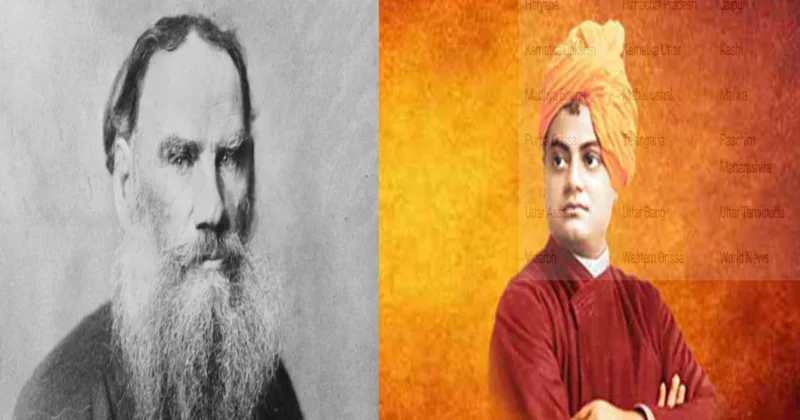
It has been rightly said of him;
He was like a naked sword,
His thought was ringing like a steel blade,
Glistening, sparkling, fluttering.
A stroke, another stroke!
This spake
Vivekananda to his followers:
‘We are not weak. And if you are weak
It is because you love your own weakness’
~ Vivekananda (A poem in Russian) by Valentin Sidorov
‘Swami Vivekananda: Studies in the Soviet Union’, is the Russian interpretation of Swami Vivekananda’s philosophy, presented through eleven essays written by Russian scholars. These essays examine how Swami Vivekananda’s ideas influenced Russia both before and after the Russian Revolution. The book also offers a concise yet insightful account of the emergence of Indology and Hindu philosophy, and of their broader impact in Russia.
Notable research-oriented essays in this compilation include Tolstoy and Vivekananda, The History of the Study of the Religious-Philosophical Heritage of Ramakrishna and Vivekananda in Russia, Swami Vivekananda’s Ideas of Enlightenment, and Swami Vivekananda – the Great Indian Humanist, Democrat, and Patriot. The Soviet communists, in contrast to their Bengali counterparts, seem to have demonstrated a deeper understanding of Vivekananda’s writings, barring attempts to interpret his ‘Indian Ideology’ as a form of ‘scientific socialism.’ Their efforts to recontextualise Vivekananda’s philosophy within political and social frameworks appear more robust and nuanced than those of Indian intellectuals, providing a valuable resource for Indian political philosophy.
The study of Tolstoy’s acquaintance with Vivekananda (Dr A. P. Gnatyuk-Danil’chuk’s article titled ‘Tolstoy and Swami Vivekananda’) reveals significant insights into the great Russian author’s intellectual world. As a philosopher, Tolstoy placed Vivekananda alongside Socrates, Marcus Aurelius, Plato, Rousseau, Pascal, Immanuel Kant, and Schopenhauer. He frequently referred to Vivekananda as a great philosopher, a fact worth highlighting given the reluctance of some mediocre Indian academics to recognise Swami Vivekananda as a philosopher. However, beyond narrow academic definitions, Vivekananda has emerged as a ‘Dharshanika Surya’, a radiant philosophical luminary who represents the spiritual heritage of the ancient nation, and his significance as a Darshanik endures into the 21st century.
After reading Swamiji’s Yoga’s Philosophy: Lectures on Raja Yoga, Tolstoy wrote to Anendra Kumar Dutta, who had sent him the book:
“I received your letter and the book, and thank you very much for both. The book is most remarkable, and I have received much instruction from it. The metaphysical side of the doctrine, the precept as to what the true ‘I’ of a man is, is excellent. So far, humanity has frequently gone backward from the true and lofty and clear conception of the principle of life but has never surpassed it.”
In the same letter, Tolstoy emphasised the task before humanity: “The task before the leading thinkers of mankind now… is to show the inevitability and need of what has ever been regarded as Prajna (knowledge). And to show that this knowledge was long known to mankind and manifested itself both in the teachings of religion as well as in the teachings of the sages, not only Indian, Egyptian, Greek, and Roman, but also the later ones unto the very last: Kant, Schopenhauer, Vivekananda, etc.”
Excerpts from Dr AP Gnatyuk-Danil’chuk’s article titled ‘Tolstoy and Swami Vivekananda’
Tolstoy made every effort to have Vivekananda’s works. On May 25, 1908, he told DP Makovitsky that he had read two volumes of Swami Vivekananda that he received on that day. “Surprisingly profound on god, soul, man, unity of religions. He is Ramakrishna’s pupil, and died in 1902.” It is only at this stage that Tolstoy at last came to know about the unusual bonds between these two thinkers so close to him.
Leo Tolstoy now began enthusiastically his reading of Vivekananda’s works. He took notes and underlined what especially impressed him. Unfortunately, to the best of our knowledge, these books have not been located. We are left only with copious notes on these books in Tolstoy’s own diary and the day-to-day notes (for instance, made on 5, 21, 23, and from June 26 to 29, 1908) of DP Makovitsky. We will cite some of these notes here. On June 5, 1908, Tolstoy told Makovitsky:
‘Since six in the morning I have been thinking of Vivekananda. Yesterday, read Vivekananda whole day. There is a chapter on justification of violent means of resisting the evil. Very talentedly written.’
On June 21, 1908, he talked to VG Chertkov about Swami Vivekananda’s article on Krishna. This article addressed the question of the righteousness or unrighteousness of violence or nonviolence. Tolstoy said: ‘Krishna sometimes commands that evil be rewarded by good and sometimes kills the evil-doer and then resurrects him and makes him feel the joy of life (“Tolstoy”, Makovitsky says, “elucidated it in the sense that this was toning down of punishment, that this leads to the same law of reward of evil by good”).
DP Makovitsky wrote on June 26, 1908: ‘Yesterday Tolstoy came to the hall with one of Swami Vivekananda’s three volumes. . . .
“Excellent book, so many thoughts are here for circle of reading”, said Tolstoy (and, later, while I galvanised his head, he read Vivekananda and underlined some sentences).’
On May 7, 1909, Tolstoy spoke to the editor of the Posrednik publishing house (which used to bring out Tolstoy’s own works) ; ‘The most eminent of modern Indian thinkers is Vivekananda and he should be published.’ “So Tolstoy had in mind the publication of an anthology of Vivekananda’s sayings. In fact, in his article ‘On Education’ (completed on 1 May 1909), he again mentioned Vivekananda amongst the best thinkers of the world, alongside Socrates, Rousseau, Kant, etc,” claims the writer Dr AP Gnatyuk-Danil’chuk in his article.
What precisely interested Tolstoy at this time and what he was reflecting upon can be understood by referring to an entry in his diary on 26 June 1908: ‘Felt now for the first time the possibility, as Vivekananda says, that “I” could completely yield to “you” — Felt the possibility of self-denial not for the sake of anything but for the sake of sound sense …. It is most difficult and even most necessary to escape from this terrible indulgence with self and with one’s “I”. And I am beginning — now before my death — to sense the possibility of such renunciation of one’s “I”. [For me] it’s not much of a virtue.’
On July 4, 1908, he noted in his diary in quite another tone: “Read Vivekananda’s article on god — an excellent one. Should be translated. I myself thought of this itself. His criticism of Schopenhauer’s will is quite true. Only one thing is not true — where he begins with (objective) judge- ment about the world.”
As we see, Tolstoy here takes the ground of the uncognizability of the highest source. Further, he ponders over problems of destruction of evil and of enhancing the good and, in his diary, makes a note of Vivekananda’s ideas which he fully subscribes to :
“Vivekananda says that the eternal destruction of evil and enhancement of good are not possible, but this is not possible only because of the notion of time or because of the notion of implementation. But there should be neither of these. Increasing the good in myself and in the world is life, mine as well as that of the world.
This increase cannot be achieved, but one must try, for the process of this increase is life itself, fulfilling one’s purpose in life, increasing good. I am only fulfilling my purpose.”
On February 16, 1909 Tolstoy received the third volume of Vivekananda’s Speeches and Writings presented to him by an Indian. Makovitsky records that Tolstoy read it and liked it immensely in the same way as he had done the earlier two volumes.
Incidentally, this volume was destined to be the last book Vivekananda sent to Tolstoy.
In 1910, which unfortunately turned out to be the last year of his life, Tolstoy continued to appreciate Vivekananda and take an interest in Indian philosophy, maybe more than before. Thus, while talking to Bulanzhe on 28 January 1910 about the book Theosophy and Modern Psychology, by Annie Besant, Tolstoy said: ‘She rests on what is weak, what is erroneous, and Vivekananda on what is true. This observation of Tolstoy further corroborates what a great contrast he discerned between the theosophists and Vivekananda, and how very akin was the thinking of these two great minds in respect of theosophy, especially in the attitude to so-called ‘miracles’.
In this later period of his life, Tolstoy was steadily distancing himself from orthodox Christianity, a shift that his close friend and doctor, Makovski, attributed to the influence of Swami Vivekananda’s works. Makovski documented this in his diary, affirming the profound impact of Vivekananda’s philosophy on Tolstoy.
“It is interesting to note here that Tolstoy at this time, as he says, is going further away from Christianity (Makovitsky, vol. IV, Notes of 13 August 1908). It is possible that this was due to Tolstoy’s reading of two volumes of Vivekananda.” (CW, vol. 37, p. 361.)