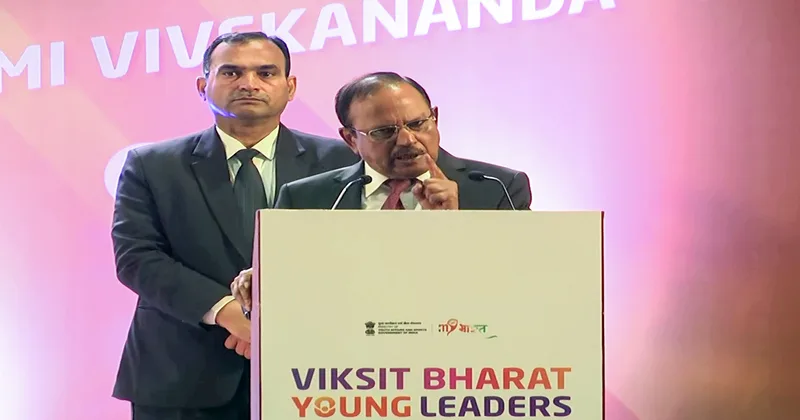
On January 10, National Security Adviser Ajit Doval addressed young Indians at the Viksit Bharat Young Leaders Dialogue, delivering a speech that traced India’s long arc of decline, domination and eventual recovery. The address focused on history, national memory and the responsibility of the present generation to rebuild institutions weakened over centuries.
Within hours, however, a familiar pattern emerged.
A single word, “revenge” was extracted from the speech, stripped of its surrounding explanation, and amplified across social media and opinion columns as proof of alleged communal intent. Political leaders and self-styled liberal commentators framed Doval’s remarks as dangerous, insecure and Islamophobic, without engaging with the substance of what was actually said.
The outrage, loud and immediate, followed a script that has become routine in India’s ideological battles: reduce a complex civilisational argument to a communal allegation, then declare debate closed.
What Ajit Doval actually said and what he didn’t
A reading of Doval’s full speech reveals neither incitement nor hostility. There was no call to violence, no naming of any religious community, and no glorification of retribution in its literal sense.
Instead, Doval spoke about India’s historical experience of foreign domination, economic collapse, cultural erosion and political powerlessness. He referred to a long period during which generations lived without agency, unable to protect their institutions, wealth or civilisational confidence.
Crucially, when he used the term “revenge”, he defined it himself. He described it not as retaliation against people, but as the act of rebuilding India into a strong, confident nation, economically resilient, institutionally capable and rooted in its own civilisational values.
The emphasis was not on grievance, but on responsibility. Not on rage, but on renewal.
One of the most persistent accusations levelled against Doval was that his remarks framed history through an anti-Muslim lens. This claim collapses when examined against the content of the speech.
Doval spoke of foreign rule, civilisational decline and colonial exploitation. He referenced well-documented academic research showing how India—along with China—accounted for a substantial share of the global economy before centuries of decline under repeated external domination.
Nowhere did he reduce this decline to a single religious group. Nor did he attribute India’s losses to contemporary communities. His argument was structural and historical, not theological or communal.
The attempt to convert a broad civilisational narrative into a Muslim-exclusive reading reveals more about the critics’ assumptions than the speaker’s intent.
Why civilisational memory makes the elite uneasy
At the heart of the backlash lies a deeper discomfort: the idea that India should remember its past honestly.
For a certain ideological ecosystem, history is acceptable only if it is sanitised, stripped of judgement, trauma and loss. Any acknowledgement of destroyed villages, looted cultural centres or economic devastation is quickly labelled as hatred or majoritarianism.
This demand is neither realistic nor globally consistent.
Civilisations across the world openly discuss slavery, colonial exploitation, genocide and historical violence. These discussions are not seen as attacks on present-day communities but as acts of collective reckoning. Germany teaches the Holocaust. The United States debates slavery and segregation. Europe confronts colonial crimes.
In India, however, remembering historical trauma is often treated as a moral transgression.
The Weaponisation of ‘Islamophobia’
Another striking feature of the backlash was the casual expansion of the term Islamophobia to include any uncomfortable discussion of India’s past.
In its proper sense, Islamophobia refers to discrimination, violence or hostility directed at Muslims because of their faith. In this case, no such targeting occurred. No contemporary Muslim community was named, threatened or harmed.
Yet the label was deployed aggressively, not to protect minorities, but to shut down historical discussion.
By collapsing memory into malice, critics transform legitimate discourse into a moral offence. This tactic does not foster harmony; it impoverishes debate.
There is a contradiction at the heart of the outrage that often goes unexamined.
Many Islamist and left-leaning voices insist that Muslim rule in India was uniformly tolerant and benevolent. Yet these same voices react with intense hostility when even general references to historical violence or decline are made.
If history was entirely peaceful, why does discussion provoke such anxiety?
The discomfort suggests not confidence, but insecurity, an unease with narratives that are no longer tightly controlled.
Acknowledging that power across history involved violence, destruction and exploitation does not delegitimise any modern community. It merely recognises that history, everywhere, has been complex and often brutal.
Reading Doval in strategic continuity
Ajit Doval’s remarks cannot be understood in isolation. They are part of a broader shift in India’s strategic and political self-perception.
The current leadership operates through a continuum of thought rather than isolated statements. The Prime Minister articulates a framework that prioritises national interest and strategic autonomy. The External Affairs Minister translates that posture into foreign policy—pushing back against unsolicited mediation and moral lecturing.
Doval’s role is to articulate this confidence internally: urging Indians to shed the habit of viewing themselves as perpetual victims or supplicants, and instead focus on rebuilding national capacity.
This is not aggression. It is self-assurance.
A recurring error made by critics is the collapse of memory into grievance. For them, remembering historical loss automatically implies resentment and hostility.
Doval’s speech argued the opposite.
He did not advocate permanent victimhood. He urged learning from vulnerability so it is never repeated. He framed history as instruction, not obsession.
Nations that forget their past do not become enlightened. They become careless.
The Real ‘Revenge’
Stripped of manufactured outrage, the substance of Doval’s argument is deeply pragmatic.
India’s rising stature has not been built through slogans, but through quiet structural decisions, economic resilience, strategic autonomy, diplomatic clarity and institutional reform.
The next phase of nation-building, as Doval implicitly suggested, lies at home: manufacturing capacity, judicial efficiency, urban infrastructure, education systems and governance reform.
This is the revenge he spoke of not loud, not theatrical, but slow, cumulative and irreversible.
The reaction to Doval’s remarks tells us less about the speech and more about the fragility of a certain intellectual consensus.
For decades, India’s elite discourse discouraged self-examination unless filtered through external approval. Any assertion of civilisational confidence was treated as insecurity. Any remembrance of trauma was labelled communal.
That consensus is now eroding.
An India that remembers its past, reflects without apology and rebuilds without seeking validation unsettles those accustomed to controlling the narrative.
Ajit Doval’s speech was not a call to hatred. It was a call to responsibility.
The attempt to recast it as communal provocation reflects an unwillingness to engage with history honestly and a fear of a nation that no longer seeks permission to remember.
Nation-building is not revenge against people.
It is revenge against decline.