DANTOUR: In a striking display of India’s operational mobility and defensive capabilities across the Indo-Pakistan border, the Indian Army, swiftly transformed a stretch of National Highway 911 near Dantour in Rajasthan into a military helicopter operating zone.
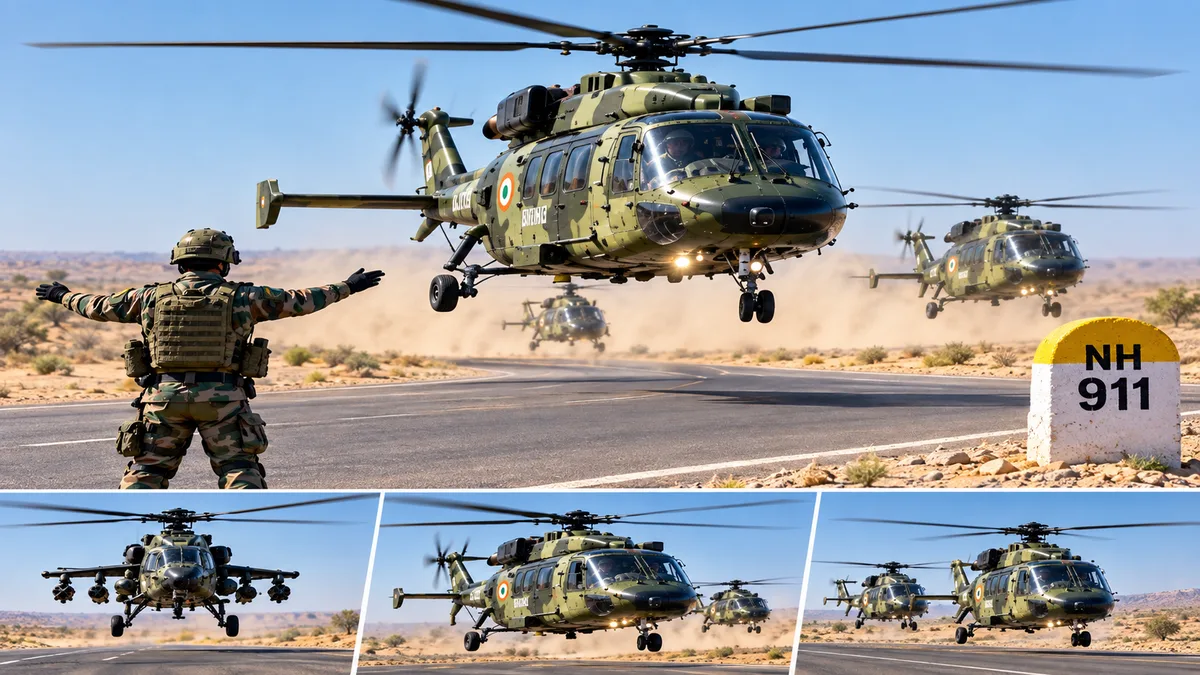
Rudra, Dhruv and Chetak helicopters conducted successful landing and take-off drills on the highway on September 29, Tuesday, testing the Army’s ability to sustain aviation operations when conventional airbases, airfields or helipads are unavailable under critical circumstances, thus fortify national security.
CLOSE TO THE INDO-PAK BORDER
WHEN A HIGHWAY BECOMES A MILITARY RUNWAY.Near Dantour, close to the India-Pakistan International Border, a stretch of Rajasthan’s NH-911 was temporarily transformed into a military runway.
Indian Army Rudra, Dhruv and Chetak helicopters conducted… pic.twitter.com/pADCxE3ow3
— Rahul Shivshankar (@RShivshankar) September 29, 2026
Highway becomes military landing zone
The exercise was conducted near Dantour in Rajasthan’s western desert, close to the India-Pakistan International Border. A designated section of NH-911 was used as an alternative critical landing surface, allowing Army Aviation crews to practise helicopter operations away from conventional aviation infrastructure.
Rudra, Dhruv and Chetak helicopters landed on and took off from the highway during the exercise. Pilots practised approaching and departing from a road surface, while ground personnel coordinated helicopter movements and managed activities at the designated landing area.
The drill was designed to test procedures and coordination required to operate from an improvised location. Such exercises provide aviation crews and ground teams with practical experience of maintaining helicopter operations from alternative sites when established facilities cannot be used, under combat scenarios and unforeseen contingencies.
Testing operations beyond conventional airfields
The exercise highlighted the importance of operational flexibility in a demanding desert environment, where distances are long and aviation infrastructure may be limited in forward areas. By practising helicopter operations from a national highway, the Army demonstrated the ability to identify and utilise alternative surfaces for aviation activity. The exercise also tested coordination between pilots and ground crews, including the approach, landing, take-off and movement procedures associated with operating from a temporary site.
The ability to use locations beyond conventional airfields and permanent helipads can provide greater flexibility in operational planning. For Army Aviation units operating in areas where established aviation facilities may be unavailable or inaccessible, familiarity with alternative landing sites will form part of contingency planning for future circumstances.
The exercise therefore brought together aviation mobility, ground coordination and operational preparedness in the desert terrain of western Rajasthan.
Rudra, Dhruv and Chetak take part
Three helicopters participated in the drill — the Rudra, Dhruv and Chetak — highlighting the Army’s use of different helicopter platforms for operational requirements. The Dhruv is a twin-engine Advanced Light Helicopter designed and developed in India by Hindustan Aeronautics Limited (HAL). The platform forms an important part of India’s indigenous helicopter capabilities.
The Rudra is the armed variant of the Dhruv and is configured for roles including reconnaissance, escort and fire support. Its participation in the exercise demonstrated the use of an armed helicopter platform in a training environment focused on alternative operating locations.
The Chetak, also manufactured by HAL, is based on the French Alouette III design and is produced in India under licence. The helicopter has been used extensively for a range of military and utility roles.
Indian Army’s drill in the Pakistan border adds strategic significance
The location of the exercise near Dantour assumes particular relevance because of its proximity to the India-Pakistan International Border. Rajasthan’s western frontier features extensive desert terrain, where conventional aviation infrastructure may not always be immediately available close to operational areas.
The exercise demonstrated a preparedness approach centred on maintaining aviation mobility even when regular landing facilities are unavailable during the conflict. Using a highway as a temporary military airfield provides alternative locations rather than relying exclusively on established airfields or permanent helipads, the drill focused on the ability to operate from a designated road surface when required.
Exercise coincides with 10th anniversary of surgical strike
The helicopter drill across the National Highway in Pakistan border also coincided with the 10th anniversary of the Indian Army’s 2016 surgical strikes across the Line of Control. The strikes were conducted on the night of September 28–29, 2016, following the September 18 terrorist attack on an Army base in Uri, Jammu and Kashmir, in which 19 Indian soldiers were killed.
The timing of the exercise, specifically in Pakistan border thus sends a strong strategic message across the border, regarding India’s national security & territorial integrity and against Islamabad’s cross-border terrorism.
The 2016 operations remain a significant episode in India’s military response to terrorism along the Line of Control. A decade later, the Army’s highway-based helicopter drill highlighted a different aspect of operational preparedness — the ability of aviation units to retain mobility, flexibility and conduct operations from locations beyond conventional military aviation facilities.