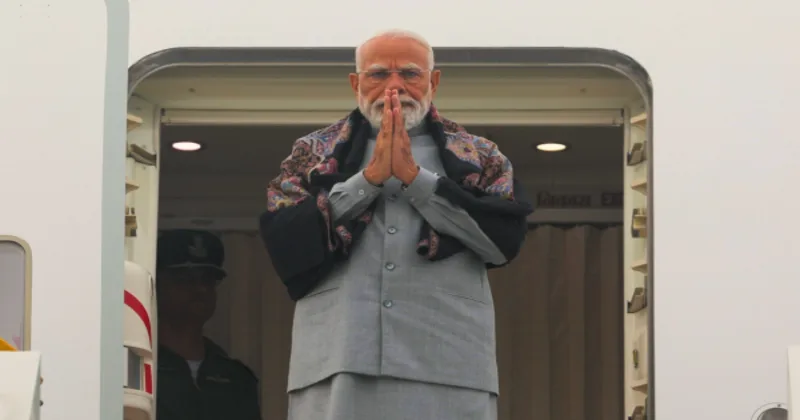
NEW DELHI: Prime Minister Narendra Modi has embarked on a diplomatic visit to West Asia and the African continent. The Prime Minister will be visiting Jordan, Ethiopia and Oman spanning from December 15 to 18. The visit reflects the policy vision of ‘Extended Neighbourhood’, a key pillar of New Delhi’s diplomatic book and strategic principle. The visit by the Prime Minister is calibrated at a crucial geopolitical juncture, when the world-nations are embroiled in tariff tussle, trade wars, energy conundrum, military conflicts, security crisis etc.
At such an era, when unpredictability has been the norm of geopolitics, the Prime Minister’s three-nation visit seeks to herald a new chapter to secure the national interest of India. It also aims to consolidate the principle of multi-alignment principle of India in order to foresee economic prosperity of the country coupled with global peace, security, stability and prosperity. “The visit will further deepen strategic partnerships in diverse fields such as trade, investment, energy, defence, security, technology, agriculture, and culture, as well as enable an exchange of views on regional and global issues of mutual interest”, a statement from the Ministry of External Affairs reiterated.
Over the next three days, will be going to Jordan, Ethiopia and Oman. These are three valued partners with whom India has age-old civilisational ties and strong bilateral relations.https://t.co/QSkwR9m6IZ
— Narendra Modi (@narendramodi) December 15, 2025
Celebrating 75 years of diplomatic journey with Jordan
In the first leg of the three nation visit Prime Minister Modi will be visiting Jordan on the invitation of King Abdullah 2. The visit comes at a major bilateral milestone, when both the nations are celebrating 75 years of diplomatic ties. PM Modi will hold bilateral talks with his Jordan counterpart His Majesty and Prime Minister Jafar Hassan. He will also hold discussions with HRH Crown Prince Al Hussein bin Abdullah 2. This is the maiden full-fledged bilateral visit by the Indian Prime Minister to Jordan in nearly 40 years.
India and Jordan established diplomatic relations in 1950 and are consistent in revolutionising their relationship over the decades through multiple diplomatic channels, negotiating forums and diasporic ties. The geographical location of Jordan at the crossroads of West Asia and Africa makes it a key partner for India’s geopolitical strategy. Jordan’s proximity to the Red Sea renders huge potential for India to explore bilateral opportunities across the region in terms of trade, connectivity, commerce etc. A secure and growing relation with Jordan thus leverages India’s access to the region across West Asia, Africa and Europe. Jordan can be considered as a gateway to strategic opportunities for India to calibrate national priorities and multilateral prosperity.
Moreover, Jordan is a rich repository of critical energy resources. The visit by the Prime Minister aims to nurture these energy ties, thus ensuring energy security of India by diversifying the supply chains. For example, Jordan supplies huge quantities of potash for India, which is vital for the fertilizers used in the Indian agricultural system. The current bilateral trade between India and Jordan stands at USD 2.75 billion and both nations aspire to hit the benchmark USD 5 billion by 2030. The bilateral discussions during the Prime Minister visit are expected to channelize in this direction.
Espousing strategic ties with Ethiopia
In the penultimate leg of the three nation visit, Prime Minister Modi will be landing in Ethiopia on December 16. This will be the maiden visit of the Prime Minister to the African country. PM Modi will be holding bilateral talks with the Prime Minister of Ethiopia Abiy Ahmed and a series of MoUs are expected to be sealed pertaining to energy security, trade etc. Prime Minister Modi will also be addressing the Ethiopian Parliament.
India and Ethiopia are also celebrating 75 years of diplomatic relations which was established in 1950. Lately, India and Ethiopia have had solid ties in the domain of trade, business, investment, infrastructure, people-to-people ties etc. Ethiopia is also the hub for Indian pharmaceutical exports and the gross bilateral trade stands at USD 2.8 billion, where India enjoys a trade surplus. Most importantly, India is the second largest trading partner of Ethiopia comprising 10.2 per cent of Ethiopia’s global trade.
Ethiopia is also one of the largest recipients of the long-term concessional credit given by India to Africa. The developmental projects assisted by the Government of India in Ethiopia reach the mark of USD 1 billion encompassing the sectors of rural electrification, railways etc. Ethiopia also houses the headquarters of the African Union(AU), thus considered as a major partner in New Delhi’s Africa strategy. Ethiopia is a key player for India to consolidate its diplomatic footprint in the African continent.
Operationalising diplomatic relations with Oman
In the ultimate leg of the three-nation visit, Prime Minister Narendra Modi will be visiting Oman on December 17 and 18. He will be holding bilateral discussions with Sultan Haitham bin Tarik. Discussions with respect to trade, investment are anticipated. Diplomatic sources also assert that signing of the Comprehensive Economic Partnership Agreement(CEPA) is expected alongside a business forum, which is hitherto approved by the cabinets of both the nations. As per this agreement, 98 per cent of Indian goods will get tariff free access to the Oman market.
India and Oman are celebrating 70 years of diplomatic relations. Both nations share deep bilateral relations in the domain of trade, business, diaspora and energy ties. India is the second largest market for Oman’s crude oil exports. India is also the fourth largest market for Oman’s non-oil exports. Indian companies have also invested in the iron, steel, cement, fertilizers and textile sectors of Oman. The bilateral trade stands at USD 10.61 billion as of 2024-25. Oman being a key country in the Gulf Cooperation Council(GCC), acts as a gateway for India to weave relations with the entire gulf region.
The geographic position of Oman also espouses wide opportunities for India. Its vicinity to the Strait of Hormuz that connects Persian gulf to the Gulf of Oman has strategic weight for India to secure its energy security credentials. For example, one-fifth of the oil imports of India reaches the country through this strategic waterway. Thus, revolutionising strong relations with Oman helps India calibrate solid energy security in an era of spiking energy wars, supply chain crunch, spiking energy prices etc.
The three nation visit by the Prime Minister across West Asia and Africa thus is a calculated strategic move of India at a crucial timeline in the geopolitical chessboard. The diplomatic visit aims to build multipolar partnerships in an era where the world is increasingly being polarised and transactional. The visit helps to explore trans-continental economic and connectivity opportunities, accelerate energy security, fuel business and investment access, tailor strong people-to-people ties who are the living bridge of bilateral relations etc. Beyond national interests, the visit to Africa and West Asia by Prime Minister Modi, helps to restore balance of power by fostering south-south cooperation in contested geopolitical landscapes such as Africa and West Asia, which is predominantly encapsulated for hegemonic ambitions.