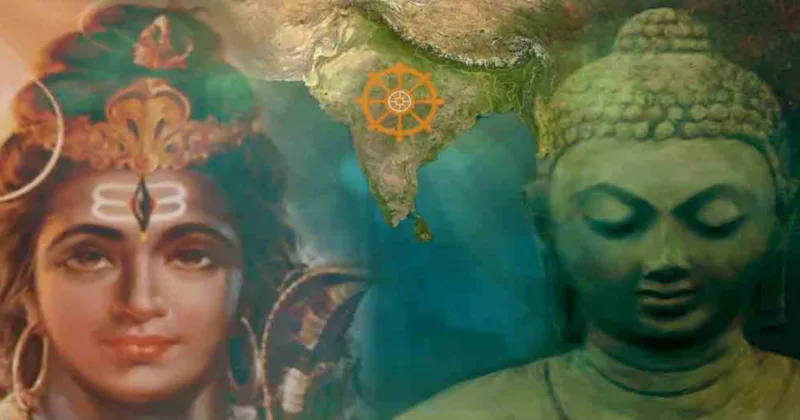
The peace-loving Dharmic traditions of Asia are under relentless assault from the two dominant Abrahamic faiths—Christianity and Islam. Historically, these forces played a pivotal role in the destruction of great ancient civilisations such as the Greek, Roman, Persian, Babylonian, Assyrian, Incan, Mayan, Aztec, and others. In modern times, this legacy persists, posing a growing threat to the survival of Eastern traditions, cultures, and civilisations.
The threat from Islamic fundamentalism and Christian evangelism
Islamic fundamentalism—manifesting in the form of global jihad—has impacted vast regions, from Kashmir to Bangladesh, Myanmar, Thailand and Indonesia.
Simultaneously, Christian evangelism, spearheaded by institutions such as the Vatican and Protestant charismatic churches, is aggressively targeting Asia for conversions. This intent is clearly articulated in the Vatican’s 1999 apostolic exhortation Ecclesia in Asia, proclaimed in New Delhi:
“Just as in the first millennium the Cross was planted on the soil of Europe, and in the second on that of the Americas and Africa, we can pray that in the third Christian millennium a great harvest of faith will be reaped in this vast and vital continent of Asia”.
Such declarations are not merely theological aspirations—they reflect strategic plans to transform the religious landscape of Asia.
Demographic transformation of Dharmic civilisations
Traditional Dharmic regions are undergoing significant demographic shifts. In countries such as Indonesia, Malaysia, Thailand, Myanmar, Vietnam, Korea, the Philippines and large parts of Bharat and China, conversions to Islam and Christianity have either already altered or are rapidly transforming the religious landscape. This change represents a continuation of historical colonisation and contemporary religious imperialism.
Consider the following examples:
Islamic conquests resulted in the widespread conversion of populations across Bharat, Malaysia, Indonesia, Pakistan, Bangladesh, Afghanistan, and parts of China.
Christian missionary efforts, particularly following the departure of colonial powers, have intensified across Asia—converting large populations in Korea, the Philippines and China, often through underground churches.
In Sri Lanka, Thailand, Vietnam, Laos and Myanmar, Christianity is now one of the fastest-growing religions. Notably, political theorist Samuel P. Huntington (Who Are We? The Challenges to America’s National Identity) openly proposed the conversion of Asians to secure continued Western Christian supremacy.
The urgency of Dharmic awakening, unity and organisation
Unless Dharmic traditions rise to this existential challenge—through cultural education, demographic awareness, and a united global outreach—they risk territorial and numerical decline, as happened to the Druids, Greeks and Romans before them.
In response to these pressing threats, Dharmic civilisations must forge a common front—not merely to survive, but to assert their shared values of dharma, mutual respect, spiritual pluralism and inner harmony. If united, the Dharmic world would constitute the largest global population group, a formidable economic force, and the most dynamic youth power on Earth—forming an indomitable cultural and geopolitical axis.
The economic power of the Dharmic bloc
The collective economic strength of the Dharmic civilisations—spanning South, Southeast and East Asia, and rooted in Hindu, Buddhist, Shinto, Taoist and Confucian traditions—is on the rise. The global economic centre of gravity is gradually shifting and has already moved eastward. While Europe and the Americas face the challenges of ageing populations, Asia benefits from a demographic dividend, with a young, vibrant and industrious populace.
Moreover, the Dharmic worldview—centred on karma, rebirth, duty (dharma), reverence for nature, and coexistence—offers a sustainable development paradigm. Unlike the Western model, which places permanence in institutional dominance, the Eastern model finds continuity in relationships, community, culture and spiritual practice—expressed through temples, family systems, and inner discipline.
Towards a dharmic civilisational alliance
The need of the hour is to transcend political boundaries and foster a civilisational alliance. This includes:
- Uniting Hindus, Buddhists, Shintos, Taoists and Confucians for mutual cultural preservation
- Establishing platforms for economic, educational and technological cooperation
- Presenting a coherent and constructive Dharmic alternative to the monopolistic and often destructive tendencies of Abrahamic frameworks
This call to action is anchored in ancient wisdom: “Dharmo Rakshati Rakshitah” – Dharma protects its protector.
The future of global civilisation may well depend on whether the Dharmic traditions can rise in unity to safeguard their heritage and offer the world a more balanced, compassionate and harmonious alternative to prevailing civilisational models.