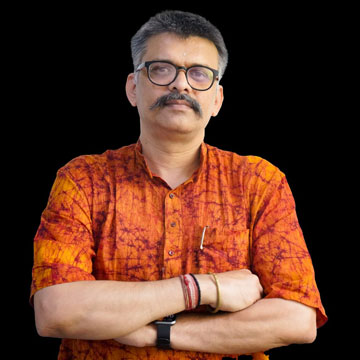

“If we wish to change this, then we have to begin to create a new India on the basis of the traditions, beliefs, knowledge systems and the nature of the people of our civilisation. We must decide to abandon the colonial systems and devices, with immediate effect. We must make plans so that we can become completely self-reliant and regenerate and consolidate our systems in the next 20-25 years, and if we don’t wish to wholly destroy them, put all the British appendages and systems in the archives merely for academic interest and research.” – Acharya Dharampal Ji, “Rebuilding Self-Confidence and Prosperity in India”, Rediscovering India – Collection of Essays and Speeches (1956-1998), Society for Integrated Development of Himalayas, Mussoorie, 2003, p. 215
Though the call for decolonising the Bharatiya mind is not new, what PM Narendra Modi said at a media conclave is much more profound and reassuring. He called out the hypocrisy of the secularists – both from the liberal and communist camps – who did not find anything communal in calling the sluggish and stagnant growth rate under Nehruvian socialism as ‘Hindu Rate of Growth’. The Prime Minister urged a national resolve to shed what he called the ‘Macaulay mindset’ – a mission that began with the 1835 policy, with a clear 10-year mission to eliminate the colonial impact through education. He, in a way, is expecting all of us to overcome the disastrous impact of two hundred years on our national psyche on a war footing, which cannot be done with mere Government intervention. Though the task is gigantic and easier said than done, decolonisation through renationalisation is possible if we decode the roots of the derogatory and self-demeaning terms and then take steps to rectify them in line with the national ethos.
The term “Hindu rate of growth” was coined by the Bharatiya economist Raj Krishna in 1978, and later popularised by the American businessman turned politician Robert McNamara to refer to the stagnant, less than 4 per cent GDP growth in Bharat after Independence for almost four decades. They ascribed this phenomenon to the supposed Hindu outlook of fatalism and contentment and used the term disparagingly. The Nehruvian socialist and the proponents of liberalism both enjoyed this academic debate of targeting the Hindu civilisation as backward and nothing but spiritual. The term may be new, but the intellectual foundation was old.
Thomas Babington Macaulay, who laid the foundation for the colonial education system in Bharat, in his infamous minutes of 1835, said that he did not know Sanskrit or Arabic and still dared to say, “all the historical information which has been collected from all the books written in the Sanskrit language is less valuable than what may be found in the most paltry abridgements used at preparatory schools in England”. No wonder Swami Vivekananda called his education system one that produced spineless individuals. But Macaulay was not alone. James Mill, whose books on the history of Bharat became a mandatory read for British officers and continues to fascinate modern historians, was even worse. According to Mr Mill who never visited Bharat or learnt any of the Bharatiya languages, “the Hindu like the eunuch, excels in the quality of a slave”, was “dissembling, treacherous, mendacious to an excess which surpasses even the usual measure of uncultivated society, was “cowardly and unfeeling”, and was “in the physical sense, disgustingly unclean in their persons and houses”. Modern historians carry the same contempt for everything Hindu, inheriting the Mill’s legacy.
Karl Marx, who is the father of equality, liberation and justice for elite intellectuals, again without knowing anything about Bharat, passed a judgement in his essay on British Rule in India in 1853, calling Bharatiya civilisation for ages as “undignified, stagnatory, and vegetative life, that this passive sort of existence evoked on the other part, in contradistinction, wild, aimless, unbounded forces of destruction and rendered murder itself a religious rite in Hindostan”. The abusive terms of monkey-worshippers and cow-worshippers to Hindus are a gift of the “great” Marx to the modern intellectuals. His contemporary, Max Weber, went ahead and stigmatised Hindus, Buddhists and the entire Asian worldview by saying, “This most highly anti-rational world of universal magic also affected everyday economics. There is no way from it to rational, inner-worldly life conduct”. The person who justified capitalism as Protestant Ethics could not see the ills of mindless profiteering and exploitation but chose to mock the ascetics of Asia as ‘aimless wanderers’. Sadly, all these intellectuals laid the foundation of ‘modern intellectual elitism’ in Bharat. Nehrus and Raj Krishnas were products of the same. Whether liberals or Marxists, for both, Hindu civilisation and whoever is calling for Hinduness, is the standard, shared punching bag.
Due to this contemptuous intellectual foundation towards Bharat and Bharatiya civilisation, the British could strip the Bharatiya mind of self-confidence and instil a sense of inferiority. Considering everything Bharatiya as outdated, unprofessional, irrational and unscientific has been infused through education and laws. The sustainable, decentralised, spiritual and highly prosperous Hindu civilisation, which contributed more than 23 per cent of global GDP, was reduced to a matter of mockery. We had an education system that was more skill-based and communitarian. Our peasants and artisans were engaged in the manufacture of iron and steel even before the arrival of the British, and the indigenous textile industry was flourishing across the regions. The surgeons and medical practitioners, even many of its astronomers and astrologers, belonged to all social categories and were recognised outside Bharat. The Hindu economic system was a different paradigm that people with alien intellectual moorings and structures can never understand. Instead of realising the limitations of the British capitalism and Nehruvian socialism as the root cause of decline and stagnation in the Bharatiya economy, they shift the blame to the Hindu way of life. Bharat is making a comeback through the Hindu economic model of Swadeshi clusters that survived the colonial onslaughts.
We need to start working on two parallel intellectual projects simultaneously. One is to expose the limitations of Western models, both capitalist and communist, and their intellectual foundations. The rot of the colonised mind is deepened, and many well-intended intellectuals also get trapped in it. Here, our semi-literate but wise people of Bharat can help those who still believe in pilgrimage and clusters. As per the true Hindu model, we have to revive the cluster economy based on trust, community skills and decentralised resource mobilisation. Vocal for local or One District, One Product (ODOP) is the contemporary manifestation of the same. We need to scale up the decentralised clusters and revive sectors facing challenges. Reforming education to the core, with not just content but skills, is also mandatory. The British undermined self-employment and agriculture, replacing them with government jobs. We will have to restore the dignity of labour so that artisans and agriculturalists innovate and experiment in their own fields. If we strive to re-establish self-esteem, courage, community feeling, and collective freedom, then the more complex problems will become clearer and solvable. The Hindu model, based on diversity, spirituality, and sustainability, can lead to true prosperity for all. The world is craving for such a model; we need to engage in another liberation struggle – for freedom from the colonial mind so that the real Hindu Model of Growth can be reclaimed.