As has happened elsewhere in the world, Bharat too has finally witnessed an unexpectedly large protest by the Gen Z generation, giving a glimpse of its strength. Several reactions to the protest at Jantar Mantar in Delhi are now emerging on social media. At the same time, social media is also bringing to light the extremely offensive and irresponsible behaviour of some abusive, uncivil and appearing to be intoxicated protesters.
Therefore, just as the mistake of dismissing the Jantar Mantar protest as insignificant must be completely avoided, it would be equally unwise to harbour naive expectations that this protest will turn out to be some kind of great revolution. To acquire a balanced perspective on this protest, it is necessary to take a quick look at Gen Z protests across the world and what they have produced.
Two years ago, the spark for the Gen Z movement in Bangladesh came from a reform related to reservations. Under the reform, a large share of civil service positions was to be reserved for the children of freedom fighters, a move that was not acceptable to the youth. However, the roots of this enormous discontent among young people lay in the new restrictions imposed by the Sheikh Hasina government through digital security laws. The Sheikh Hasina government failed to handle the 36-day youth uprising properly. As a result, unofficial accounts say that several hundred people were killed and thousands injured. Eventually, the Prime Minister herself had to leave the country and go into exile.
A popularly elected government did come to power a year and a half later, but in the election held at that time, the party formed by the Gen Z youth who had led the uprising won just six seats in Parliament. Today, Bangladesh’s Gen Z feels that its expectations have not been fulfilled by the newly elected government that came to power after the Gen Z uprising. In short, there was a movement, the government changed, but the discontent among the youth has not been brought fully under control.
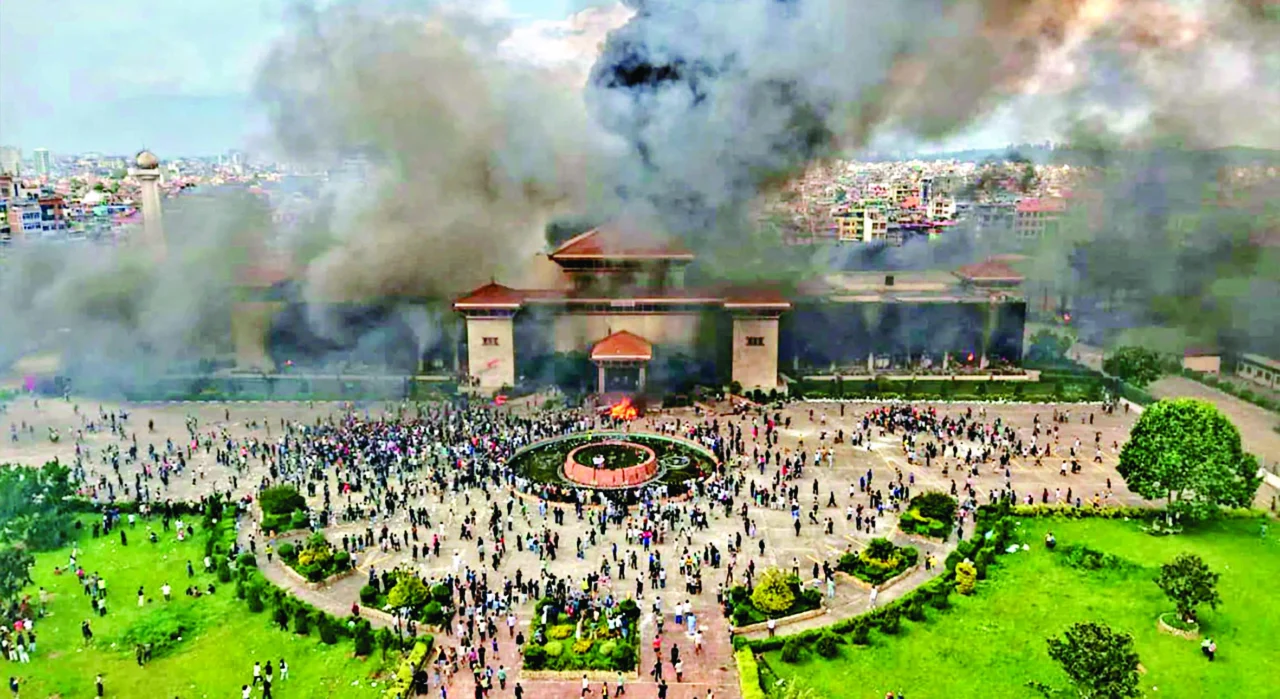
The story in Nepal is no different. Just a few months ago, young Prime Minister Balen Shah came to power with a two-thirds majority, only to face youth discontent at the beginning of this month
The story in Nepal is no different. Just a few months ago, young Prime Minister Balen Shah came to power with a two-thirds majority, only to face youth discontent at the beginning of this month. Young people are already feeling disillusioned, with the situation developing so quickly after the self-immolation of a young man, Ganesh Nepali, who had become angry following an argument with the police over the simple issue of parking in Kathmandu.
Soon after coming to power, Balen Shah had presented a 100-point reform plan. He is also facing public anger over the issue of removing unauthorised settlements in the city, particularly those along the riverbanks. As reforms move forward, the interests of established groups naturally come under pressure. On the question of overcoming this resistance, the inexperienced Prime Minister appears confused. As a result, Gen Z’s discontent
continues even today.
Gen Z Discontent Across Globe
Far away, in Bulgaria, too, a Gen Z movement brought about major political upheaval last December. Two young women, Malena Malcheva and Valeria Burkova, along with their millions of Instagram followers, made imaginative use of social media to oppose a government proposal for a burdensome tax. Their opposition became so intense that nearly a hundred thousand people took to the streets of the capital, Sofia, in fierce demonstrations. Eventually, Bulgaria’s Prime Minister had to step down.
Later, in April-May, the Russia-friendly leader and former Prime Minister Rumen Radev was elected with a majority. But here too, the uprising by Gen Z protesters has brought about only a change of faces rather than fundamental change. What happens next in Bulgaria will therefore be instructive to watch.
Towards the end of last year, there were also examples in Peru and across Latin America where largely leaderless but nevertheless extremely vibrant popular movements received support from Gen Z. In Peru, there had already been discontent with the government over corruption, repression and the erosion of democratic rights since the political upheaval of 2022. This was given further impetus by a controversial pension reform in 2025, leading to the emergence of a movement called the ‘Gen Z Collective’.
The situation became violent after a 32-year-old protester and rapper, Eduardo Ruiz, was shot dead by the police, leaving hundreds injured. Impeachment proceedings were also initiated against President Dina Boluarte, but when José Jerí, who himself faced allegations of sexual misconduct, was appointed in her place, the mood among the youth became one of ‘cover this up and cover that up too’. Within just a few days, José Jerí also stepped down, and a new electoral process is still underway. There too, the question remains as to when and how the established rulers will satisfy Gen Z’s hunger for widespread change.
In Kenya, too, Gen Z youth protests have been underway since 2024. The government had introduced a Finance Bill imposing huge taxes on everyday goods, against which young people launched a movement both online and on the ground. Following in the footsteps of Nigeria’s #EndSARS movement, the leaders of this protest proudly and repeatedly described their movement as “leaderless, tribeless and fearless”.
As in several other countries that have witnessed a Gen Z eruption, the movement in Kenya intensified after the killing of 29-year-old protester Rex Masai and the subsequent storming of Parliament
As in several other countries that have witnessed a Gen Z eruption, the movement in Kenya intensified after the killing of 29-year-old protester Rex Masai and the subsequent storming of Parliament. After all this, the Finance Bill was indeed withdrawn. However, on June 25 of the same year, more than 60 people were killed in police repression and many others went missing. Even after two years, families affected by this repression are still waiting for justice. This is also one of the reasons why Kenya’s youth movement continues.
Significantly, Kenyan youth regard June 25 as a kind of ‘Resistance Day’, because it was on that very day in 2024 that the Finance Bill was withdrawn.
The Gen Z Challenge
Four points emerge clearly from all these examples. The first is that, one after another, in different countries, popularly elected governments in democratic systems are increasingly being found incapable of meeting constantly changing public expectations. The second is that there is strong public disapproval of the compromises that elected leaders in democratic countries are making — sometimes inevitably — in order to win elections or remain in power.
The third point is that, in most countries, there are simply no alternatives available that practise politics in a fundamentally different manner from the existing rulers elected within the established democratic framework. The fourth and final point is that Gen Z protesters have no alternative but to initially use the democratic system available to them, obtain a mandate from the people, and then work to make that very system more flawless.
Will Gen Z be able to do all this? Does the Gen Z generation, which is caught in a kind of game of snakes and ladders in several countries across the world, possess the determination, perseverance and maturity required for it? If these questions do not receive positive answers, one would not need an astrologer to predict that Bharat’s Gen Z protesters will become the new Kejriwals of this decade.