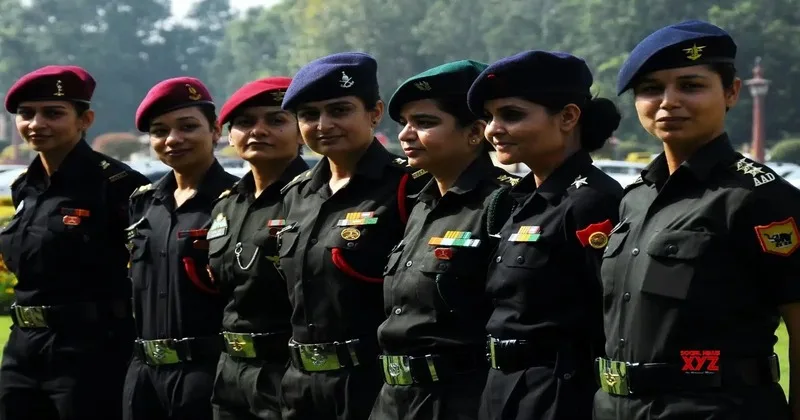
In recent times, there has been a lot of debate going on with regard to the entry of women officers in India’s armed forces. Defence experts as well as amateurs have come up with opinions, and some people have even gone to the extent of labelling this important issue as the phenomenon of conquering “the last male bastion”.
Let us delve deeper into this issue and analyse the matter in its entirety, going beyond the concepts of women’s liberation and gender bias.
India’s competence as a military power is beyond doubt; and the war-potential of the country and the issue of entry of women in India’s armed forces purely from the perspective of making India militarily strong is an issue worth deliberating about.
Unlike developed countries like the USA, UK, Canada and Germany, India as a nation isn’t all that experienced with regard to the introduction of women in the armed forces. The first batch of women joined in 1992. Military science is a complex subject, and India’s military establishment is now coming to terms with the long-term ramifications of women’s issues involved in the military landscape.
Women have been serving in the armed forces of developed countries for a long time, and countries like the USA, Israel, Britain and Canada, for instance, have acquired a level of understanding of women’s issues that remains unmatched.
The United States, in particular, has played a pioneering role when it comes to the question of inducting women in the armed forces – a mind-boggling 200,000+ American women are on active duty, which literally means 20 per cent of the US armed forces’ bench strength.
Israel is another country that India’s armed forces can look up to when it comes to the induction of women. Although women are not allotted combat duties, they have carved a niche for themselves in administrative and technical positions.
If defence statistics are anything to go by, the Indian Army has 6,807 women and constitutes 0.56 per cent of the Army, the Indian Air Force has 1,607 women representing 1.08 per cent of the Force, and the Indian Navy has 704 female officers who constitute 6.5 per cent of the Naval Force. If we consider the number of women officers in the three defence establishments, a total of 9,118 women are on active duty, and the best part is that approval has been granted for the induction of 1,700 females as jawans in the Corps of Military Police.
There has been a remarkable increase in the number of women deployed in the armed forces during the year 2020 and apart from the Permanent Commission to Women Officers in the category of Judge Advocate General and Army Education Corps, the Government of India has off late has also pronounced the grant of Permanent Commission to Women Officers in all three Services where women are eligible for commission.
Women in Indian Armed Forces – Historical lookback
Before we delve into the role of women in the Indian Armed Forces, it would be prudent to know the history behind this sensitive issue. Women’s presence in the Indian Armed Forces first took shape way back in 1888 with the creation of the Indian Military Nursing Service. The nursing staff of the Indian Army played a stellar role during World War I and so impressive was their dedication in the wartime that it convinced the then Army’s top brass to further expand and reinforce the women’s wing with the formation of an exclusive Women’s Auxiliary Corps that would facilitate women personnel to serve in non-combat positions like administration, tele communications, accounting etc.
One woman who by dint of her exemplary service to the nation during World War II attained legendary status – Noor Inayat Khan’s name needs no introduction, at least not in the armed forces circle! In the days of yore, the British Indian Army, though very receptive to the idea of inducting women in the armed forces, limited the involvement of women to primarily non-combat roles. Later on, with the advent of Netaji Subhas Chandra Bose’s Azad Hind Fauj, an exclusive women’s combat regiment – Rani of Jhansi Regiment saw women fighting on the battlefront against the Imperial Japanese Army in erstwhile Burma.
Contemporary trends
We are right now living a life fraught with dangers and in constant fear of the coronavirus, which shows no signs of ebbing. One cold February morning, as I flipped through the pages of the morning newspaper, I was awestruck by the caption – “Indian military sees threefold increase in women personnel in 6 years”. This got me charged up!
The Hindustan Times, February 9, 2021, states – “The headcount of women in the military has increased almost three-fold over the last six years, with more avenues being opened for them at a steady pace, latest government figures showed. There are 9,118 women currently serving the army, navy and air force, with the services giving them more opportunities to boost career progression, the government told Parliament on Monday.
The report further states – “Since then, the government has taken a raft of measures to empower women, including allowing them to fly fighter planes, naval aircraft and giving them permanent commission in different branches. Excluding the medical wing in which women have been serving for decades, the army accounts for 6,807 women officers, the air force 1,607, and the navy 704 women officers. In percentage terms, women still form a small part of the military—0.56 per cent of the army, 1.08 per cent of the air force and 6.5 per cent of the navy”.
Isn’t this inspiring? As an Indian, it indeed is!
The Hindustan Times reports that the year 2015 should be considered as the “Year of Reckoning” for women in India’s armed forces. That year, the Indian Air Force for the first time decided to induct women into the fighter wing. The Indian Navy followed suit, opening up multiple avenues for women in recent years, and India’s first naval women were commissioned as pilots of the Maritime Reconnaissance Aircraft in 2016.
This indeed is a quantum leap if one considers that not far back in the early 90s, when women were not allowed to function in any infantry and combat roles. In November 2020, approximately 70% of women officers were considered for permanent commission in the Indian Army, which in itself speaks volumes about India Inc’s eagerness to make space for those wannabe women warriors.
The Government of India’s July 23, 2020 order that grant of permanent commission to women officers be given in 10 streams made national headlines — Army Air Defence (AAD), Signals, Engineers, Army Aviation, Electronics and Mechanical Engineers (EME), Army Service Corps (ASC), Army Ordnance Corps (AOC), and Intelligence Corps in addition to the existing streams of Judge and Advocate General (JAG) and Army Educational Corps (AEC).
The Supreme Court verdict on women officers in combat arms
In March 2020, the Supreme Court passed a milestone judgement – “Induct women officers in all types of warships in Indian Navy, as a natural process of societal evolution, the possible induction of women into combat arms is going to be the next challenge, which Indian Military will be confronted with. The leadership in combat arms at each level, from detachment to highest formation, is laid on a bedrock principle of ‘Leading from the front’ which must not be compromised”.
This judgement entails that all officers and soldiers have to go through the same selection criteria – toughness schedule, promotion exams, command criteria assignments and appointments with no concessions. It is to be noted that most armies in developed countries that employ women officers have “gender neutrality” when it comes to physical standards, and many are working towards achieving that.
The Supreme Court has unequivocally stated that women officers who volunteer for combat action must comply with the standards ensured and that the standards should in no way be lowered just to make room for women officers; or else this will compromise the “Operational Effectiveness” of the force.
Major General S B Asthana, who is a strategic and defence analyst and a veteran General with 40 years experience under his belt, has been awarded by the President of India twice, the United Nations etc…puts the entire issue very succintly – “It, therefore, implies that if every male infantry officer has to go through commando course, every women officer opting for infantry must go through the same. If every other combat arms officer has to go through Commando/Counterinsurgency/Mountain warfare course and serve in Rashtriya Rifle or Assam Rifle for at least one tenure, the same yardstick must apply to women officers”.
The future ahead
At a time when the Indian Military establishment is working full-time towards creating that “Ideal Work Station” ambience, I am sure that an efficient and cohesive system will evolve over time.
All selections for command-based assignments will, I am sure, be merit-based rather than gender-based, while at the same time ensuring the overall operational efficiency of the Armed Forces. Achieving gender equality isn’t an easy task when it has to be implemented across the board – equal hardships by all officers and an identical selection process will require a lot of streamlining in the existing structure.
I, for one, find a lot of similarity between high-altitude mountaineering and working in the armed forces. Both are high-risk jobs and require considerable amounts of zeal, energy, passion, and to say the least, one has to be ambitious.
The founder of the world-renowned Angs Himalayan Adventures, Ang Tshering Lama, who specialises in conducting mountaineering trips to some of the world’s most demanding and awe-inspiring mountains like Everest and K2, had this to say when he was asked to comment on how his company motivates women mountaineering novices on those tough and dangerous mountains –
“We plan meticulously knowing fully well that there will always be hazards at rarefied heights. The weather conditions can change dramatically within seconds. Furthermore, climber’s mindset too can change that effects their physical conditioning. We, as mountain guides have guidelines in place that help us to take the expedition all the way to the summit, no matter what”.
He further elaborates – We understand that female climbers have a soft side, and we are extra cautious not to push them too hard. We make a distinction between the time we spend climbing and the time we spend at the camp. During the daytime, yes, we push them hard, but we are extra careful not to push them beyond limits. When we are at the camp, that’s the time we try to focus on the softer side. For instance, once you arrive at camp after a really hard day out in the mountains, that’s the time when people, particularly female climbers, need support and need confidence boosters: a bottle of wine or even a letter from their family. Inevitably, these small gestures mean a lot, and they tend to forget about the unpredictable nature lying ahead”.
Like high-altitude mountaineering, working in the Armed Forces will always be dangerous. This is what a job in the Armed Forces gives – an incredibly high stake! The thrill of serving for the nation is by far the most cherished desire one can harness as a true citizen of the country.
As an Indian, I look forward to the day when the best officers will get command positions irrespective of whether they are male or female. The nation expects a highly disciplined and cohesive armed force. In the years to come, I am sure women armed forces personnel will prove their mettle and carve a niche for themselves by trusting the programs, processes and protocols, which the Indian defence establishment has developed over many years of keen observation and research.
Jai Hind. Ek Bharat Shaktishali Bharat.