




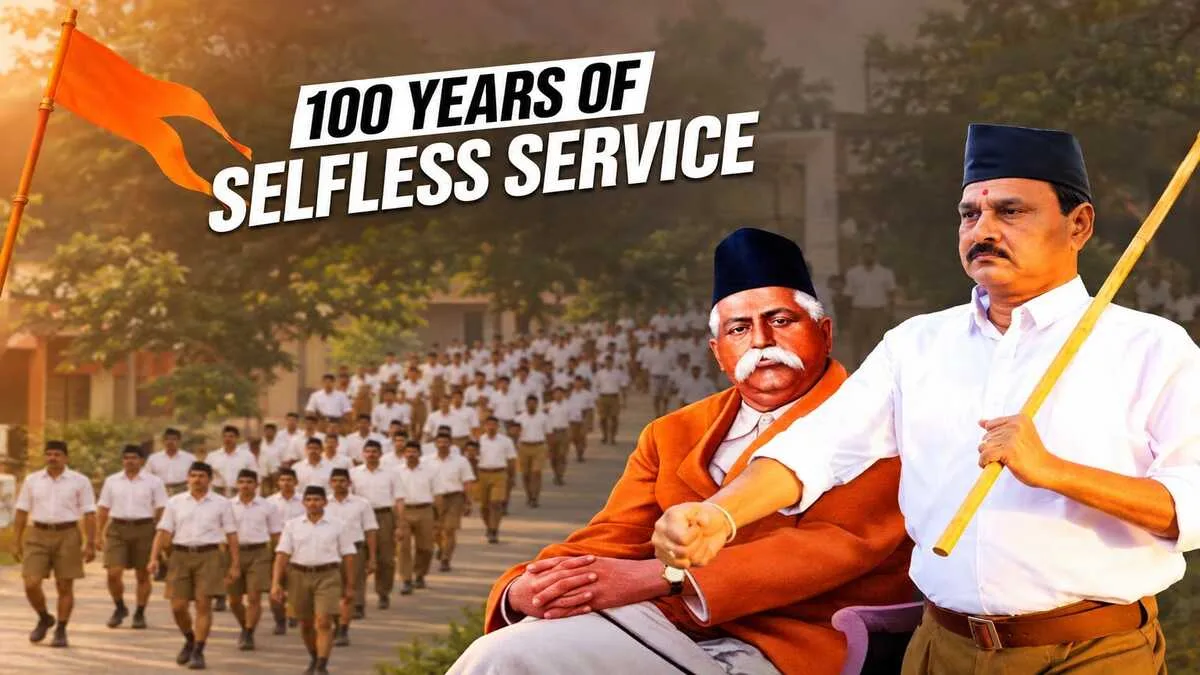
In India’s cultural tradition, Vijayadashami is not merely a festival; it is a symbol of introspection, resolve, and renewal. This day conveys the message of the triumph of righteousness (*dharma*) over unrighteousness (*adharma*), truth over falsehood, and moral restraint over ego. Lord Rama’s victory over Ravana is not just a mythological episode; it also symbolises the establishment of wisdom, self-restraint, duty, and morality in human life. It was on this auspicious occasion—September 27, 1925—that Dr. Keshav Baliram Hedgewar founded the Rashtriya Swayamsevak Sangh (RSS) in Nagpur. This historic link between Vijayadashami and the founding of the Sangh has, over time, become an integral part of the organization’s identity.
In 2025, the Sangh completed one hundred years since its inception. In 2026, its journey has entered its 101st year. This milestone is not merely an occasion to look back at the history of an organization, but also an opportunity to evaluate the ideology, methodology, and social impact that have established a distinct presence within the social and ideological landscape of modern India.
The genesis of the organisation during the freedom struggle
In the early decades of the twentieth century, India was under British rule. The freedom movement was gaining momentum, and alongside political awakening, social reform initiatives were underway across various parts of the country. It was within this environment that Dr. Hedgewar identified the importance of social organization and the cultivation of national character. His vision was that the enduring strength of a nation lies not merely in political independence or its system of governance, but in the organizational capacity, discipline, and sense of social responsibility of its citizens. The Rashtriya Swayamsevak Sangh (RSS) was founded with the vision of cultivating volunteers—through regular interaction, collective activities, and training—who would look beyond their personal interests to understand their obligations toward society and the nation. The organization’s initial methodology prioritized physical training, group sports, intellectual discussions, and a disciplined daily routine. In this framework, the development of the individual was considered the cornerstone of nation-building. This perspective raises a pertinent question that remains relevant today: should a nation’s true strength be assessed solely by its economic progress, technological prowess, or military capability, or should equal importance be given to the character, sense of duty, and social conduct of its citizens?
Shakha: The Practice of Discipline and Collectivity
The identity of the RSS is deeply intertwined with its *shakha* (branch) system. In a *shakha*, volunteers gather regularly to participate in sports, physical exercises, prayers, intellectual discussions, and other collective activities. The organization holds that such a routine fosters punctuality, cooperation, self-confidence, and a sense of social responsibility. Discipline, in its broader sense, extends beyond mere adherence to rules; it encompasses self-regulation, respect for the rights of others, the protection of public property, and a steadfast commitment to one’s duties, even in challenging circumstances. Adherence to traffic rules, maintaining cleanliness, practicing honesty, and behaving responsibly in public life are all forms of civic discipline. However, any organization’s achievements in character building should be evaluated not only by its stated objectives but also by the conduct of its members, its social impact, and its tangible actions. Discipline acquires broader social value only when it is coupled with discernment, sensitivity, and respect for dissenting views.
Cultural Consciousness and National Identity
In the ideological vision of the RSS, Indian culture, civilizational continuity, and a Hindu cultural identity occupy a central position. Proponents of the organization view this as an effort to strengthen India’s historical consciousness, cultural self-confidence, and national unity. On the other hand, there has also been critical debate regarding his perspective on Hindutva, the status of minorities, and the relationship with pluralistic nationalism. To understand this discourse, it is essential to consider the vast scope of Indian culture. India’s civilization is composed of numerous languages, religious beliefs, regional traditions, folk arts, and philosophical schools of thought. Vedic and Upanishadic philosophy, Buddhist and Jain traditions, the Bhakti movement, Sufi thought, and diverse folk cultures are all distinct dimensions of this cultural heritage. Therefore, in its broader sense, national consciousness is not merely about recalling the glories of the past; it also entails the creation of a contemporary social order in which all citizens can live with equal dignity and rights. Cultural self-confidence and national unity become enduring only when they are rooted in dialogue, coexistence, and mutual respect.
From Service Initiatives to Social Engagement
Over time, volunteers associated with the Sangh (RSS) and various affiliated organizations have carried out numerous activities across sectors such as education, healthcare, rural development, social awareness, and disaster relief. The involvement of volunteer groups during natural disasters and local crises has become a significant aspect of social life. In a vast and diverse nation like India, addressing social challenges requires collaboration among the government, local communities, non-governmental organizations, and voluntary groups. The true significance of service initiatives lies in how effectively they reach those in need, the consistency of their efforts, and the transparency of their outcomes. The most fundamental principle of service is the dignity of the individual receiving assistance. When help is extended to those in need—transcending barriers of caste, class, language, region, or religious identity—such service strengthens social trust. A practical expression of patriotism is also reflected in this kind of responsible conduct.
A Century-Long Journey: Expansion, controversy, and discourse
Following Dr. Hedgewar’s tenure, the leadership of the Sangh underwent various changes, and its organizational reach expanded over time. Numerous organizations—either ideologically aligned with or affiliated to the Sangh—have been active in diverse fields, including education, student affairs, the labor sector, social service, and politics. Since these organizations possess their own distinct structures and operational methods, their contributions and activities should be evaluated within their specific contexts. Since India’s independence, the Sangh’s engagement with public life has experienced many ups and downs. Bans, political developments, and ideological differences have sparked debates regarding its role. Supporters of the Sangh highlight its organizational growth, cultural activities, and service initiatives, while critics raise questions about its ideological direction, social inclusivity, and concept of nationalism. To understand the history of any large organization, it is essential to examine its controversies and the criticisms it has faced, alongside its achievements. An objective historical assessment should be based neither on mere praise nor on a predetermined stance of opposition. It should be based on a prudent examination of facts, social consequences, and diverse perspectives.
The need for the Sangh in modern times and its role in nation-building
Given the current circumstances in the country, there is a profound need for organizations like the Rashtriya Swayamsevak Sangh (RSS) that can guide the youth on what is right and what is wrong. Along with the RSS, organizations like the Vidyarthi Parishad also bear the responsibility of providing proper guidance to the nation’s youth and integrating them into the national mainstream. It is crucial to ensure that the youth do not lose their way; they should be imbued with a spirit of “nation-first” and must understand what their role and contribution should be toward nation-building and the development of India.The Rashtriya Swayamsevak Sangh is a unique organization; even after 100 years since its inception, its relevance remains undiminished. Today, young people from well-educated families are leaving the comforts of their homes to join the Sangh, driven by a desire to do something significant for the nation.
This supreme spirit of sacrifice is unparalleled. Notably, they view not just their own families, but the entire nation and society as their own family. Our esteemed Prime Minister, Narendra Modi, set a remarkable example of this himself many years ago. Many young people who join the Sangh look beyond personal ambitions, resolving instead to contribute to society and the nation. Their willingness to sacrifice their time, talents, and personal comforts for the greater social good is truly inspiring. For them, the idea of viewing society as an extended family embodies a distinct philosophy of service and dedication.
At a time when we observe a different kind of disorientation among the youth, it is incumbent upon all nationalist organizations to help them understand and internalize India’s ancient culture, civilization, and values. Furthermore, they must be guided away from paths that lead them astray, ensuring instead that their energies are channeled constructively rather than being squandered on the wrong path. In today’s digital age, young people face a multitude of challenges—ranging from an information overload to misleading propaganda, ideological confusion, the lure of substance abuse, social discord, and a lack of clear direction. In such times, it is essential that the development of youth is not confined merely to education and employment; rather, it must encompass character building, discipline, social responsibility, sensitivity, and a spirit of dedication toward the nation.
They must realize that their role in the nation-building and development of India extends far beyond shaping their own personal futures; the future of the country will be defined by their knowledge, hard work, innovation, and ethical conduct. As India navigates a period of significant transformation, the proper guidance of its youth power has become the most critical requirement for the nation’s future. The youth represent the energy, potential, and possibilities of any nation; however, their strength becomes truly meaningful only when they are inspired to discern between right and wrong, to understand their duties, and to prioritize the national interest above all else. In this context, the role of organizations such as the Rashtriya Swayamsevak Sangh (RSS), the Akhil Bharatiya Vidyarthi Parishad (ABVP), and various other social and cultural entities has become profoundly significant.
The continued activity and social presence of the Rashtriya Swayamsevak Sangh (RSS) as it approaches its centenary year underscore the enduring relevance of principles such as organizational building, discipline, service, and cultural consciousness. Many young people who join the Sangh choose to look beyond personal ambitions, committing themselves to contributing to society and the nation. Their willingness to sacrifice their time, talents, and personal comforts for the greater social good is truly inspiring. For them, the idea of viewing society as an extended family offers a unique perspective on service and dedication.
The life of Prime Minister Narendra Modi serves as an unparalleled example of his association with the Sangh and his commitment to public life. His journey illustrates how embracing social and national responsibilities—transcending one’s personal life—can profoundly shape an individual’s life path. It is essential for the younger generation today to understand India’s *sanatan* (timeless) culture, civilization, and values. The true essence of these values lies not merely in following traditions, but in embodying principles such as truth, duty, compassion, tolerance, service, and a commitment to the well-being of all. Young people should steer clear of any tendencies that might channel their energy toward violence, hatred, substance abuse, or social fragmentation. Furthermore, they should cultivate the ability to ask questions, make prudent decisions, respect diverse viewpoints, and remain steadfast in their allegiance to the Constitution. In times of disaster and crisis, volunteers of the Rashtriya Swayamsevak Sangh have frequently participated in relief, rescue, and service operations.
The active involvement of such volunteer organizations during floods, droughts, earthquakes, and other calamities highlights the power of social cooperation and human empathy. The significance of civic cooperation and relief efforts has been clearly demonstrated during national crises and times of war. Such services convey the message that patriotism is not limited to mere ideas or slogans; rather, it manifests through assisting those in need, fostering social unity, and upholding one’s responsibilities during times of crisis. On numerous occasions—whether during natural disasters like droughts, floods, and earthquakes, or amidst untoward incidents, conflicts, or internal unrest—volunteers of the Sangh have performed commendable work in serving and protecting suffering humanity. The Sangh has also consistently proven to be a vital civil defense force in strengthening the nation’s internal security framework. The Sangh, the Vidyarthi Parishad, and various other youth organizations are continuously expanding their efforts in this direction.
It is the moral obligation of all social organizations to engage the youth in constructive endeavors—such as education, skill development, environmental conservation, social harmony, the promotion of respect for women, the cultivation of a scientific temper, and nation-building. They must instill the understanding that dedication to the nation is not merely an emotional bond; it entails the honest discharge of one’s duties, respect for the law, and sensitivity toward every segment of society. The future of a nation is determined not by the sheer size of its youth population, but by their character, ideas, discernment, and actions. If the youth are provided with the right direction, a positive outlook, and opportunities to serve, they can become the primary force in transforming India into a developed, self-reliant, empowered, and value-driven nation. This is the call of the hour and the significant responsibility of nation-building that lies before the Rashtriya Swayamsevak Sangh, the Vidyarthi Parishad, and all other social organizations.
The present era is defined by science, technology, and economic progress; yet, it also brings challenges such as the erosion of family values, social fragmentation, rising individualism, and a growing detachment from cultural identity. In such times, the role of the Sangh should be viewed not merely as that of an organization, but in the context of its efforts to instill discipline, a spirit of service, core values, and national consciousness within society. The relevance of the Sangh in the modern age lies in the recognition that true development is driven not only by material resources but, more importantly, by the presence of aware, sensitive, and responsible citizens. Social harmony, environmental conservation, awareness of indigenous products (*swadeshi*), disaster relief, education, healthcare, and service initiatives among marginalized sections are all part of the scope of work of the Sangh and its affiliated organizations. The broader objective of these efforts is to foster a spirit of cooperation within society and to inspire citizens to participate actively in the national interest.
Today, the Sangh also faces the challenge of broadening its dialogue to align with the aspirations of the new generation, the demands of the digital age, and the complexities of social diversity. Strengthening social harmony, upholding constitutional values, fostering respect for all communities, and promoting inclusive development enhance the relevance of any nationwide organization.The core philosophy of the Sangh is a continuous journey—from the development of the individual to the building of the nation. In truth, nation-building is not the sole responsibility of governments; it is a shared obligation of every citizen. Only when service becomes an ingrained value, when diversity transforms into a source of unity, and when the national interest transcends personal self-interest, can the vision of a developed India (*Viksit Bharat*) be realized in its true sense.
The Sangh’s Endeavors in Modern Times: Steps Toward Nation-Building
In the evolving social and global landscape, the Rashtriya Swayamsevak Sangh (RSS) continues to pursue its core objective—nation-building through the shaping of individuals. The focus of the Sangh’s activities extends beyond the mere conduct of *shakhas* (daily gatherings); it encompasses the cultivation of discipline, a spirit of service, moral values (*sanskar*), social harmony, and a sense of responsibility toward the nation. Through physical exercise, yoga, sports, intellectual discussions, and collective activities in its daily *shakhas*, the Sangh emphasizes the development of leadership, cooperation, and a sense of duty among its volunteers (*swayamsevaks*). Furthermore, through various service initiatives, it contributes to sectors such as education, healthcare, rural development, environmental conservation, and disaster relief. Various service-oriented organizations affiliated with the Sangh strive to reach marginalized sections of society and address the specific needs of the community.
In contemporary times, the Sangh is also working to raise awareness on issues such as social harmony, *swadeshi* (indigenous self-reliance), *kutumb prabodhan* (strengthening family values), environmental conservation, and civic duties. In this digital age, conveying the essence of Indian culture, history, and traditions to the younger generation also forms a significant part of these efforts. Today, as society navigates various challenges and differences, the roles of dialogue, service, and mutual cooperation have become increasingly vital. The Sangh faces the ongoing task of fostering trust amidst social diversity, broadening dialogue across all sections of society, and exemplifying positive change through its service initiatives. Ultimately, the core objective of the Sangh’s endeavors is to cultivate conscious, disciplined, and service-oriented citizens—individuals who understand their obligations toward society and contribute actively to the nation’s progress. This progression—from the shaping of individuals to the transformation of society, and from societal transformation to the building of the nation—serves as the foundational principle for the Sangh’s efforts in modern India. Beyond the Centenary: New Challenges and New Responsibilities
Today, India is navigating an era marked by technological transformation, urbanization, employment challenges, economic inequality, environmental crises, and the spread of misinformation through digital channels. The new generation requires guidance that not only fosters responsible citizenship but also cultivates a scientific temper, the capacity for dialogue, and social sensitivity. In such times, the significance of the concept of ‘individual development’ (vyakti nirman) will be measured by how effectively it aids in addressing these contemporary challenges. An organization can earn broad social trust only when it aligns its core principles with the evolving needs of the times, encourages dialogue among diverse communities, and integrates social harmony into its own conduct. Nation-building is not the exclusive domain of any single organization, ideology, or government; it is a shared responsibility of citizens, institutions, society, and the state. In a democratic India, the coexistence of diverse viewpoints, a commitment to constitutional values, and the equal dignity of all citizens serve as the essential foundations for this process. The founding of the Rashtriya Swayamsevak Sangh (RSS) is linked to the festival of Vijayadashami. Its hundred-year journey offers an opportunity to reflect on a broader question: how to bridge India’s cultural heritage with the future, strengthen social unity, and translate dedication to the nation into concrete actions for the public good.
The Ideals of Shri Ram and the Obligations of Citizens
It is natural to remember Bhagwan Shri Ram on the occasion of Vijayadashami. The Ramayana—through the lives of Ram, Sita, Lakshmana, Bharata, Hanuman, and other characters—illuminates various facets of duty, sacrifice, loyalty, service, and moral conduct (maryada). Bharata’s sacrifice inspires one to prioritize duty over power. Hanuman’s dedication links strength with service. The character of Sita invites reflection on patience, self-respect, and the dignity of women. The message inherent in these narratives is not limited to religious faith alone; rather, it should be viewed through the lens of responsibility, self-restraint, and ethical conduct in human life. For any individual or organization, ideals hold true significance only when they are reflected in actual conduct. The profound message of Vijayadashami is ‘self-conquest’ (victory over the self). Symbolically, the ten heads of Ravana are associated with ego, anger, greed, attachment, and other human frailties. This interpretation serves as a reminder that before pursuing external achievements, one must identify and address the weaknesses within oneself. It underscores a vital principle: the necessity of balancing power with restraint, discipline with discernment, and national pride with respect for human dignity.
The enduring message of Vijayadashami is that true victory is not merely the triumph over an external adversary, but the mastery over one’s own ego, selfishness, and inner weaknesses. The vision of nation-building through individual development becomes meaningful only when cultural consciousness translates into social harmony, discipline into civic duty, organisational strength into public welfare, and patriotism into respect and service toward every individual. This is the inspiration offered by Vijayadashami and the fundamental benchmark for advancing toward a responsible, inclusive, and empowered India.