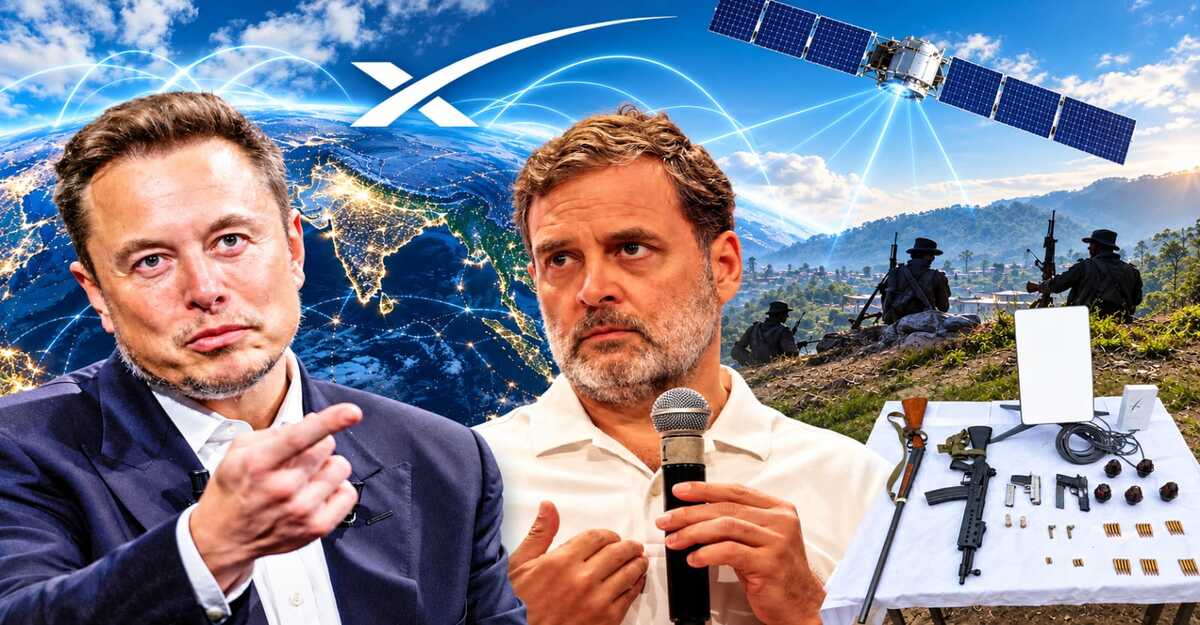
Elon Musk’s criticism of India over the delay in granting final approval for Starlink’s satellite internet services has triggered a political controversy, with Lok Sabha Leader of Opposition Rahul Gandhi welcoming the billionaire entrepreneur to the country.
On October 7, 2026, Musk accused unnamed business interests of obstructing Starlink’s entry into the Indian market, writing on X: “Unfortunately, we are being blocked by certain oligarchs in order to maintain their monopolistic chokehold on the Indian people. You can guess who they are… This is a crime against the people of India!”
On October 8, Musk escalated his criticism, asking: “Starlink is licensed in over 165 countries and has spent five years complying with every single law and requirement of the government of India, so why still no license? Is Ambani the real boss of India?”
Supporting his post, LoP Rahul Gandhi wrote: “Welcome to India, Elon. Wait till you discover the other guy.” Musk replied: “Thank you, Rahul. This is indeed troubling.” The exchange brought renewed attention to the delay in Starlink’s commercial launch and the regulatory scrutiny surrounding the satellite internet service.
However, the controversy extends beyond allegations of market competition. The unauthorised use of Starlink terminals by smugglers, criminal networks and terrorist groups in different parts of the world has raised questions about satellite communications, territorial jurisdiction and national security.
Incidents involving equipment seized in India, alongside reports of black-market networks operating in conflict zones and countries where Starlink is not authorised, have brought these concerns into focus.
Black-market Starlink networks and the national security challenge
A major investigative report published by Israeli newspaper Haaretz on May 12, 2026, reported that encrypted Starlink traffic could be tracked using Mobile Advertising IDs (MAIDs). According to the report, two Israeli-owned intelligence companies, Target Team and Rayzone, developed methods to bypass terminal encryption and combine ground-based data to identify concealed terminals.
The investigation reportedly uncovered hundreds of thousands of terminals worldwide, including devices operating through clandestine black-market networks in India.
The reported findings raised questions about the security and traceability of satellite internet connections. Starlink uses a constellation of low-Earth-orbit satellites to provide connectivity in areas where conventional telecommunications infrastructure is limited or unavailable. However, the movement of terminals across borders and their activation through authorised accounts can create enforcement challenges when equipment is used outside approved jurisdictions.
Thank you, Rahul.
This is indeed troubling. https://t.co/JlEAP6vmqR
— Elon Musk (@elonmusk) October 8, 2026
The black market has exploited ordinary Starlink consumer hardware and subscription arrangements. Smugglers can purchase equipment in countries where the service is authorised and activate terminals through roaming plans registered in licensed territories. The equipment can subsequently be transported into areas where Starlink has not received regulatory approval or where its use is restricted.
Online traders have reportedly advertised Starlink equipment through WhatsApp and Facebook groups, while some have provided instructions on concealing satellite dishes to avoid detection. These practices complicate the task of identifying unauthorised connections and determining who is using them.
Investigations reported by Bloomberg and The Wall Street Journal in 2024 also highlighted the presence of unauthorised terminals in territories where Starlink was unavailable, restricted by local authorities or affected by US sanctions. Although SpaceX has the technical capacity to identify terminal locations and remotely deactivate equipment, unauthorised devices continued to be accessible through informal trading networks.
From Manipur to the Andaman Sea: Starlink equipment seized in India
India encountered concerns over the unauthorised presence of Starlink equipment in two significant incidents in November and December 2024, before the company received approval to begin commercial operations in the country.
On December 13, 2024, security forces recovered a Starlink-branded satellite dish and router during an operation in Imphal East, Manipur. The equipment was seized alongside weapons and ammunition in an area affected by insurgent violence. Reports identified the suspected users as members of the banned People’s Liberation Army (PLA), a Meitei insurgent organisation.
The recovery raised questions about how satellite communication equipment had reached the group and whether such technology could be used to coordinate activities in areas affected by internet restrictions.
📌 In December 2024, Indian security forces recovered equipment bearing Starlink branding during an operation in conflict-hit Manipur.
Musk insisted that Starlink's satellite beams were inactive over India.
🚨 But the investigation shows that the militant groups were using it… pic.twitter.com/dERNiLP5qw
— The Tathya (@_TheTathya) October 8, 2026
An earlier incident occurred on November 23, 2024, when Indian authorities intercepted a Myanmar fishing vessel off the Andaman and Nicobar Islands. The vessel was linked to a major methamphetamine seizure involving approximately 6,000 kilograms of drugs valued at ₹36,000 crore. Investigators found a Starlink Mini terminal among the equipment aboard the vessel, alongside satellite communication equipment and SIM cards from multiple countries.
Andaman and Nicobar Police subsequently confirmed that the smugglers had used Starlink internet connectivity for navigation across the sea. The discovery was reported as the first such instance in India involving the use of Starlink connectivity by smugglers for maritime navigation. Authorities also sought information about the terminal’s purchase, ownership and usage history as part of the investigation.
The two incidents brought different dimensions of the issue into focus that the recovery of satellite communication equipment in an insurgency-affected region and its reported use in a major international drug-smuggling operation.
Myanmar, Sudan, Russia and Ukraine: Unauthorised terminals in conflict zones
The misuse of Starlink has also been reported in Southeast Asia, Africa and the Russia-Ukraine conflict. In October 2024, hundreds of active, unauthorised Starlink kits were reportedly seized during a raid on the KK Park cyber-scam compound in Myawaddy, Myanmar. The compound was associated with large-scale online fraud operations.
In October 2025, SpaceX announced that it had deactivated more than 2,500 terminals suspected of being used by scam centres in Myanmar. The action highlighted SpaceX’s ability to remotely activate, authorise or deactivate Starlink terminals across the world.
In Sudan, where Starlink equipment was reportedly purchased in Gulf countries and smuggled through Chad or South Sudan, the Rapid Support Forces (RSF) relied extensively on satellite connectivity to circumvent domestic network restrictions. The equipment provided communications in areas where conventional networks were disrupted or unavailable.
🤡 Russia’s State Duma has given Elon Musk a choice: either cut off Starlink for Ukraine — or Russia will “leave no trace of anyone”
State Duma chairman Vyacheslav Volodin claimed Elon Musk’s satellites are allegedly being used by Ukraine “to kill children” and said the… pic.twitter.com/R6KXpqX3QP
— NEXTA (@nexta_tv) May 26, 2026
The Russia-Ukraine conflict has presented another challenge. Although Starlink was not authorised in Russia or Ukraine under the circumstances described in the supplied reports, Russian troops operating on the front lines in Ukraine reportedly obtained terminals through black-market channels and online marketplaces, including eBay.
Users in Yemen and Venezuela have also employed satellite connectivity to circumvent censorship and restrictions on conventional communications. These cases demonstrate how the same technology can serve different purposes, ranging from civilian connectivity to military communications and activities conducted outside local regulatory frameworks.
India’s security conditions and the regulatory road ahead
The Indian government has made national security and regulatory compliance central to the approval process for Starlink’s commercial operations. The Ministry of Home Affairs (MHA), Department of Telecommunications (DoT) and national security agencies are involved in examining the conditions under which satellite internet services can operate within the country.
The government has rejected Musk’s allegations that domestic business interests are responsible for the delay. It has maintained that Starlink and competing satellite communication operators must undergo the prescribed regulatory and security assessments before beginning commercial services. In October 2026, the Ministry of Communications stated that the regulatory framework was fair and non-discriminatory and that security assessments were under way for the licensed satellite communication operators.
The government has required Starlink to comply with conditions before receiving final commercial spectrum approval. Under the requirements outlined in the supplied material, all data originating in India must be routed exclusively through authorised ground stations located within the country. This condition is intended to ensure that Indian communications remain subject to domestic regulatory oversight.
Another requirement concerns the precise location reporting of land-based mobile terminals. These terminals must report their locations to Indian servers either once every minute or after travelling 2.6 kilometres. The requirement is intended to help authorities identify equipment operating outside permitted areas and respond to unauthorised use.
Starlink must also incorporate India’s indigenous satellite navigation system, NavIC, into its terminals by 2029. The requirement is intended to reduce dependence on Western GPS infrastructure and address concerns about foreign manipulation of location information.
The Pentagon and Ukrainian intelligence agencies have also worked with SpaceX to establish a verification whitelist intended to disable unauthorised signals in active combat zones. Meanwhile, South Africa and Zimbabwe have seized smuggled equipment and pursued enforcement measures against unauthorised use.
The regulatory question facing India is therefore not limited to the commercial introduction of satellite internet. It also concerns the ability to identify terminals, enforce territorial restrictions, trace unauthorised equipment and prevent satellite connectivity from being used to facilitate smuggling or activities that threaten national security.
Rahul Gandhi’s public support for Elon Musk raises questions about whether his intervention adequately prioritises India’s national security interests or undermines the government’s efforts to prevent the misuse of foreign satellite technology.