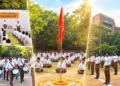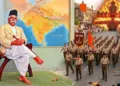




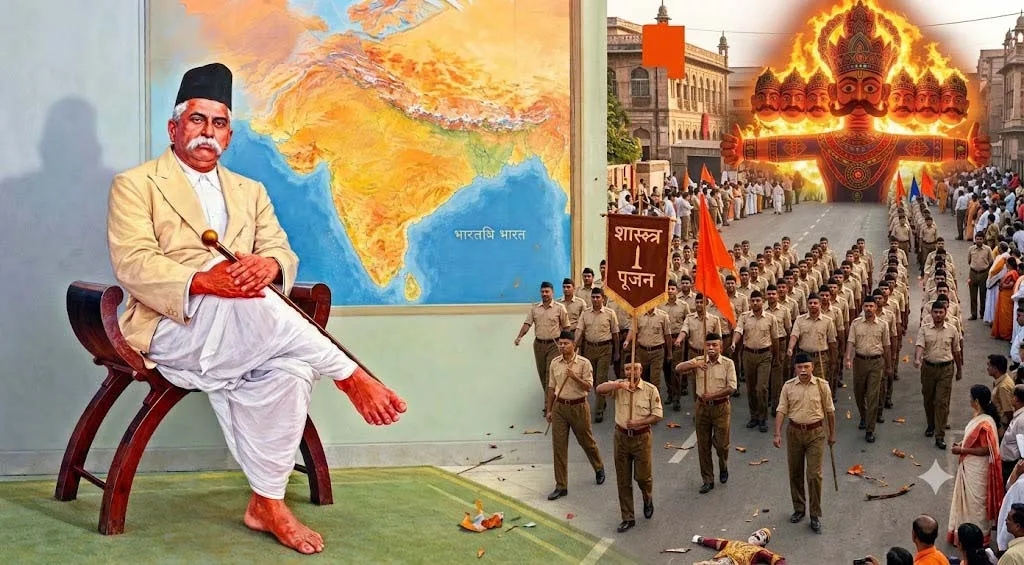
The morning of September 27, 1925, arrived in Nagpur much like any other ordinary autumn day. The morning breeze still carried the lingering, fragrant scent of the previous evening’s Vijayadashami celebrations—the familiar aroma of marigold garlands draped across the city as a timeless symbol of good’s triumph over evil and light over darkness. Yet, sitting in quiet solitude, Dr. Keshav Baliram Hedgewar had not slept a wink all night.
For years, a single agonising question had continuously agitated Dr. Hedgewar’s mind: Why did this ancient land of thirty crore Hindus remain subjugated under foreign colonial rule? He had been an active participant across virtually every stream of the freedom struggle—attending secret meetings of armed revolutionaries, joining the Indian National Congress, suffering imprisonment on charges of sedition, and undergoing rigorous training in underground revolutionary societies. Yet, deep down, he felt a profound sense of incompleteness, as though an attempt was being made to cast the roof of a grand palace without laying a rock-solid foundation.
That very morning, he summoned a small group of young men to the grounds of Dr BS Moonje’s Shivaji School in the Mahal area of Nagpur. The gathering was modest in number, filled with curiosity, and entirely uncertain of what was about to unfold. Standing before them was Dr Hedgewar—a man of slight build and unassuming demeanour, but with eyes radiating an extraordinary inner spark. He delivered no thunderous orations, nor did he issue any political manifestos. In a warm, simple voice, he merely said, “Come, let us play Kabaddi.”
Early Realisation of Bharat’s Vulnerability
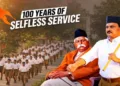
There was no grandiose ceremony, no printed Constitution, nor any formal public announcement. Yet, in that unassuming moment, an epoch-making historical turning point took place. What the prevailing scholars and politicians of the era had failed to comprehend, Dr. Hedgewar grasped with profound clarity: Bharat’s fundamental vulnerability lay not in a scarcity of ideologies, but in a dearth of organised, disciplined, and self-confident individuals. He recognised that national unity could never be manufactured merely through legislative enactments; it had to be lived and experienced daily—on the playground, through unbreakable bonds of brotherhood, and through shared collective discipline. From that sunlit Vijayadashami morning on a humble field in Nagpur, the organisation that came into existence was named the Rashtriya Swayamsevak Sangh (RSS). What is recognised today as the world’s largest voluntary movement began its monumental journey with a simple game of Kabaddi.
Hindutva Vs Marx-Inspired Commies
By a striking historical coincidence, the formal establishment of the Communist Party of India (CPI) also took place in the very same year, 1925, at its Kanpur conference. Thus, two diametrically opposed ideological currents made their entrance onto the Bharatiya political stage simultaneously. On one side stood the RSS, born under the guidance of Dr. Hedgewar, seeking to unite society through “Cultural Nationalism” or “Hindutva”—a philosophy grounded in Bharat’s millennia-old civilisational ethos, Sanatan heritage, spiritual unity, and eternal values. On the other side was the journey of the Communists launched in Kanpur, anchored in Karl Marx and Vladimir Lenin’s theories of historical materialism, violent class warfare, and the internationalist agenda of the Moscow-centric Third Communist International (Comintern).
In the fundamental political doctrine of the Communists, Bharat had never existed as an integral or historic nation. In his 1922 treatise India in Transition, published from Geneva, Marxist theorist Manabendra Nath Roy (MN Roy) analysed Bharatiya society primarily as an artificial battleground of economic class struggle between an emerging bourgeoisie and the proletariat. From the Communist viewpoint, Bharat’s cultural heritage and spirituality were merely “the opium of the masses,” while the very concept of nationalism was viewed as a deceptive veneer protecting capitalist ruling-class interests. At the Sixth Congress of the Comintern held in Moscow in 1928, explicit directives were issued to Bharatiya Communists to launch relentless attacks against all cultural nationalist movements, branding them as “bourgeois reactionary.”
In sharp contrast, Dr. Hedgewar—drawing upon his rich revolutionary experience and deep contemplation of Bharatiya philosophy—understood that a civilisation as diverse as Bharat could never be comprehended or united through European theories of class warfare or dogma centred purely on economics. To awaken Bharat to her true majesty, her thousand-year-old cultural soul had to be re-energised. This divergence was not merely conceptual; it represented a profound ideological conflict. And from that very conflict emerged a century-old Communist campaign of hatred, slander, character assassination, and calculated conspiracy against Dr. Hedgewar, his worldview, and the RSS that he created.
Revolution of Anushilan Samiti & Communist Lies
Among the most despicable political conspiracies orchestrated by Communist and later Marxist historians was the systematic attempt to erase Dr. Hedgewar’s glorious role in the freedom struggle from mainstream history and paint him as “absent from the independence movement.” For decades, Leftist theorists who dominated Bharat’s premier historical research institutions crafted a flawless ecosystem of Goebbelsian falsehoods. However, when primary historical documents, police archives, and official intelligence reports are examined, this edifice of disinformation collapses like a house of cards.
The Shakha system designed by Dr. Hedgewar was a modern institutional evolution of Maharashtra’s traditional Akhada (gymnasium) culture and Tilak’s framework of public festivals
Born on April 1, 1889, in Nagpur to an impoverished yet deeply self-respecting family, Keshav Baliram Hedgewar inherited an uncompromising flame of patriotism from early childhood. In 1897, when sweetmeats were distributed across schools in Bharat to celebrate the Diamond Jubilee of Queen Victoria’s reign, the eight-year-old Keshav threw his sweets into a dustbin, demanding: “Why should we eat sweets to celebrate the reign of a foreign power that has enslaved our country?” Later, in 1908, he was expelled from Nagpur’s Neil City School for leading students in chanting the slogan Vande Mataram in defiance of the colonial Government’s infamous ‘Risley Circular’.
In 1910, Keshav arrived in Kolkata under the guise of enrolling in Kolkata Medical College, which served as a covert gateway to the heartland of armed revolutionary struggle. The renowned revolutionary Trailokyanath Chakraborty (affectionately known as ‘Maharaj‘), in his celebrated memoir Thirty Years in Jail and India’s Freedom Struggle, poignantly documented how Dr. Hedgewar worked shoulder-to-shoulder day and night with the top leadership of the Dhaka Anushilan Samiti during his years in Kolkata. Young Keshav became a deeply trusted associate of prominent revolutionaries including Shyam Sunder Chakraborty, Pulin Behari Das, and Rash Behari Bose of the Alipore Bomb Case. In secret British CID reports, his code name was recorded as ‘Cocaine’. He operated an impenetrable revolutionary network supplying intelligence, funds, messages, and firearms between Kolkata and Central Bharat. Renowned researcher Dr. Rakesh Sinha, in his authoritative biography of Dr. Hedgewar, details how Dr. Hedgewar later provided secret shelter in Nagpur to the revolutionary Rajguru following the assassination of British officer Saunders.
Sacrificing Medical Practice for Freedom Movement
Upon returning to Nagpur in 1916, Dr. Hedgewar set aside his medical practice entirely to dedicate his life to the freedom movement. At the 1920 Nagpur session of the Indian National Congress, he introduced two groundbreaking resolutions before the Subjects Committee: the first calling for Bharat’s complete independence from British rule, and the second envisioning a global socio-economic structure free from exploitation.
Subsequently, in 1921, responding to Mahatma Gandhi’s call for the Non-Cooperation Movement, he plunged into the struggle and was arrested in Nagpur on charges of sedition. The written statement presented by Dr. Hedgewar before the British magistrate in Nagpur on August 19, 1921, stunned even the presiding judge, Mr. Smelly. In his historic judgement, Judge Smelly noted: “Hedgewar’s written defence is even more fierce, dangerous, and seditious than the original speech for which he was prosecuted!” The court sentenced him to one year of rigorous imprisonment. Later, during the 1930 Jungle Satyagraha, Dr. Hedgewar entrusted the organisational responsibilities of the RSS to a senior colleague and actively led hundreds of volunteers into the satyagraha, earning a nine-month prison sentence in Yavatmal.
Yet, Marxist historians completely excised the historic contributions of this valiant revolutionary, setting a grim precedent in historical negationism. E. M. S. Namboodiripad, in his A History of the Indian Freedom Struggle, and Sumit Sarkar, in Modern India 1885-1947, craftily deleted Dr. Hedgewar’s imprisonments and revolutionary struggle from their narratives. Bipan Chandra, in Nationalism and Colonialism in Modern India, went so far as to claim that the rise of the RSS was a British conspiracy designed to alienate youth from the mainstream freedom movement.
The historical reality, however, tells a remarkably different story. On June 20, 1940, merely days before Dr. Hedgewar’s passing, Netaji Subhas Chandra Bose personally travelled to Nagpur to meet the terminally ill leader. Contemporary reports from the Hitavada and Maharashtra newspapers, along with Forward Bloc archival documents, conclusively prove that Netaji sought Dr. Hedgewar’s counsel to formulate a joint strategy combining armed revolutionary action and political movement. Had Dr. Hedgewar been anti-freedom or loyal to the British, an uncompromising revolutionary leader of Netaji’s stature would never have visited his doorstep. But Communist ideologues maliciously suppressed this historical truth, committing an unpardonable distortion of history.
Conspiracy of Commies: Maligning Doctorji & RSS
During and after the Second World War, the most malicious weapon deployed by Communists to vilify Dr. Hedgewar and the RSS on the international stage was branding them with European “Fascist” or “Nazi” labels. Directed by the international communist ecosystem, Bharatiya Leftists engaged in ceaseless propaganda claiming that the ‘Shakha’ system developed by Dr. Hedgewar was copied from the structures of Italian Fascism or German Nazism.
A pseudo-academic foundation for this smear campaign was attempted by extreme Left researchers—most notably Marzia Casolari in her 2000 article published in Economic and Political Weekly (EPW), titled Hindutva’s Foreign Tie-up in the 1930s: Reflections on Politicisation of Religion. Casolari and her Indian Marxist collaborators alleged that in the 1930s, Dr. Hedgewar and Dr. B. S. Moonje were influenced by Mussolini’s fascist youth organisations.
However, a rigorous examination based on primary documents exposes these claims as hollow and politically motivated. International scholar Dr. Koenraad Elst, in his seminal works The Saffron Swastika: The Notion of Hindu Fascism and Negationism in India, demonstrated with robust evidence that Dr. Hedgewar drew nothing from European fascist ideologies. His philosophical inspiration was entirely indigenous—rooted in the spiritual nationalism of Maharishi Aurobindo Ghosh, Swami Vivekananda’s call for a vibrant and powerful Hinduism, the Vande Mataram ethos of Bankimchandra’s Anandamath, Lokmanya Bal Gangadhar Tilak’s Swadeshi movement, and the selfless action (Nishkama Karma Yoga) taught in the Bhagavad Gita.
When Dr. Hedgewar founded the RSS in Nagpur in 1925, Mussolini’s regime in Italy was not fully consolidated, and Hitler possessed virtually no political standing in Germany. The Shakha system designed by Dr. Hedgewar was a modern institutional evolution of Maharashtra’s traditional Akhada (gymnasium) culture and Tilak’s framework of public festivals. Nonetheless, Marxist scholars such as Aijaz Ahmad in Lineages of the Present: Political Essays, alongside historians Irfan Habib and Romila Thapar, routinely labelled the RSS as “fascist” without providing substantiating evidence.
In her doctoral dissertation approved by Jabalpur University, titled Understanding Human Response in Organisations: A Study of Rashtriya Swayamsevak Sangh with a Management Perspective, Dr. Sadhana Satish Modh provided empirical data demonstrating that the RSS Shakha is essentially a psychological process designed for character building, discipline, and self-sacrifice. Communist theorists could never answer why, among the hundreds of speeches delivered by Dr. Hedgewar across India between 1925 and 1940, not a single address contained hatred directed toward any community. Every speech focused squarely on self-purification, character building, the eradication of caste barriers, and the construction of a glorious, undivided India (Akhand Bharat). Yet, the international communist network deliberately affixed a European “fascist” label onto this sovereign, indigenous reform movement.
Dissecting Falsehoods of Huddar Episode
For decades, Communists weaponised the episode involving Gopal Mukund Huddar (G. M. Huddar) to assassinate Dr. Hedgewar’s character and project internal fractures within the organisation. GM Huddar was a prominent young volunteer and office-bearer of the RSS in the 1920s. In the mid-1930s, he travelled to Europe to join the International Brigades in the Spanish Civil War, where he became inspired by Leftist internationalism and subsequently joined the Communist Party of India upon his return.
Communist publications and party organs such as People’s War and later New Age painted Huddar’s exit as an escape from an “autocratic military dictatorship” run by Dr. Hedgewar. Leftist historians distorted statements to claim that the RSS lacked internal democracy.
The historical reality was precisely the opposite. The personal affection and bond between Dr. Hedgewar and GM Huddar remained unbroken throughout their lives. Shifts in political ideology are entirely natural in a democratic society, and Dr. Hedgewar’s RSS was never a rigid institution that shackled individuals against their will. In his own later writings, Huddar acknowledged with deep reverence that his admiration for Dr. Hedgewar’s unmatched selflessness, genial warmth, and unadulterated patriotism remained steadfast throughout his life.
Yet, the Communist propaganda machinery selectively excised these truthful admissions, constructing half-truths and imaginary grievances to malign Dr. Hedgewar as an “authoritarian organiser.”
Truth About Gandhi’s Murder, Sardar Patel & Partition
The most sinister plot to destroy the RSS and suppress Dr. Hedgewar’s legacy was executed following the assassination of Mohandas Karamchand Gandhi in 1948. Communist and Leftist political factions immediately attempted to link Nathuram Godse with the RSS and Dr. Hedgewar’s ideology, mounting intense political pressure to ban the organisation.
However, truth cannot remain buried indefinitely. In his authoritative book Golwalkar and R.S.S., Jagat S. Bright revealed how the then Home Minister, Sardar Vallabhbhai Patel, in a letter dated February 27, 1948, addressed to Prime Minister Jawaharlal Nehru, explicitly stated that following an exhaustive investigation by CID Chief Sanjeevi, it was definitively established that the RSS had no role whatsoever in the conspiracy to assassinate Mahatma Gandhi. Later, in 1967, the judicial commission headed by retired Supreme Court Justice J. L. Kapoor thoroughly re-examined the matter and fully exonerated the RSS of any involvement.
During the horrific tragedy of Partition, when millions of Hindus and Sikhs were fleeing Pakistan to save their lives, RSS volunteers risked their own lives to run massive relief and rescue operations. In his 1948 publication Now It Can Be Told, Prof. A. N. Bali wrote: “No Hindu or Sikh who survived the hellish violence of Partition can ever deny the boundless sacrifice and heroism demonstrated by the volunteers of the Sangh.” Yet Leftist historians deliberately excised these acts of heroism from mainstream textbooks, branding the organisation with a sweeping “communal” label.
Brutal Communist Attacks in Parliamentary & State Politics
Following India’s independence, as the Communist Party of India (CPI) and later the Communist Party of India (Marxist) [CPI(M)] gained state power in parliamentary politics, they deployed state machinery to erase Dr. Hedgewar’s name, work, and legacy. This state-sponsored persecution reached its zenith in Kerala and West Bengal under Left rule.
In Kerala, following the formation of the first Communist Ministry under EMS Namboodiripad in 1957, severe political and physical repression was unleashed against RSS Shakhas and the expansion of Dr. Hedgewar’s vision. Whenever Communists found themselves outmatched in intellectual and political discourse, they resorted to red terror and political assassinations. Hundreds of young RSS volunteers in Kerala were brutally murdered by Communist cadres simply for adhering to the ideals of Dr. Hedgewar.
In West Bengal, during the 34 years of Left Front rule (1977–2011), intellectual terror was unleashed on an unprecedented scale. Through the West Bengal State Book Board, history textbooks from primary to university levels were systematically rewritten through a Communist lens. While pages were devoted to the Bolshevik Revolution in Russia, the Chinese Revolution, and biographies of Lenin and Stalin, the foundational contributions of Dr. Hedgewar and the Anushilan Samiti revolutionaries were omitted entirely.
Official records of the West Bengal Legislative Assembly (Legislative Assembly Proceedings) reveal that Left MLAs and Ministers repeatedly used vilifying language on the floor of the House, describing Dr. Hedgewar as a “communal poison tree” or a “fascist.” Whenever independent social or cultural organisations attempted to organise birth anniversary commemorations or seminars on Dr. Hedgewar in Kolkata, SFI and DYFI cadres utilised police influence to disrupt and dismantle those events.
Naxal-Maoist Terror and Attacks on Service Projects
The armed Naxalite movement, initiated in 1967 from Naxalbari in West Bengal by Charu Majumdar and Kanu Sanyal, eventually evolved into radical Maoist terrorism. Even more fiercely than mainstream parliamentary Communists, Naxal and Maoist insurgents targeted Dr. Hedgewar’s vision and the social service projects inspired by him.
A reading of the CPI (Maoist) Central Committee’s secret policy document from 2004, titled Urban Perspective Plan: Our Work in Urban Areas, reveals a chilling perspective. In that recovered secret document, it was explicitly stated that the single greatest internal obstacle to armed Maoist revolution was “the network of cultural and social service work run under the ideology of the RSS and Dr. Hedgewar.” Maoists acknowledged in their theoretical guidelines that if RSS service projects such as ‘Ekal Vidyalayas’, ‘Vanvasi Kalyan Ashram’, and free healthcare initiatives expanded in tribal and backward regions, common people could no longer be provoked into armed violence.
Consequently, across India’s ‘Red Corridor’—tribal belts spanning Chhattisgarh, Jharkhand, Odisha, and Andhra Pradesh—Maoists unleashed brutal violence against hundreds of full-time workers (Pracharaks) and volunteers who worked in accordance with Dr. Hedgewar’s principles. Numerous innocent teachers, physicians, and social workers were murdered after being branded “class enemies” or “police informers.” Maoist publications like Red Star persistently vilified Dr. Hedgewar as a “feudal and imperialist agent”—a stark contrast to the historical reality of Dr. Hedgewar’s nineteen months of imprisonment under British rule and his lifelong revolutionary sacrifices.
Ramakrishna Mission’s Vow of Service and ‘Oneness’ vs. ‘Class Struggle’
The primary instrument of Communist ideology is class conflict and social division. In stark contrast, the foundation of Dr. Hedgewar’s life and philosophy rested upon the eternal spiritual consciousness of Sri Ramakrishna and Swami Vivekananda—specifically the principle of Shiva Jnane Jiva Seva (serving living beings as embodiments of the Divine).
As a medical student in 1913, during the devastating Damodar river floods in the Burdwan and Hooghly regions, Dr. Hedgewar worked tirelessly alongside monks of the Ramakrishna Mission to deliver flood relief. During the Ganga Sagar Mela, when thousands of pilgrims fell victim to a cholera epidemic, Dr. Hedgewar personally tended to patients and cleaned excrement, setting a selfless example of human service.
Where Communists sought to divide society, Dr. Hedgewar sought to unite it. In his celebrated autobiographical work Manu, Sangh and I (Manu, Sangh Aur Main), Ramesh Patange recounted how attending RSS Shakhas enabled him to shed the shackles of caste and experience true social oneness. In 1934, Mahatma Gandhi, and in 1939, Dr. B. R. Ambedkar visited RSS camps in Wardha and Nagpur respectively, expressing deep admiration for the genuine social equality and absence of untouchability among the volunteers. In his landmark book Dr. Ambedkar and Samajik Samrasta, Dattopant Thengadi meticulously recorded this historical camaraderie between Dr. Ambedkar and the RSS leadership.
Historical Connections with Mahatma Gandhi
Despite decades of Communist efforts to suppress the truth, the deep ideological and personal relationships that Dr. Hedgewar shared with revered national leaders like Mahatma Gandhi and Netaji Subhas Chandra Bose are now fully in the public domain.
On December 25, 1934, an RSS winter training camp was held near Wardha. Mahatma Gandhi, who was staying nearby at the Sevagram Ashram, expressed a personal desire to visit the camp. Gandhi was deeply impressed by the genuine social harmony, total absence of caste distinctions, and high level of discipline among the 1,500 volunteers present. The following day, December 26, 1934, Mahatma Gandhi held a detailed discussion with Dr. Hedgewar at Sevagram. This historic dialogue is documented at length in The Diary of Mahadev Desai (Volume 1). Dr. Hedgewar clearly explained to Gandhi that the Sangh did not rely on external financial funding or political patronage, but functioned entirely on the selfless Gurudakshina and character-building efforts of its volunteers.
Similarly, on June 20, 1940, just days before his death, Netaji Subhas Chandra Bose visited Nagpur to meet the ailing Dr. Hedgewar. Documents from Netaji’s Forward Bloc and contemporary reports in Nagpur’s Hitavada newspaper confirm that Netaji sought Dr. Hedgewar’s guidance to chart a coordinated strategy for the final snti-British struggle. Had Marxist historians prioritised historical truth, these profound interactions between Dr. Hedgewar, Mahatma Gandhi, and Netaji Bose would have found an honored place in the nation’s history textbooks.
An Imperishable Legacy
For over four decades following independence, top educational and research bodies such as the Indian Council of Historical Research (ICHR), the Indian Council of Social Science Research (ICSSR), and NCERT remained under Left-wing control, attempting to erase Dr. Hedgewar from national memory. Yet history does not bow to diktats of any political ideology; it moves according to the unyielding laws of truth.
Where Communists sought to consume society in the flames of class warfare, caste resentment, and violence, the Sangh—following the path laid down by Dr. Hedgewar—silently carried out the monumental task of social harmony and national reconstruction. From protecting millions of displaced Hindu and Sikh refugees during the 1947 Partition to delivering relief during the 1943 Bengal Famine and every subsequent natural disaster in post-independence Bharat, volunteers have repeatedly put their lives on the line for their fellow citizens.
In the modern digital era, an editorial cabal spanning platforms like Wikipedia, Alt News, The Wire, The Scroll, and international Left-leaning media outlets continuously attempts to rewrite Dr. Hedgewar’s history by inserting negative and unsourced narratives. Whenever nationalist consciousness rises on social media platforms, coordinated networks of bots and Leftist cadres launch organised campaigns targeting Dr. Hedgewar.
Yet an objective review of history reveals that the era of supreme Communist dominance has drawn to a close. The Soviet system that nurtured global Communism has collapsed; China has transformed its Marxism into capitalist authoritarianism; and in India, Communism faces an existential political and social decline. Conversely, the modest seed planted by Dr. Hedgewar on Vijayadashami in 1925 has grown into a vast, global banyan tree.
Rising above a century of Communist propaganda, slander, and conspiracy, the truth of Dr. Keshav Baliram Hedgewar shines brightly today. His immortal ideals of character building (Vyakti Nirman), social harmony (Samajik Samrasta), and Cultural Nationalism stand recognised across the globe as the foundational driving force behind the resurgence of twenty-first-century India.